
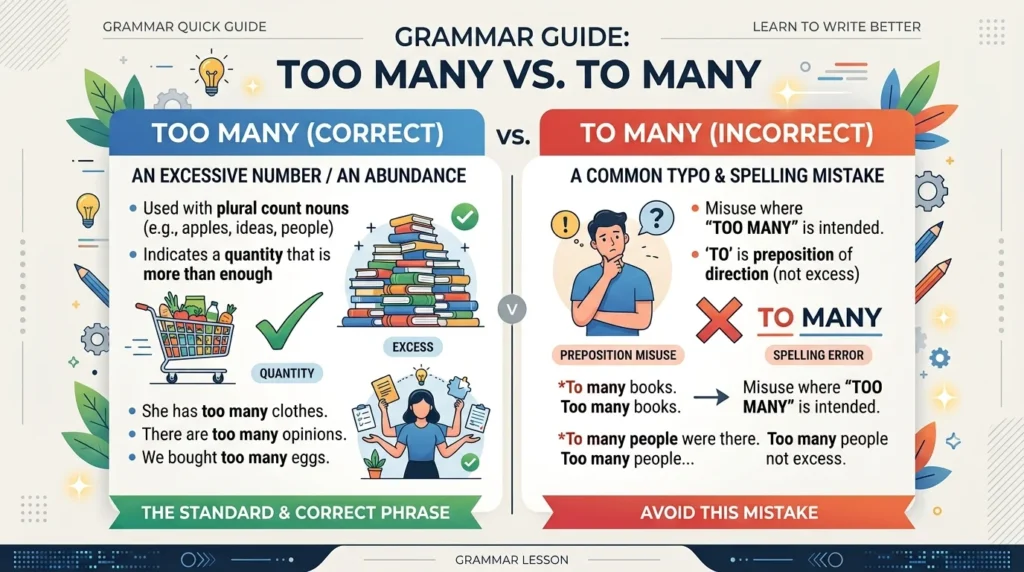

Too many is the correct phrase when you mean “more than necessary,” “more than wanted,” or “a large number.” To many is generally incorrect in standard English. The confusion happens because to and too sound alike, but they have different meanings and grammatical functions. For example, “There are too many people here” is correct, while “There are to many people here” is incorrect.
Quick Answer
Use too many when you are talking about an excessive number of countable things or people. Use to many only when to and many happen to appear next to each other for separate grammatical reasons, which is uncommon. In the sentence “I have too many books,” too many is correct because it means “more books than necessary.” The easiest way to remember it is: too many = more than enough.
What Is the Difference Between Too Many and To Many?
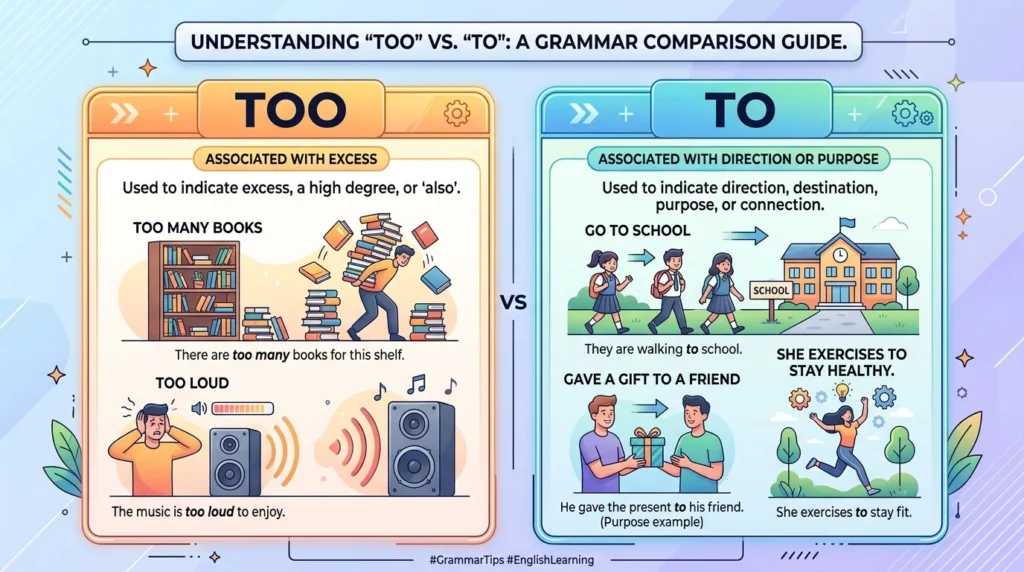
Too many and to many sound very similar, but they are not normally interchangeable. The word too can mean “more than is wanted, needed, or suitable.” It is commonly used before a plural countable noun with many.
For example:
There are too many cars on this road.
Here, too many means there are more cars than the speaker considers reasonable or desirable.
The word to usually works differently. It can show direction, purpose, or a relationship between words.
For example:
I went to the store.
In standard English, to many is not the phrase you use to express an excessive number.
Why It Matters
Choosing between too and to is a small spelling decision, but it can affect the clarity and credibility of your writing. The mistake is especially noticeable because too and to are extremely common words.
You may see this distinction in emails, school assignments, business communication, social media posts, applications, and everyday messages. Writing “too many mistakes” correctly is important when you want your English to look polished and professional.
The Core Rule
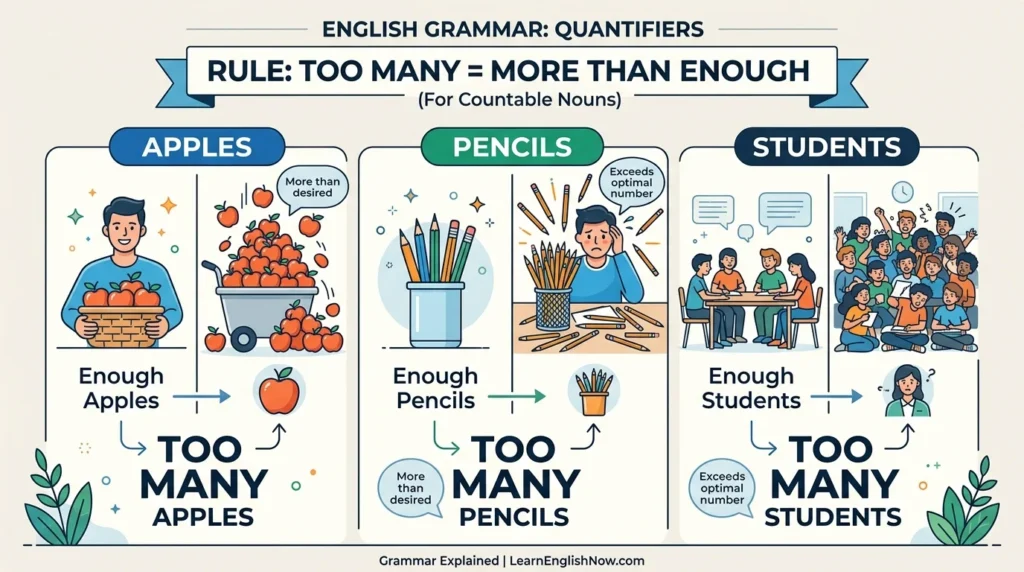
Use “too many” when you mean “more than necessary, wanted, or appropriate.”
Too many + plural countable noun
- too many people
- too many questions
- too many emails
- too many mistakes
- too many books
- too many choices
Remember:
Too many = more than enough.
For example:
There are too many options.
This means there are more options than the speaker wants or needs.
How to Use Too Many
Too many is used before plural countable nouns. A countable noun is something that can normally be counted individually, such as books, people, cars, questions, or apples.
Too Many People
Use too many when there are more people than desired or suitable.
Example:
There are too many people in the room.
The speaker believes the number of people is excessive.
Too Many Things
You can use too many with physical objects.
I bought too many clothes.
She has too many bags.
We have too many boxes in the garage.
Too Many Questions
Too many can also describe an excessive number of questions.
The interviewer asked too many questions.
I received too many questions about the project.
Also read: Choosing or Chosing
Too Many Mistakes
This phrase is common when discussing writing, schoolwork, work performance, or other tasks.
There are too many mistakes in this report.
I made too many mistakes on the test.
Too Many vs. Too Much
One common source of confusion is knowing when to use too many and when to use too much.
Use too many with plural countable nouns. Use too much with uncountable nouns.
| Phrase | Use | Example |
|---|---|---|
| too many | Plural countable nouns | There are too many books. |
| too much | Uncountable nouns | There is too much water. |
Compare:
There are too many apples.
There is too much juice.
You can count individual apples, but you do not normally count juice as separate individual units in this context.
Correct Examples
- There are too many people waiting outside.
- I have too many emails to answer today.
- She bought too many books for the trip.
- We made too many changes to the original plan.
- There are too many advertisements on this website.
- He asked too many questions during the meeting.
- I ate too many cookies after dinner.
- The teacher noticed too many mistakes in my assignment.
- They gave us too many choices.
- There are too many cars on the road this morning.
- She has too many responsibilities at work.
- I received too many notifications on my phone.
Also Read: Tying or Tieing
Incorrect vs. Correct
| Incorrect | Correct | Why |
|---|---|---|
| There are to many people here. | There are too many people here. | Too means an excessive number in this sentence. |
| I have to many books. | I have too many books. | The sentence means the number of books is excessive. |
| She asked to many questions. | She asked too many questions. | Too many describes an excessive number of questions. |
| There were to many cars. | There were too many cars. | The intended meaning is “more cars than necessary.” |
| He made to many mistakes. | He made too many mistakes. | Too many is the correct quantity expression. |
| We received to many emails. | We received too many emails. | The number of emails is excessive. |
| They gave us to many options. | They gave us too many options. | Too many expresses more options than wanted or needed. |
| She bought to many dresses. | She bought too many dresses. | Too is needed to express excess. |
| I have to many tasks today. | I have too many tasks today. | The sentence refers to an excessive number of tasks. |
| There are to many choices on the menu. | There are too many choices on the menu. | Too many is the standard phrase for an excessive number. |
Why Do People Make This Mistake?
They Sound the Same
The main reason people confuse to and too is pronunciation. In many varieties of English, the words sound alike in ordinary speech. When people hear “too many,” they may not immediately know which spelling they should use.
Because spelling cannot always be determined from pronunciation, writers need to remember the meaning and grammatical function of each word.
“To” Is Extremely Common
To appears in many common English structures, including phrases such as “go to school,” “talk to me,” and “give it to him.” Because it is so frequent, writers sometimes type to automatically when they hear the sound.
Autocorrect Does Not Always Catch It
Both to and too are correctly spelled English words. A spellchecker may therefore recognize either one as a valid word. The problem is the meaning of the sentence, not simply the spelling of an individual word.
Translation Interference
Learners may also confuse these words because their first language may use one word or one sound where English uses several different words. Learning the function of too can make the distinction much easier.
Common Mistakes Checklist
- Writing “to many” when you mean “more than necessary.” Use too many.
- Confusing sound with spelling. Remember that to and too can sound alike.
- Using too many with an uncountable noun. Use too much when appropriate.
- Relying only on spellcheck. Both to and too are real words, so context matters.
- Forgetting the meaning of too. In too many, it expresses excess.
Also Read: Quieter vs More Quiet
Too Many in Real English
Grammatically Correct
“There are too many people here” is standard English. The phrase too many correctly describes an excessive number of countable people. It is common in both speech and writing and can be used whenever the speaker considers the quantity greater than necessary, wanted, or appropriate.
Grammatically Possible but Unnatural
The sequence to many can technically appear when to and many belong to separate parts of a sentence, but this is not the normal construction for expressing an excessive quantity. For learners, treating to many as an alternative spelling of too many will lead to errors.
Natural Everyday English
Too many is extremely natural in everyday English. People commonly say “too many people,” “too many questions,” “too many emails,” and “too many things to do.” It can express annoyance, concern, surprise, or simply an observation that the quantity is greater than desired.
American vs. British English
There is no meaningful American-versus-British difference in the spelling of too many. Both American and British English use too many to describe an excessive number of countable things or people.
For example, both varieties use:
There are too many people in the room.
I have too many emails to answer.
The distinction between too and to is therefore a standard English distinction rather than a regional spelling difference.
Formal vs. Informal Usage
Too many is appropriate in both formal and informal English. The phrase itself does not create an informal tone.
Informal:
There are too many people here.
Professional:
The report contains too many unnecessary details.
Academic:
The study considers too many variables to establish a clear relationship.
The surrounding sentence determines the level of formality, not the phrase too many itself.
Also Read: Onsite or On Site or On-Site
Comparison Table
| Feature | Too | To |
|---|---|---|
| Meaning in “too many” | More than necessary or wanted | Does not express excess |
| Common grammatical role | Adverb | Preposition or infinitive marker |
| Example | Too many people | Go to school |
| Can express excess? | Yes | No |
| Correct phrase for excessive quantity | Too many | To many is not normally correct |
Real-Life Situations
In an Interview
If you are explaining why a process needs improvement, you might say:
“There are too many steps in the current process.”
In a Meeting
You could say:
“We have too many issues to discuss in one meeting.”
In an Email
A professional email might contain:
“There are too many revisions to complete before Friday.”
In a Text Message
In casual conversation:
“I have too many things to do today.”
In an Exam
If you see a sentence such as “There are ___ people in the room,” ask yourself whether the intended meaning is “more people than necessary.” If it is, the answer is too many.
How to Remember Too Many vs. To Many
The easiest memory trick is to connect too with the idea of excess.
Too many = more than enough.
For example:
I have too many shoes.
This means I have more shoes than I need or want.
You can also remember the difference this way:
- Too can mean “more than necessary.”
- Many refers to a large number of countable things.
- Therefore, too many means “more than the desired or suitable number.”
When you mean excess, choose too, not to.
Quick Practice Quiz
Choose too many or to many in each sentence.
- There are ___ people at the entrance.
- I received ___ messages this morning.
- She bought ___ clothes.
- We have ___ problems to solve today.
- He made ___ mistakes in the report.
- There are ___ cars parked outside.
- The teacher asked ___ questions.
- I have ___ assignments this week.
- They gave us ___ choices.
- There are ___ advertisements on the page.
Answers
- too many
- too many
- too many
- too many
- too many
- too many
- too many
- too many
- too many
- too many
Frequently Asked Questions
Is “too many” correct?
Yes. Too many is the standard phrase used to describe an excessive number of people or countable things.
Is “to many” ever correct?
The words to and many can appear next to each other in unusual sentence structures, but to many is not the standard phrase for expressing an excessive number.
What does “too many” mean?
Too many means more than is necessary, wanted, suitable, or acceptable. For example, “There are too many cars” means there are more cars than the speaker considers appropriate.
Why do people write “to many” instead of “too many”?
The words to and too commonly sound alike. Because of this, people may choose the wrong spelling when writing quickly or relying on pronunciation.
Is “too many” one word?
No. Too many consists of two separate words: too and many.
Can “too many” be used with people?
Yes. Too many people is a completely standard expression.
What is the difference between “too many” and “too much”?
Too many is normally used with plural countable nouns, while too much is used with uncountable nouns. For example, “too many books” but “too much water.”
Is “too many” formal or informal?
Too many can be used in both formal and informal English. The phrase itself is neutral in register.
What is an easy way to remember “too many”?
Remember that too can mean “more than necessary.” Therefore, too many means “more than the desired or suitable number.”
Which is correct: “there are too many” or “there are to many”?
There are too many is correct when you are describing an excessive number. For example: “There are too many people in the room.”
Can “too many” be used in academic writing?
Yes. It is grammatically standard and can be used in academic writing when the meaning requires it, such as “The model includes too many variables.”
Quick Summary
Too many is the correct phrase when you mean “more than necessary,” “more than wanted,” or “an excessive number.” It is normally followed by plural countable nouns, such as too many people, too many books, or too many questions. To many is not normally correct when expressing this meaning. The confusion mainly comes from the fact that to and too sound alike. Remember the simple rule: too = more than enough. So when you mean an excessive number, write too many, not to many.
See Also:
LYS Meaning in Text Explained – Love, Emotion & Social Media Use
DD Meaning in Text Explained: Full Guide, Uses, Examples & Hidden Meanings