


Shiny is the correct and standard spelling. Shiney is generally a misspelling and should not be used in standard English. Shiny is an adjective meaning bright, glossy, or reflecting light. For example, “She bought a shiny new car.” The confusion happens because the verb is shine, and English spelling rules do not always make the change to -y obvious.
Quick Answer
Shiny is the correct spelling in standard English. Shiney is a common spelling mistake. Use shiny when you mean something that is bright, glossy, polished, or reflects light. The correct pattern is shine → shiny, not shine → shiney. For example: “He wore a shiny black jacket.” If you are unsure, remember that the final e in shine is dropped before adding -y.
What Is the Difference Between Shiny and Shiney?
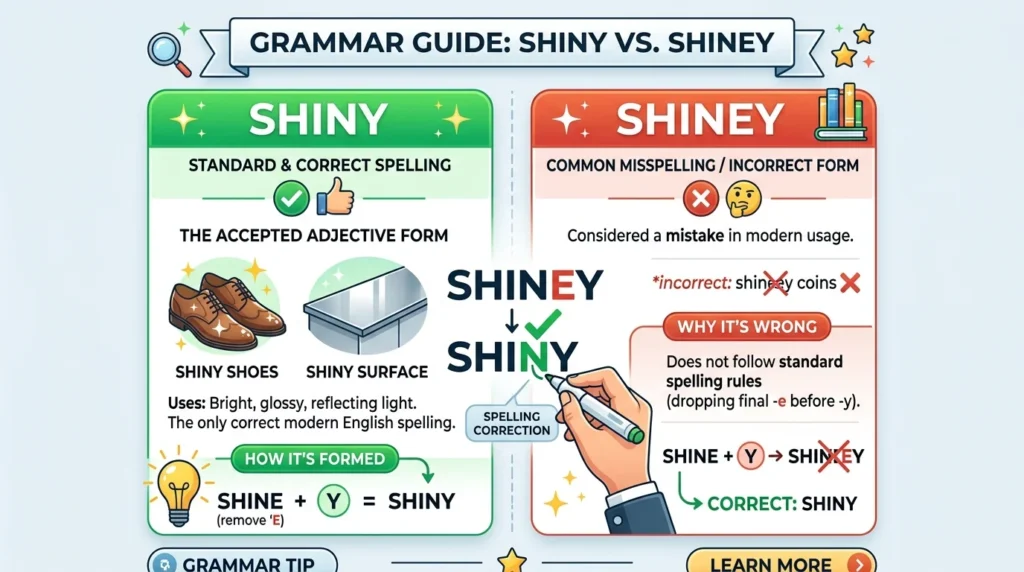
Shiny and shiney are not two standard spelling variants of the same adjective. Shiny is the correct word, while shiney is normally considered an incorrect spelling.
The adjective shiny describes something that reflects a lot of light or has a smooth, bright, glossy appearance.
- a shiny surface
- shiny shoes
- shiny hair
- a shiny new phone
- shiny metal
The word comes from shine, but when -y is added, the spelling becomes shiny.
shine → shiny
Not:
shine → shiney
Why Is Shiny Spelled Without the E?
The spelling becomes easier to understand when you look at how shine changes when -y is added.
The base word is:
shine
The adjective is:
shiny
The final e is dropped before the -y is added.
This gives us:
- shine → shiny
- noise → noisy
- ice → icy
- spice → spicy
So the spelling shiney incorrectly keeps the final e from shine.
The Core Rule
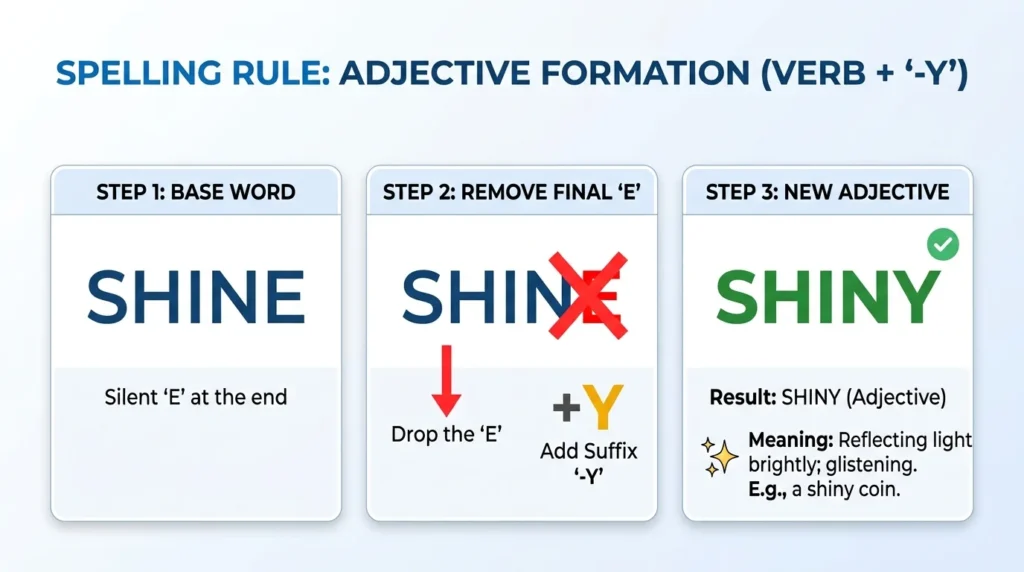
The correct spelling is “shiny,” not “shiney.”
If you are describing something that looks bright, glossy, polished, or reflective, use shiny.
Correct: The floor looks shiny.
Incorrect: The floor looks shiney.
Easy Memory Trick
Think:
SHINE + Y = SHINY
The E disappears before Y:
shine → shiny
Also Read: Too Many or To Many
How to Use Shiny
Shiny is an adjective, so it describes a noun. It can describe physical objects, surfaces, materials, hair, clothing, and even figurative things.
Describing Objects
- He bought a shiny new watch.
- The children found a shiny coin.
- She placed the shiny ornament on the table.
- I need a shiny silver button for the jacket.
- The store displayed a shiny black motorcycle.
Describing Surfaces
- The kitchen floor looked shiny after cleaning.
- The table has a shiny surface.
- The freshly painted wall was unusually shiny.
- The metal became shiny after polishing.
Describing Hair
Shiny is also commonly used for hair that looks smooth and healthy.
- Her hair looks shiny in the sunlight.
- The conditioner left my hair soft and shiny.
- He wants his hair to look shiny without appearing greasy.
Correct Examples
- The new car has a shiny black exterior.
- She polished her shoes until they were shiny.
- I noticed a shiny object on the ground.
- The kitchen counters looked shiny after cleaning.
- He bought a shiny silver watch for his father.
- Her hair looked shiny under the studio lights.
- The children were excited to decorate the shiny ornaments.
- The freshly polished floor was extremely shiny.
- The designer chose shiny fabric for the costume.
- A shiny layer of paint covered the wooden door.
- The new phone has a shiny glass back.
- The coins looked shiny after they were cleaned.
Incorrect vs. Correct
| ❌ Incorrect | ✅ Correct | Why |
|---|---|---|
| The car is shiney. | The car is shiny. | Shiny is the standard spelling. |
| She has shiney hair. | She has shiny hair. | The adjective is spelled shiny. |
| I bought a shiney watch. | I bought a shiny watch. | The final e in shine is dropped before -y. |
| The floor looks shiney. | The floor looks shiny. | Shiny is the correct adjective. |
| He found a shiney coin. | He found a shiny coin. | Shiney is a spelling error. |
| The paint is still shiney. | The paint is still shiny. | Use shiny for a glossy appearance. |
| She wore a shiney dress. | She wore a shiny dress. | The standard spelling is shiny. |
| This material looks shiney. | This material looks shiny. | The adjective does not retain the final e. |
| The table became shiney. | The table became shiny. | Shiny is the correct adjective. |
| His shoes were shiney. | His shoes were shiny. | The spelling shiney is incorrect in standard English. |
Why People Make This Mistake
The Word “Shine” Influences the Spelling
The most obvious reason is that shine contains an e, so writers may naturally think that adding -y produces shiney.
That looks logical at first glance, but the standard spelling is shiny.
Pronunciation Can Be Misleading
Shiny is pronounced roughly like SHY-nee. The pronunciation does not clearly tell you that the spelling should omit the e.
Someone who hears the word without seeing it written may therefore spell it according to the visual pattern they expect.
English Spelling Patterns Are Not Always Predictable
English contains many spelling patterns that learners have to memorize rather than derive perfectly from pronunciation.
That is why recognizing the written form shiny is useful. Once you have seen it often enough, the correct spelling becomes automatic.
Spellcheck May Not Explain the Pattern
A spellchecker can tell you that shiney is incorrect, but it may not explain why.
Knowing the pattern is more useful:
shine → shiny
That makes it easier to remember the spelling the next time you write it.
Also Read: If He Was or If He Were
Common Mistakes Checklist
Writing “Shiney”
❌ The floor is shiney.
✅ The floor is shiny.
Why it happens: The writer keeps the final e from shine.
How to avoid it: Memorize shine → shiny.
Confusing “Shiny” With “Shining”
These words are related but not identical.
Shiny describes an appearance:
The table is shiny.
Shining can describe something that is actively giving off or reflecting light, or an action involving shine:
The sun is shining.
Both can be correct, but they have different grammatical roles and meanings.
Using “Shiny” When You Mean “Shine”
Shiny is an adjective, while shine can be a verb.
- The shoes shine in the sunlight.
- The shoes are shiny.
The first describes what the shoes do; the second describes their appearance.
Shiny in Real English
Grammatically Correct
Shiny is the standard adjective used when describing something with a bright, glossy, or reflective appearance.
The new floor looks shiny.
This is completely ordinary English. It can be used in casual conversation, professional descriptions, product writing, school assignments, and other standard contexts.
Grammatically Possible but Unnatural
There is no standard grammatical reason to prefer shiney in ordinary English. It is generally not treated as a separate standard adjective.
If you encounter shiney, the intended word is almost certainly shiny.
Natural Everyday English
Native and proficient English speakers commonly use shiny for objects, surfaces, hair, shoes, metal, cars, and other things with a glossy or reflective appearance.
Common phrases include:
- shiny shoes
- shiny hair
- shiny surface
- shiny object
- shiny new car
- shiny metal
These are natural combinations in everyday English.
Also read: Tying or Tieing
American vs. British English
There is no meaningful American vs. British spelling difference between these forms.
In both American and British English:
- shiny = standard spelling
- shiney = nonstandard/misspelled form
You should therefore use shiny regardless of which major English variety you are writing.
Formal vs. Informal Usage
Shiny works in both formal and informal English.
In everyday conversation:
Your shoes are really shiny.
In professional or academic writing:
The treatment produced a smooth, shiny surface.
The word itself does not create an informal tone. The surrounding vocabulary determines the overall level of formality.
Comparison Table
| Feature | Shiny | Shiney |
|---|---|---|
| Standard English word? | Yes | No |
| Correct spelling? | Yes | No |
| Part of speech | Adjective | — |
| Meaning | Bright, glossy, or reflective | Usually intended to mean shiny |
| Related base word | Shine | Shine |
| Correct formation | Shine → shiny | ❌ Shine → shiney |
| Used in formal writing? | Yes | No |
| Used in everyday English? | Yes | No |
| Recommended spelling | Shiny | Avoid |
Real-Life Situations
In a Product Description
This phone has a shiny glass finish.
Shiny describes the appearance of the phone.
In a School Assignment
The polished surface became shiny after it was cleaned.
The adjective describes the resulting appearance.
In a Workplace Email
The sample has a shiny finish, so I believe we should compare it with the previous version.
Here, shiny is perfectly appropriate in professional communication.
In a Text Message
Your new shoes are so shiny 😂
The same standard spelling works in casual texting.
In an Online Review
The product looks shiny and more expensive than I expected.
Again, shiny is the correct form.
How to Remember Shiny vs. Shiney
Use this simple rule:
If you mean “bright or glossy,” write SHINY.
Then remember the spelling change:
shine → shiny
The easiest visual memory is:
SHINE − E + Y = SHINY
Once you remember that the final e disappears, shiney becomes much easier to avoid.
Also read: Choosing or Chosing
Quick Practice Quiz
Choose the correct spelling in each sentence.
- The polished table looks shiny / shiney.
- She has shiny / shiney hair.
- He bought a shiny / shiney new car.
- The metal became shiny / shiney after polishing.
- I found a shiny / shiney coin.
- The shoes were incredibly shiny / shiney.
- The phone has a shiny / shiney surface.
- The floor looked shiny / shiney after cleaning.
- The decoration has a shiny / shiney finish.
- His jacket had several shiny / shiney buttons.
Answers
- shiny
- shiny
- shiny
- shiny
- shiny
- shiny
- shiny
- shiny
- shiny
- shiny
Frequently asked question
Is “shiney” a word?
Shiney is not the standard spelling of the adjective. In standard English, the correct form is shiny.
Is shiny the correct spelling?
Yes. Shiny is the standard spelling.
Why is it shiny and not shiney?
The final e in shine is dropped when forming shiny: shine → shiny.
What does shiny mean?
Shiny means bright, glossy, or reflective. For example, “The car has a shiny finish.”
Can I use shiny in formal writing?
Yes. Shiny is a standard adjective and can be used in both formal and informal writing when it accurately describes something.
Is shiny the same as shining?
No. Shiny usually describes an appearance, while shining can describe something that is giving off or reflecting light or the action of shining.
What is the plural of shiny?
Shiny is an adjective, so it does not normally have a plural form. You can say “shiny shoes” or “shiny objects.”
Is “shiny” related to “shine”?
Yes. Shiny is formed from the verb shine and functions as an adjective.
Do American and British English spell shiny differently?
No. Shiny is the standard spelling in both American and British English.
What is the easiest way to remember shiny?
Remember shine → shiny. Think of it as shine minus the final e, plus y.
Quick Summary
Shiny is the correct spelling, while shiney is generally a misspelling. Shiny is an adjective used to describe something that is bright, glossy, smooth-looking, or reflective. The correct spelling comes from shine → shiny, with the final e removed before -y is added. For example, you can write “shiny shoes,” “a shiny surface,” or “a shiny new car.” There is no important American/British spelling difference here, so shiny is the correct choice in both varieties. If you see shiney in your writing, replace it with shiny. The simplest memory trick is: SHINE − E + Y = SHINY.
See Also:
TGIF Meaning in Text: Definition, Examples & Replies
FYD Meaning in Text: What It Means & How to Reply
THO Meaning in Text Explained – Simple Definition & Real Examples