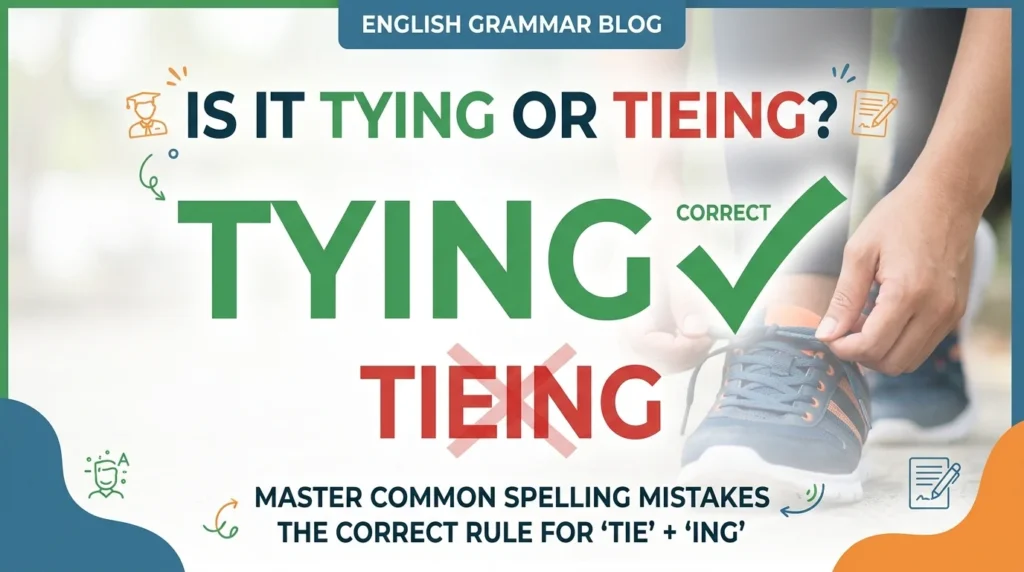

If you’re wondering whether tying or tieing is correct, the standard modern spelling is tying. The word comes from the verb tie, but when -ing is added, the final -ie changes to -y. Therefore, tie → tying, not tie → tieing.
Quick Answer
Tying is the correct standard spelling in modern English. The spelling follows the pattern where a verb ending in -ie changes -ie to -y before adding -ing. So, tie becomes tying. For example, write “She is tying her shoes,” not “She is tieing her shoes.”
What Is Tying?
Tying is the -ing form of the verb tie. The verb “tie” can mean to fasten something, make a knot, secure an object, connect two things, or create a connection between ideas or situations.
For example:
- I tie my shoes every morning.
- She is tying her shoes.
- He is tying a knot.
- They are tying the ropes together.
The important point is that the spelling changes when -ing is added.
Why Is It Tying, Not Tieing?
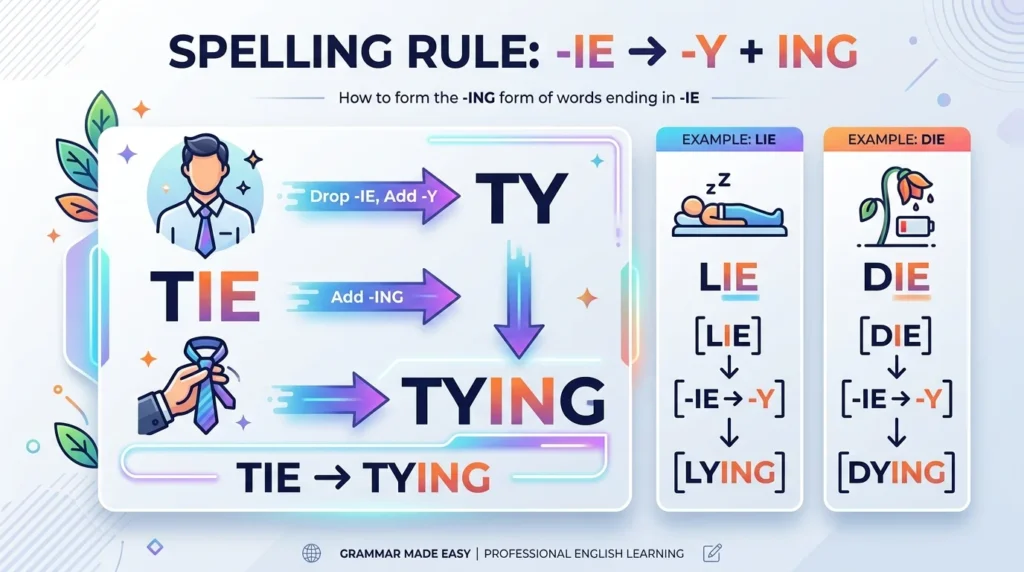
The spelling follows a common English spelling pattern. When certain verbs end in -ie, the -ie changes to -y before -ing is added.
The basic pattern is:
-ie → -y + -ing
| Base Verb | -ing Form |
|---|---|
| tie | tying |
| lie | lying |
| die | dying |
| vie | vying |
| untie | untying |
The easiest way to remember it
Don’t think of the word as tie + ing. Instead, change -ie to -y first:
tie → ty + ing → tying
This simple pattern makes the spelling much easier to remember.
Why Does It Matter?
Writing tying correctly helps your English look polished and professional. A spelling mistake such as tieing is usually easy for readers to understand, but it can make formal or educational writing appear less careful.
Correct spelling is especially useful when writing:
- School assignments
- Essays
- Business emails
- Reports
- Job applications
- Website content
- Academic writing
- Social media posts
How to Use Tying
Tying as an action
Use tying when someone is fastening, securing, connecting, or making something with a knot.
For example:
“She is tying her shoes.”
“He is tying a rope around the box.”
“I’m tying the balloons together.”
Tying in everyday expressions
You may commonly see tying in expressions such as:
- tying your shoes
- tying a knot
- tying a ribbon
- tying a rope
- tying your hair
- tying a package
- tying two things together
- tying the score
Tying in a figurative sense
Tying can also mean connecting things in an abstract or figurative way.
For example:
“The report is tying the results to the original research.”
Here, tying means connecting one thing with another rather than physically fastening something.
Correct Examples
- “I’m tying my shoes.”
- “She is tying a ribbon around the gift.”
- “He was tying the rope to the tree.”
- “They are tying the boxes together.”
- “The students practiced tying different knots.”
- “I’m tying the documents together before sending them.”
- “She spent the afternoon tying ribbons around the packages.”
- “The team scored late, tying the game.”
- “He is tying his hair back before cooking.”
- “The study examines the effects of tying these variables together.”
- “The company is tying the payment schedule to project milestones.”
- “Begin by tying the two ends together.”
Incorrect vs. Correct
| Incorrect | Correct | Why |
|---|---|---|
| She is tieing her shoes. | She is tying her shoes. | The -ie changes to -y before -ing. |
| He is tieing a knot. | He is tying a knot. | The standard modern form is tying. |
| I’m tieing the ribbon. | I’m tying the ribbon. | The verb follows the -ie → -y spelling pattern. |
| They are tieing the ropes. | They are tying the ropes. | Tie becomes tying. |
| She was tieing her hair. | She was tying her hair. | Tying is the standard spelling. |
| He enjoys tieing knots. | He enjoys tying knots. | The gerund form is tying. |
| We’re tieing the packages. | We’re tying the packages. | The -ie changes before -ing. |
| They started tieing the ropes. | They started tying the ropes. | The correct modern form is tying. |
| I’m tieing the ends together. | I’m tying the ends together. | Do not simply add -ing to tie. |
| He was tieing the boat to the dock. | He was tying the boat to the dock. | Tying is the normal spelling in modern English. |
Why Do People Make This Mistake?
1. The “just add -ing” mistake
English learners often learn that the -ing form is made by adding -ing to a verb.
For example:
- work → working
- play → playing
- read → reading
Because of this, it is easy to assume that tie + ing should become tieing. However, verbs ending in -ie follow a different spelling pattern.
See Also:
WTE Meaning in Text Explained – Usage & Social Media Guide
TRUE Meaning in Text Explained – Full Guide, Usage, Examples (2026)
2. The spelling looks logical
Tieing may look logical because the letters in the original word remain visible. However, English spelling sometimes changes the form of a word when a suffix is added.
3. Pronunciation does not reveal the spelling
When you hear the word tying, you cannot easily determine whether it should be written with y or ie. This makes the word particularly easy to misspell.
4. Overgeneralizing spelling rules
Learners may know that many verbs take -ing by simply adding the ending. Applying that rule to every verb can lead to forms such as tieing.
5. Translation interference
People learning English may apply spelling patterns from their first language. If the equivalent word-forming process in another language does not change the base word, tieing may seem natural.
Common Mistakes Checklist
- Writing “tieing”: Use tying instead.
- Simply adding -ing: Remember that -ie changes to -y.
- Confusing it with the final-e rule: The transformation is tie → ty + ing, not simply removing the final e.
- Thinking it changes by dialect: Both American and British English normally use tying.
- Assuming “tieing” never appears: Historical and variant uses exist, but tying is the normal modern choice.
Tying in Real English
Tying is the natural everyday form used when talking about fastening, securing, or connecting something. Expressions such as “tying my shoes,” “tying a knot,” and “tying the package” are normal in modern English. The word works naturally in conversation, school writing, professional communication, and academic writing.
Tieing is different. Although the spelling can appear in older or historical material and is recognized as a variant in some sources, it is not the form modern writers normally choose. For contemporary general English, tying is the straightforward standard choice.
American vs. British English
There is no meaningful American-versus-British spelling difference for this word. Both varieties use tying as the standard modern form.
For example:
- tying your shoes
- tying a knot
- tying a ribbon
- tying the rope
- tying the score
You do not need to use tieing when writing British English.
Formal vs. Informal Usage
Tying can be used in both formal and informal English.
Informal
“I’m tying my shoes. I’ll be there in a minute.”
Professional
“The company is tying the payment schedule to project milestones.”
Academic
“The research examines the effects of tying these factors to the proposed model.”
The spelling remains tying regardless of the level of formality.
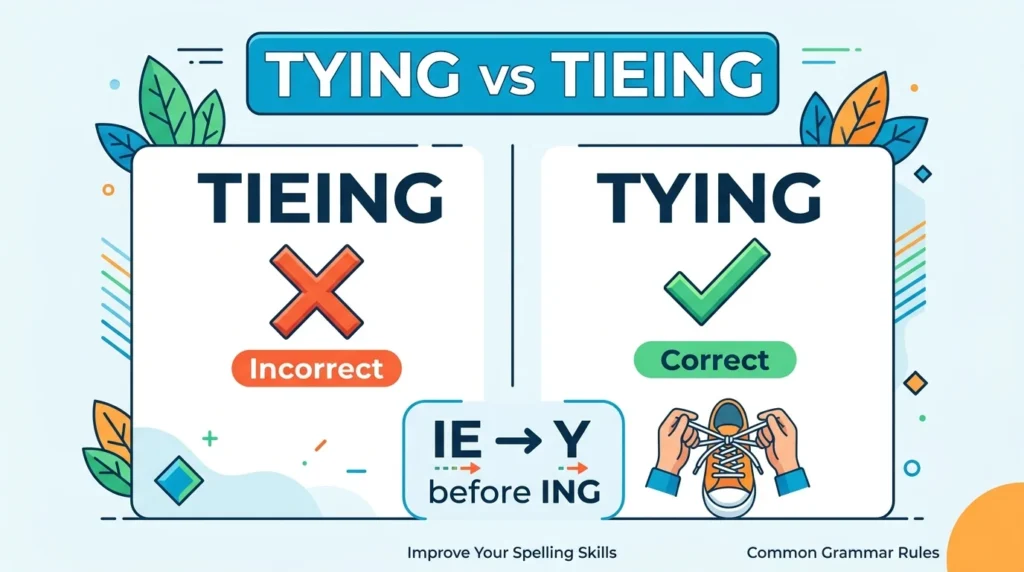
Tying vs. Tieing Comparison
| Feature | Tying | Tieing |
|---|---|---|
| Base word | tie | tie |
| Standard modern spelling | Yes | No |
| Normal everyday usage | Yes | Normally avoided |
| Formal writing | Yes | Normally avoided |
| Academic writing | Yes | Normally avoided |
| American English | Yes | Normally avoided |
| British English | Yes | Normally avoided |
| Formation | tie → tying | tie + ing |
Real-Life Situations
In a text message
“I’m tying my shoes. Be there soon.”
In a work email
“I’m tying the final documents together and will send them shortly.”
In a classroom
“The students are practicing tying different types of knots.”
In an interview
“One of my responsibilities involved tying the cables together.”
In an exam
If you see a sentence such as:
“She is ______ her shoelaces.”
The correct answer is tying.
In instructions
“Begin by tying the two ends together.”
How to Remember Tying
The easiest memory trick is:
IE becomes Y before ING.
Remember these examples:
- tie → tying
- lie → lying
- die → dying
- vie → vying
You can also remember:
TY + ING = TYING
Is Tieing Ever Used?
You may occasionally find tieing in historical writing or older sources. It can also be recorded as a variant spelling.
However, this does not make it the preferred spelling for contemporary general English.
If you’re writing something today, the practical choice is simple:
Use “tying.”
Quick Practice Quiz
Choose tying or tieing in each sentence.
- She is ______ her shoes.
- He was ______ the rope to the tree.
- They are ______ the boxes together.
- I’m ______ my hair back.
- The team is ______ the score.
- ______ a knot takes practice.
- She started ______ the ribbon around the gift.
- He is ______ the two ends together.
Answers
- tying
- tying
- tying
- tying
- tying
- Tying
- tying
- tying
Frequently Asked Questions
Is tying or tieing correct?
Tying is the standard modern spelling of the -ing form of tie.
Why is tying spelled with a y?
When this type of verb ending in -ie takes -ing, the -ie changes to -y.
Is tieing a real word?
Tieing has appeared as a historical or variant spelling, but tying is the normal spelling used in modern English.
Is tying used in British English?
Yes. Tying is the standard spelling in British English.
Is tying used in American English?
Yes. American English also uses tying.
How do you spell tying a knot?
The correct spelling is tying a knot.
How do you spell tying your shoes?
The correct spelling is tying your shoes.
What is the spelling rule for tying?
The basic pattern is -ie → -y + -ing. Therefore, tie becomes tying.
What other words follow the same pattern?
Examples include lie → lying, die → dying, vie → vying, and untie → untying.
Is tieing a spelling mistake?
In contemporary standard writing, you should normally use tying instead of tieing.
What is the easiest way to remember tying?
Remember: IE becomes Y before ING. This gives you tie → tying.
Conclusion
When choosing between tying and tieing, use tying in modern English. The spelling follows the pattern in which -ie changes to -y before -ing is added. That gives us tie → tying.
The same pattern can be seen in words such as lie → lying and die → dying. Although tieing can appear in historical or variant usage, tying is the standard choice for contemporary writing. Whether you’re writing a text message, school assignment, professional email, or academic paper, tying is the spelling you should use.
See Also:
Audacity Meaning: Definition, Examples & Synonyms
Period Meaning in Text Messages: Simple Guide with Real Chat Examples
WYMM Meaning in Text Explained Simply – Definition, Examples & Online Use