
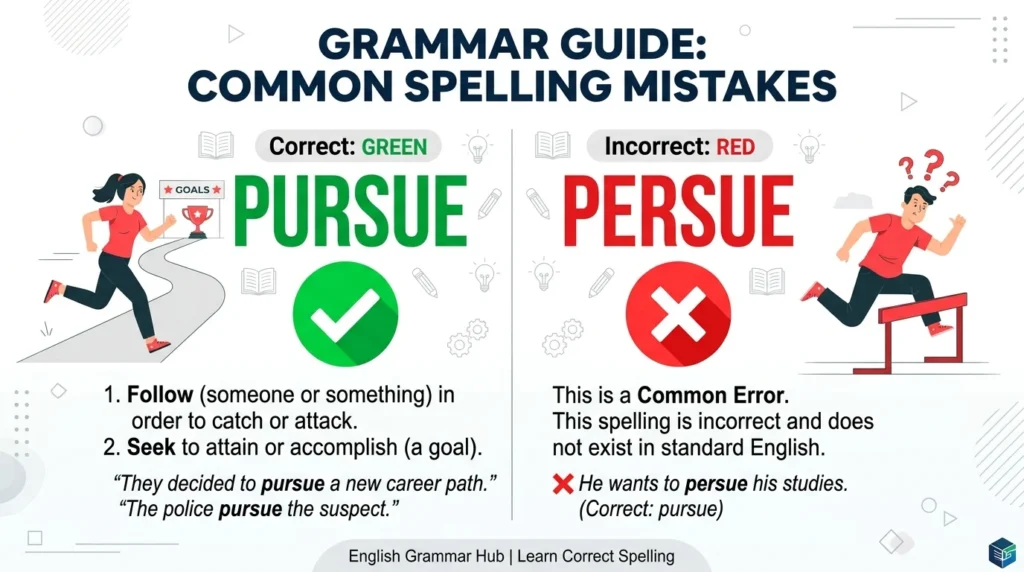

Quick Answer: The correct spelling is pursue. “Persue” is a misspelling and should not be used in standard English. Pursue is a verb meaning to follow or chase someone or something, or to try to achieve a goal, career, plan, or ambition. For example: “She decided to pursue a career in medicine.”
See Also:
IMU Meaning in Text Revealed: Hidden Meaning Explained Simply
What Is “Pursue”?
Pursue is the correct English spelling. It is a verb used when someone follows or chases something, or makes a continued effort to achieve something. Cambridge Dictionary and Oxford Learner’s Dictionaries both list pursue as the standard spelling. :contentReference[oaicite:0]{index=0}
For example:
- She wants to pursue a career in science.
- The police began to pursue the vehicle.
- He decided to pursue his dream.
Why Does “Pursue or Persue” Matter?
The spelling difference is small, but using the wrong form can make your writing look careless or incorrect. Persue is a common spelling mistake caused by the way the word sounds.
When writing emails, assignments, applications, articles, or professional documents, use pursue.
Core Rule: Pursue Is Correct
The simple rule is:
Use “pursue.” Do not use “persue” in standard English.
The word is spelled with pur- at the beginning:
p-u-r-s-u-e → pursue
How to Use “Pursue” Correctlyy

1. To Follow or Chase
Use pursue when someone follows or chases another person or thing, especially to catch it.
Example: The police pursued the car.
2. To Work Toward a Goal
Use pursue when someone actively tries to achieve a goal, ambition, or dream.
Example: She is pursuing her dream of becoming a doctor.
3. To Continue an Activity or Plan
You can also use pursue when continuing to work on a plan, career, interest, strategy, or course of action.
Example: The company plans to pursue a new marketing strategy.
See Also:
IHHT Meaning in Text Explained (Most People Get This Wrong!)
Correct Examples of “Pursue”
- I want to pursue a career in engineering.
- She decided to pursue her dream.
- He plans to pursue higher education.
- The police pursued the suspect’s vehicle.
- We should pursue every possible solution.
- She is pursuing a degree in business.
- They decided to pursue legal action.
- He continued to pursue his goals despite the difficulties.
- The company is pursuing new business opportunities.
- Students can pursue their interests through extracurricular activities.
- The journalist decided to pursue the story further.
- She wants to pursue a career in medicine.
Incorrect vs Correct
| Incorrect | Correct | Why? |
|---|---|---|
| ❌ I want to persue my dream. | ✅ I want to pursue my dream. | “Pursue” is the correct spelling. |
| ❌ She will persue a career in medicine. | ✅ She will pursue a career in medicine. | The word begins with “pur-.” |
| ❌ He decided to persue higher education. | ✅ He decided to pursue higher education. | “Persue” is a spelling error. |
| ❌ We should persue this opportunity. | ✅ We should pursue this opportunity. | Use “pursue” for an opportunity you try to achieve. |
| ❌ The police began to persue the car. | ✅ The police began to pursue the car. | “Pursue” can mean to chase or follow. |
| ❌ She is persuing her goals. | ✅ She is pursuing her goals. | The -ing form is “pursuing.” |
| ❌ He persued his ambition. | ✅ He pursued his ambition. | The past tense is “pursued.” |
| ❌ They are trying to persue the matter. | ✅ They are trying to pursue the matter. | “Pursue” can mean to continue dealing with something. |
| ❌ She wants to persue a new career. | ✅ She wants to pursue a new career. | “Pursue” is the standard spelling. |
| ❌ He hopes to persue his interests. | ✅ He hopes to pursue his interests. | The correct spelling is “pursue.” |
Why Do People Spell It “Persue”?
1. Phonetic Similarity
The pronunciation of pursue can make the spelling difficult to remember. Because the first syllable can sound similar to “per,” some people incorrectly write persue.
2. Spelling Pattern Confusion
English contains many words beginning with per-, so writers may naturally assume that persue is correct.
3. Typing Quickly
When typing quickly, it is easy to replace the u in pur with an e. Spell-checking can help catch the mistake, but it is better to remember the correct spelling.
See Also:
GPI Meaning in Text Explained: What This Confusing Slang REALLY Means
Common Mistakes Checklist
- ❌ Do not write persue.
- ✅ Write pursue.
- ✅ Past tense: pursued.
- ✅ -ing form: pursuing.
- ❌ Do not write persued.
- ❌ Do not write persuing.
- Remember that the beginning is pur-, not per-
“Pursue” in Real English
Natural Usage
“Pursue” is very common when talking about goals, careers, education, ambitions, plans, opportunities, and interests. For example, “She decided to pursue a career in medicine” is a natural and standard sentence.
Another Common Meaning
“Pursue” can also describe physically following or chasing someone or something. For example, “The police pursued the vehicle.” This meaning is also standard in both British and American English.
American vs British English
There is no spelling difference between American and British English for this word. Both use pursue. Oxford and Cambridge list the same standard spelling, although pronunciation can vary between British and American English. :contentReference[oaicite:1]{index=1}
Formal vs Informal Usage
Pursue is suitable for both formal and everyday English. It is especially common in formal contexts involving careers, education, business, goals, plans, and legal matters.
For casual conversation, simpler alternatives such as “follow,” “go after,” or “try to achieve” may sometimes sound more natural depending on the context.
Comparison Table

| Word | Correct? | Meaning | Example |
|---|---|---|---|
| Pursue | ✅ Yes | To follow, chase, or try to achieve | She wants to pursue her goals. |
| Persue | ❌ No | Misspelling of pursue | Do not use “persue.” |
| Pursued | ✅ Yes | Past tense and past participle | He pursued his dream. |
| Pursuing | ✅ Yes | Present participle | She is pursuing a degree. |
Real-Life Situations
In Education
“After high school, Maya plans to pursue a degree in computer science.”
In the Workplace
“Our company is pursuing new opportunities in international markets.”
In an Email
“I am writing to pursue or persue an update regarding my application.”
In Everyday Conversation
“He decided to pursue his passion for photography.”
In Academic Writing
“The researchers pursued several approaches to solve the problem.”
In News or Reporting
“Authorities continued to pursue the investigation.”
Practice Quiz
Choose the correct spelling in each sentence:
- She wants to (pursue / persue) a career in law.
- He decided to (pursue / persue) his ambition.
- The police began to (pursue / persue) the vehicle.
- They are (pursuing / persuing) new opportunities.
- She (pursued / persued) her dream for many years.
Answers
- pursue
- pursue
- pursue
- pursuing
- pursued
Frequently Asked Questions
Is “pursue” or “persue” correct?
Pursue is correct. “Persue” is a misspelling.
What does pursue mean?
Pursue means to follow or chase someone or something, or to try to achieve a goal, plan, career, or ambition. :contentReference[oaicite:2]{index=2}
Is “persue” a word?
“Persue” is not the standard spelling of the English verb. Use pursue instead.
How do you spell pursue?
It is spelled P-U-R-S-U-E: pursue.
What is the past tense of pursue?
The past tense and past participle are pursued. :contentReference[oaicite:3]{index=3}
What is the -ing form of pursue?
The -ing form is pursuing. :contentReference[oaicite:4]{index=4}
Can pursue mean chase?
Yes. “Pursue” can mean to follow or chase someone or something, especially when trying to catch them. :contentReference[oaicite:5]{index=5}
Can pursue be used for a career?
Yes. “Pursue” is commonly used with careers, degrees, goals, ambitions, and interests. For example: “She plans to pursue a career in medicine.” :contentReference[oaicite:6]{index=6}
Is pursue used in American and British English?
Yes. Pursue is standard in both American and British English. The spelling is the same in both varieties.
What is an easy way to remember pursue?
Remember that pursue starts with pur-, not per-. Think: “pursue your purpose.”
Conclusion
Pursue is the correct spelling, while persue is a common misspelling. Use pursue when you mean to follow, chase, continue with, or work toward something. The related forms are pursued and pursuing. Remember the simple spelling pattern: pur + sue = pursue.
See Also:
OOO Meaning in Text & Emails – Full Definition, Usage & Social Media Guide‘
WND Meaning in Text – Hidden Slang Explained With Real-Life Examples