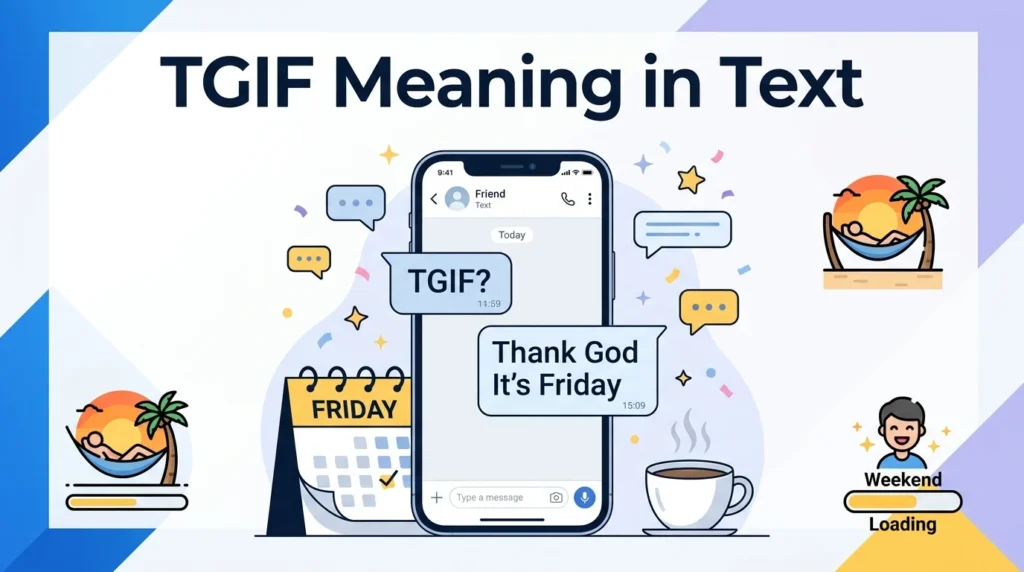

Some text abbreviations are confusing because they look new. TGIF is different. You may have heard it for years, seen it in captions, or read it in Friday messages, but still wonder what it really means in texting. TGIF meaning in text is simple: it usually means “Thank God It’s Friday.” People use it when they feel happy, relieved, or excited because the workweek or school week is ending. Merriam-Webster defines TGIF as an abbreviation for “thank God it’s Friday,” and Collins explains it as something people say when they are glad the workweek is almost over.
In real chats, TGIF is more than a phrase. It is a mood. It can mean, “I survived the week,” “I need rest,” “weekend plans are starting,” or “Friday finally came.” This guide explains the meaning, origin, social media use, examples, replies, similar terms, and other meanings so you can understand TGIF without guessing.
Meaning & Definition
TGIF meaning in text is “Thank God It’s Friday.” It is an informal abbreviation used to show happiness, relief, or excitement at the end of the week. People usually send it on Friday, especially after a tiring week of work, school, exams, deadlines, meetings, or personal responsibilities. When someone writes “TGIF!”, they are usually saying they are glad Friday has arrived and the weekend is near.
The most common meaning is emotional, not literal. Many people who use TGIF are not making a religious statement. They are using it as a casual phrase, similar to “Finally, it’s Friday,” “Weekend is here,” or “I’m glad the week is over.” That is why TGIF works in friendly chats, social media captions, office group messages, and casual posts. Dictionary.com also lists TGIF as an informal abbreviation for “thank God it’s Friday.”
For example, if your friend texts, “TGIF, I need sleep,” they mean the week was tiring and they are happy Friday has come. If someone posts “TGIF vibes” on Instagram, they are sharing a Friday mood, usually connected with rest, fun, food, travel, parties, or weekend plans.
A softer version is “Thank Goodness It’s Friday.” Some people prefer this because it avoids religious wording. The meaning stays almost the same. Both versions express relief and happiness, but “Thank God It’s Friday” is the traditional and most widely recognized form.
TGIF is casual. It belongs in relaxed conversations, not serious business documents. It works best when the tone is light, friendly, and connected to Friday or the weekend.
What Does TGIF Meaning in Text?
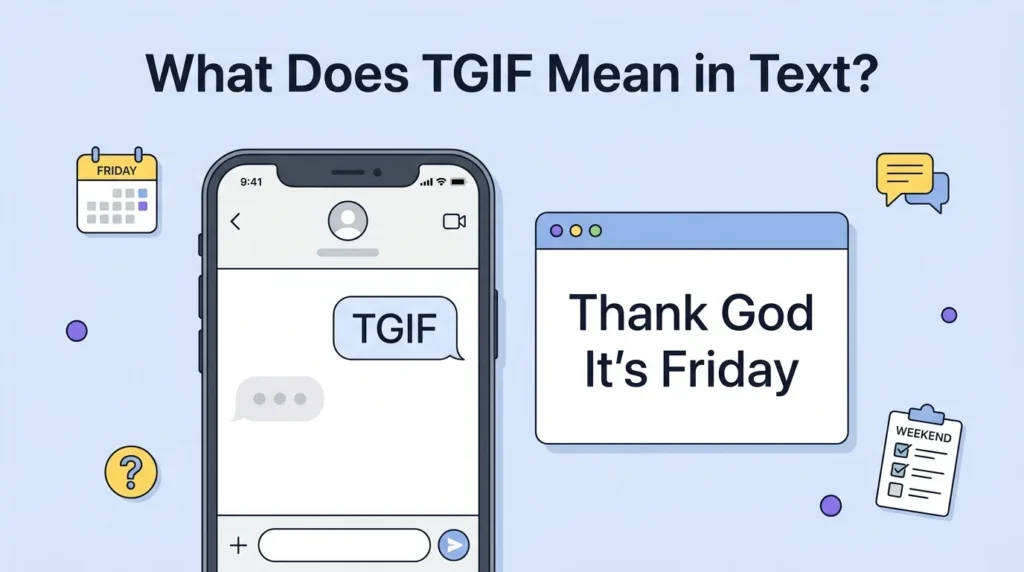
TGIF meaning in text is “Thank God It’s Friday.” People use it to show relief, happiness, or excitement because Friday has arrived and the weekend is close.
Featured snippet answer:
TGIF means “Thank God It’s Friday” in text. It is a casual abbreviation used in messages, captions, comments, and social media posts to express joy or relief at the end of the workweek or school week.
Example:
Friend: “Long week. I’m exhausted.”
You: “TGIF! Time to relax.”
Here, TGIF means you are happy the week is ending.
The easiest way to understand TGIF is to replace it with “Finally, it’s Friday.” If the sentence still makes sense, then TGIF is being used in its normal texting meaning. For example, “TGIF, I’m ordering pizza tonight” means the person is celebrating Friday in a casual way.
TGIF is often used with phrases like “weekend mode,” “Friday mood,” “finally Friday,” “Friday vibes,” and “weekend plans.” It is positive most of the time. People use it when they feel tired but happy, stressed but relieved, or excited about free time. It is one of the clearest and safest slang terms because its meaning is widely known.
Background / Origin
The phrase “Thank God It’s Friday” became popular because Friday is the end of the normal workweek for many people. For workers, students, and office teams, Friday often represents relief. It means deadlines are ending, alarms may slow down, and personal time is near. TGIF turned that shared feeling into a short, catchy abbreviation.
The phrase became strongly connected with popular culture, restaurants, music, and television. It is also linked to the well-known restaurant name TGI Fridays, and the phrase appeared in entertainment titles such as the 1978 film Thank God It’s Friday. Over time, people began using TGIF not only as a phrase but as a social expression for Friday excitement.
There is one important detail: not every famous use of TGIF means the same thing. For example, ABC’s 1990s family TV programming block called TGIF was later explained by its creator as meaning “Thank Goodness It’s Funny,” not “Thank God It’s Friday.” Reports from People and Entertainment Weekly covered that clarification in 2025.
Still, in normal texting, the meaning is almost always “Thank God It’s Friday.” Texting culture made it even more common because short phrases are easy to send. Instead of writing a full sentence like “I’m so glad this week is finally over,” people can simply type “TGIF.”
That is why TGIF remains popular. It is short, easy, positive, and instantly connected with the feeling of reaching Friday.
Usage in Different Contexts
General Usage
In general texting, TGIF is used when someone wants to express relief, happiness, or excitement on Friday. It often appears at the start or end of a message. For example, “TGIF, this week was brutal” means the person had a hard week and feels glad it is ending. “TGIF, any plans tonight?” means the person is ready to talk about weekend plans.
TGIF can also be used in captions, memes, workplace chats, school groups, and friend conversations. It is usually positive, but it can also carry a tired tone. Someone may say “TGIF, I barely survived this week” to make a stressful week sound funny. In that case, TGIF works as a small celebration after pressure.
The term is not romantic by default. It is mostly about Friday, weekends, rest, and social plans. If someone sends TGIF, they are usually not flirting unless the rest of the message has romantic meaning.
Formal Usage
TGIF is not ideal for formal writing. You should avoid it in business proposals, academic essays, official reports, legal documents, serious client emails, and professional applications. It sounds casual and emotional, which may not fit formal communication.
However, TGIF can be acceptable in light workplace messages if the company culture is friendly. For example, a team lead might write, “TGIF, everyone. Great work this week.” That sounds warm and human. But in a formal report, it would look unprofessional.
If you want a formal alternative, use phrases like “Have a good weekend,” “Wishing everyone a restful weekend,” or “Thank you for your work this week.” These phrases keep the friendly meaning without sounding too casual.
Informal Usage
TGIF works best in informal communication. It is perfect for texting friends, posting Friday captions, replying to memes, sharing weekend plans, or chatting in casual groups. It feels natural because people already connect Friday with relief and fun.
For example, “TGIF, movie night?” is simple and friendly. “TGIF, I need coffee and silence” sounds funny and relatable. “TGIF, beach tomorrow” creates excitement.
In informal chats, TGIF can be used alone as a full message. If someone texts “TGIF!”, they are usually starting a Friday mood conversation. You can reply with your own weekend plans, a joke, or a simple agreement.
TGIF Meaning on Social Media Platforms
- WhatsApp →
On WhatsApp, TGIF is usually used in private chats, family groups, school groups, and office groups. Someone may write “TGIF, finally done with work” or “TGIF, what’s the plan tonight?” It usually means the person is relieved Friday has arrived. In work groups, TGIF can be friendly, but it should still match the tone of the group. - Snapchat →
On Snapchat, TGIF often appears with selfies, short videos, food snaps, party plans, or weekend captions. A person may post “TGIF” with a picture from a café, gym, car, classroom, or office desk. On Snapchat, the meaning is usually visual: the person is showing they are ready for the weekend. - TikTok →
On TikTok, TGIF appears in captions, comments, and Friday-themed videos. People use it with funny workweek videos, weekend outfit clips, payday jokes, school memes, and relatable tired-after-the-week content. A comment like “TGIF because this week was too much” means the viewer strongly relates to the Friday relief. - Instagram →
On Instagram, TGIF is common in captions, reels, stories, and comments. People use it with photos of coffee, travel, food, parties, sunsets, outfits, and weekend activities. Captions like “TGIF vibes” or “TGIF mood” usually mean the person is celebrating the start of the weekend. It is a lifestyle caption as much as a text abbreviation.
Other Meanings in Different Fields
- Medical →
In medical and biological contexts, TGIF may appear as part of scientific names such as TGIF1, also known as TGFB induced factor homeobox 1. NCBI describes TGIF1 as a human gene connected with a protein involved in transcription regulation, and mutations in this gene are associated with holoprosencephaly type 4.This is not texting slang. If you see TGIF or TGIF1 in a medical paper, do not read it as “Thank God It’s Friday.” - Physics →
TGIF is not a common standard abbreviation in basic physics. If it appears in a physics document, it may be an internal label, file name, software reference, project acronym, or author-defined shorthand. Scientific writing often defines abbreviations before using them. So, if TGIF appears in a technical paper, check the definition inside that document instead of assuming the texting meaning. - Technology →
In technology, Tgif can refer to an Xlib-based interactive 2-D drawing tool under X11 on Linux and other Unix-like systems. The official Tgif page describes it as an interactive vector graphics drawing tool. This meaning is completely different from TGIF in texting. In tech contexts, always read the surrounding topic first.
Examples of TGIF Meaning in Text in Sentences
- Example 1: After a long workweek
A: “This week felt like a whole month.”
B: “TGIF. I’m doing nothing tonight.”
Here, TGIF means the person is relieved because Friday has arrived. The message shows tiredness and the desire to rest. - Example 2: Weekend plan chat
A: “Any plans after work?”
B: “TGIF! Let’s grab dinner.”
In this example, TGIF creates a positive Friday mood. The person is using it to move the conversation toward weekend plans. - Example 3: School or college conversation
A: “We finally submitted the assignment.”
B: “TGIF, my brain is finished.”
Here, TGIF shows relief after academic pressure. The person is happy that both the assignment and the week are ending. - Example 4: Social media caption
Post: “Laptop closed. Coffee ordered. Weekend loading.”
Caption: “TGIF.”
In this case, TGIF works as a short caption. It tells readers the person is entering weekend mode without needing a long explanation.
Common Misconceptions
- Misconception 1: TGIF is always religious
TGIF includes the word “God,” but most people use it casually. They usually mean “I’m glad it’s Friday,” not a formal religious statement. If someone wants a softer version, “Thank Goodness It’s Friday” works too. - Misconception 2: TGIF is only for office workers
TGIF is common among office workers, but they are not the only people who use it. Students, freelancers, teachers, parents, retail workers, content creators, and social media users also use it. Anyone who feels relieved on Friday can use TGIF. - Misconception 3: TGIF means the weekend has already started
TGIF does not always mean someone is free right now. It means they are happy Friday has arrived. Some people still have work, school, errands, or night shifts after saying TGIF. The phrase is about the feeling of reaching Friday, not always full freedom.
Similar Terms & Alternatives
- Finally Friday — A simple phrase used when Friday has arrived after a long week.
- Friday vibes — A social media phrase used for the mood, energy, or excitement of Friday.
- Weekend mode — Means someone is mentally ready for the weekend.
- Happy Friday — A friendly greeting often used in messages and workplace chats.
- Thank Goodness It’s Friday — A softer version of TGIF without religious wording.
- Weekend loading — Means the weekend is about to begin.
- Friday mood — Used to describe relaxed or excited Friday energy.
- Long week, short patience — A funny phrase for feeling tired by Friday.
- Cheers to the weekend — A celebratory phrase for weekend plans.
- Fri-yay — A playful version of Friday used in captions and casual posts.
- End of the week — A clearer formal alternative.
- Have a good weekend — A polite response or workplace-friendly alternative.
How to Respond to TGIF Meaning in Text When Someone Uses It
When someone sends TGIF, they are usually sharing relief or excitement. Your reply should match that mood. If they sound tired, respond with support. If they sound excited, respond with energy. If they are making plans, continue the plan. TGIF is easy to reply to because it opens the door for weekend conversation.
- Response 1:
“Seriously, this week was long. Time to rest.”
Use this when the other person sounds tired or relieved. It agrees with their mood and keeps the chat natural. - Response 2:
“TGIF! Any weekend plans?”
This is a simple reply when you want to continue the conversation. It works well with friends, coworkers, or casual chats. - Response 3:
“Same here. I’ve been waiting for Friday all week.”
Use this when you want to show agreement. It sounds friendly and relatable without being too much.
If the message comes from a coworker or client, keep your reply clean. Something like “Happy Friday, hope you have a great weekend” is safer than slang-heavy replies.
Difference Between TGIF Meaning in Text and Similar Terms
TGIF meaning in text is close to phrases like “Happy Friday,” “Finally Friday,” “Friday vibes,” and “weekend mode,” but each one has a slightly different feeling. TGIF is stronger than “Happy Friday” because it shows relief, not just greeting. “Happy Friday” is polite and friendly. “TGIF” sounds more emotional, like the person has been waiting for the week to end.
TGIF is also different from “Friday vibes.” Friday vibes is more about mood, style, and social media energy. It is often used with photos, outfits, coffee, travel, food, or party captions. TGIF is more direct. It simply says the person is glad Friday is here.
Compared with “weekend mode,” TGIF focuses on Friday itself. Weekend mode means the person has mentally switched into rest or fun mode. Someone can say TGIF in the morning and still work all day. But if they say “weekend mode activated,” they are acting like the weekend has already started.
Compared with “Fri-yay,” TGIF is more classic and widely understood. Fri-yay sounds playful and trendy, while TGIF sounds familiar and universal. Both are casual, but TGIF works for a wider audience.
The simple difference is this: TGIF expresses relief. Happy Friday gives a greeting. Friday vibes shows a mood. Weekend mode shows a mindset.
Relevance in Online Conversations & Dating Apps
TGIF is still relevant in online conversations because it gives people an easy way to start a light, positive conversation. Friday naturally creates social energy. People are more likely to talk about food, movies, travel, rest, parties, sleep, gaming, family time, or weekend plans. TGIF works as a simple opener because almost everyone understands the feeling.
On dating apps, TGIF can be useful if you do not want to start with a boring “hey.” A message like “TGIF. What’s your ideal Friday night?” feels more natural than a random compliment. It gives the other person an easy topic to answer. They can talk about dinner, movies, staying home, going out, or relaxing after work.
TGIF also helps keep the tone low-pressure. It is not too romantic, too serious, or too personal. That makes it a safe opener for early conversations. But do not overuse it. If every message sounds like a caption, it becomes weak. Use TGIF as a conversation starter, then ask a real question.
In modern chats, TGIF works because it connects with a shared human feeling: people are tired, and Friday feels like a reward.
Frequently Asked Questions
What does TGIF mean in text?
TGIF means “Thank God It’s Friday.” It is used to show happiness, relief, or excitement because Friday has arrived.
Is TGIF slang?
Yes, TGIF is informal slang or an abbreviation. It is common in texting, captions, comments, and casual conversations.
What does TGIF mean on WhatsApp?
On WhatsApp, TGIF usually means someone is happy the week is ending. It is often used in friend groups, family chats, and workplace messages.
Is TGIF professional?
TGIF is casual, not fully professional. It may be fine in a friendly workplace chat, but avoid it in formal emails, reports, and official documents.
Does TGIF mean Thank God or Thank Goodness?
The most common meaning is “Thank God It’s Friday.” Some people use “Thank Goodness It’s Friday” as a softer alternative.
How do you reply to TGIF?
You can reply with “Happy Friday,” “Same here,” “Any weekend plans?” or “Finally, this week was long.” Match the other person’s mood.
Conclusion
TGIF meaning in text is “Thank God It’s Friday.” It is a simple, popular abbreviation people use to show relief, happiness, or excitement at the end of the week. In texting, WhatsApp messages, Snapchat stories, TikTok comments, Instagram captions, and casual workplace chats, TGIF usually means the person is glad Friday has arrived and the weekend is close.
It is not always meant as a serious religious phrase; many people use it casually like “finally Friday” or “weekend is near.” The phrase works because it captures a feeling almost everyone understands: the week was long, and Friday feels better. Still, TGIF is informal, so it does not belong in serious documents or formal business writing. Use it with friends, social posts, relaxed groups, or friendly workplace messages. If you want a safer version, write “Happy Friday” or “Have a great weekend.”
See Also:
ONG Meaning in Text: What It Really Means in Chat Today