
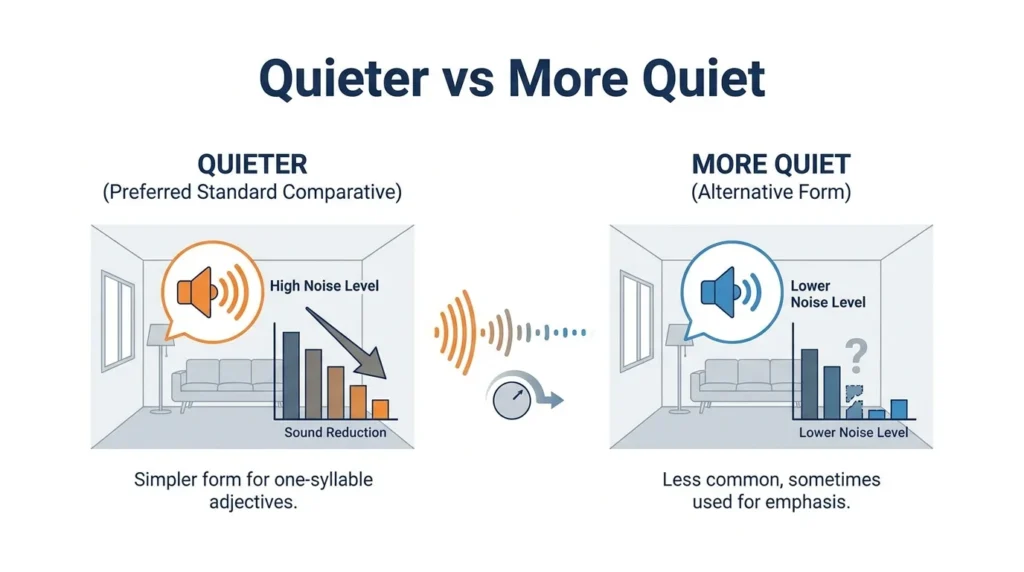

If you are comparing quieter vs more quiet, the safest and most natural choice in ordinary English is quieter. It is the standard comparative form of quiet, and it works naturally in conversation, professional writing, schoolwork, and everyday communication.
However, more quiet is not automatically grammatically wrong. Because quiet is a two-syllable adjective, English can sometimes form its comparative with more + adjective. The important difference is that the two forms are not equally common or equally natural in every sentence.
Quick Answer
Quieter is the standard and usually preferred comparative form of quiet. Use it when you mean that something has less noise, activity, or disturbance than something else: “This room is quieter than the kitchen.” More quiet can also be grammatical, but it is much less common and may sound deliberate, emphatic, or less natural depending on the sentence. When you are unsure, choose quieter.
What Is the Difference Between Quieter and More Quiet?
Quieter and more quiet are comparative forms that express a greater degree of quietness.
The adjective quiet can describe several related ideas. It can mean having little noise, having little activity, being peaceful, speaking very little, or being calm and restrained.
For example:
- The library is quiet.
- The library is quieter than the cafeteria.
- The neighborhood becomes quieter at night.
The form quieter adds the comparative ending -er to quiet. It is the form most readers and speakers expect when making a straightforward comparison.
More quiet uses a different comparative structure:
- The library is more quiet than the cafeteria.
This sentence can be understood, and the construction can occur in real English. However, it is not normally the first choice when a simple comparison is being made.
That distinction matters because grammar is not only about whether a sentence can be constructed. Good English also considers usage, naturalness, clarity, and context.
A useful way to think about the two forms is:
Quieter = the normal comparative choice.
More quiet = possible in some contexts, but usually less natural than quieter.
The difference becomes especially important for English learners. A learner who is told that more quiet is completely wrong may later encounter it in genuine English and become confused. On the other hand, telling learners that both forms are equally interchangeable also gives them an incomplete picture.
The better answer is that quieter is the default form, while more quiet is a possible alternative whose acceptability depends on context and style.
Why Does the Choice Matter?
At first glance, choosing between two nearly identical expressions may seem unimportant. In practice, small grammar choices affect how natural and polished your English sounds.
Consider these sentences:
- “Could you please be quieter?”
- “Could you please be more quiet?”
Both communicate the basic idea. The first is the ordinary choice and sounds immediately familiar.
Now consider a workplace email:
“The meeting room on the second floor is quieter in the afternoon.”
The sentence is concise and natural.
Using more quiet would not necessarily destroy the meaning, but it could make the sentence feel less direct:
“The meeting room on the second floor is more quiet in the afternoon.”
The difference becomes particularly noticeable when you are writing for school, work, professional communication, or public-facing content. You generally want the form that readers process effortlessly.
Choosing quieter can help because it follows the established comparative pattern associated with quiet.
This also explains why a simple dictionary-style answer is not enough. A learner may ask:
“Is more quiet grammatically possible?”
That is one question.
They may actually mean:
“Which one should I use?”
That is a different question.
For practical writing, the second question is usually more important.
Also Read: Eventhough vs Even Though: Which Is Correct?
Situations where the distinction matters
You may encounter this choice when:
- asking someone to lower their voice
- comparing two rooms
- describing neighborhoods
- discussing machines or vehicles
- writing about sound levels
- comparing workplaces
- describing a change in atmosphere
- writing an essay
- sending a professional email
- speaking naturally in conversation
In nearly all straightforward comparisons, quieter is the easiest choice.
The Core Rule
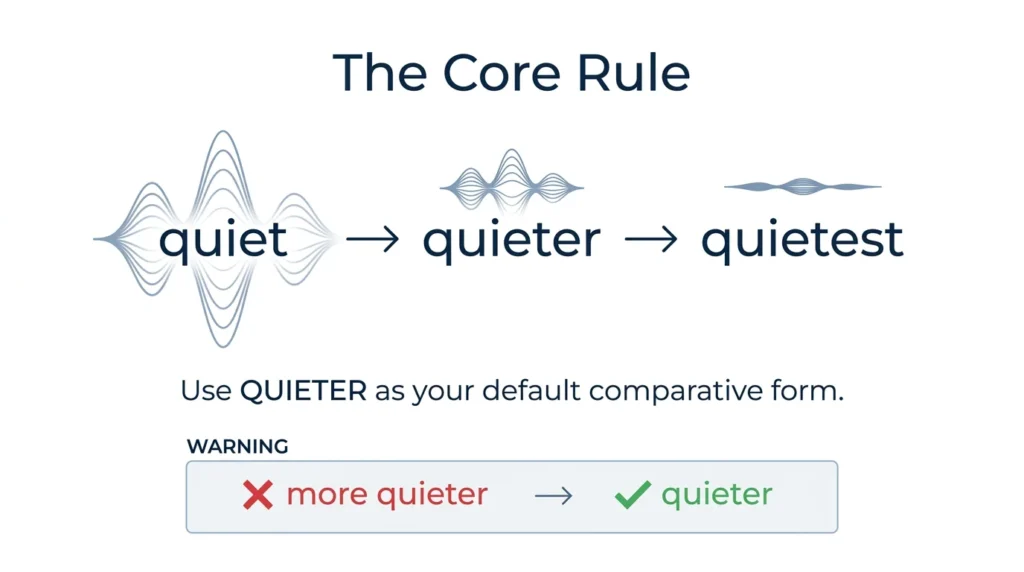
Use “quieter” as your default comparative form of “quiet.”
The basic pattern is:
quiet → quieter → quietest
Examples:
- This room is quiet.
- This room is quieter than the other one.
- This is the quietest room in the building.
Do not automatically assume that more quiet is impossible. It can occur, but it is not normally the form you should reach for first.
There is also an important rule about more quieter.
Do not combine the two comparative markers:
❌ more quieter
Choose one:
✅ quieter
or, where more quiet genuinely fits the context:
✅ more quiet
The same principle applies to other comparative forms. English normally does not need two comparative markers on the same adjective.
How to Use Quieter
The most common use of quieter is to compare two people, places, objects, situations, or periods of time.
Comparing places
The library is quieter than the student lounge.
Our new office is much quieter than the old one.
Comparing times
The streets are quieter after midnight.
The restaurant is quieter in the afternoon.
Comparing sounds
This fan is quieter than the previous model.
The new engine is considerably quieter.
Comparing people’s voices
She spoke in a quieter voice during the presentation.
Could you speak a little quieter?
In formal grammar, more quietly may be preferable when modifying the verb speak, because quietly is an adverb:
Could you speak more quietly?
However, speak quieter is also common in everyday English, especially in informal speech. The important point is not to confuse the adjective quiet/quieter with the adverb quietly/more quietly.
Comparing levels of activity
Quiet can describe activity, not just sound.
Business is quieter during the winter.
The store is much quieter on weekday mornings.
Here, quieter does not necessarily mean that nobody is making noise. It can mean that there are fewer people, less activity, or less business.
Also Read: PDA Meaning: What Does PDA Mean in Text & Dating?
How to Use More Quiet
More quiet should not be treated as the normal replacement for quieter. If you simply want to compare two things, quieter will usually be the better choice.
Still, more quiet can appear when a writer or speaker wants to preserve the adjective in its base form or create a particular contrast or rhythm.
For example:
The evening became more quiet as the visitors gradually left.
This construction is understandable and can occur in natural writing, although many speakers would simply say:
The evening became quieter as the visitors gradually left.
The second version is usually more direct.
Another possible context involves a contrast between qualities:
The new design is more quiet than the previous model.
This may occur when quiet is being presented as one quality among several being compared. But even here, quieter would generally remain the simpler choice:
The new design is quieter than the previous model.
Therefore, do not create a special rule saying that more quiet is required for emphasis. Context can make it suitable, but there is no universal grammar rule that says you should use it for emphasis.
Correct Examples
Here are examples covering common situations.
- Conversation:
“Could you be quieter? The baby is sleeping.” - Home:
“The bedroom is quieter than the living room.” - Workplace:
“The conference room is quieter in the morning.” - Email:
“I found a quieter place where we can discuss the project.” - School:
“Students usually work better in a quieter classroom.” - Academic writing:
“The experiment was conducted in a quieter environment to reduce background noise.” - Technology:
“The latest model has a quieter cooling system.” - Travel:
“This hotel is quieter than the one we stayed at last year.” - Social media:
“I need somewhere quieter to finish this assignment.” - Everyday description:
“The neighborhood gets quieter after sunset.” - Work meeting:
“Let’s move to the smaller room; it’s much quieter.” - Comparison over time:
“The office has become noticeably quieter since the renovation.”
Incorrect vs. Correct
| ❌ Incorrect or less suitable | ✅ Correct / Preferred | Why |
|---|---|---|
| The library is more quiet than the café. | The library is quieter than the café. | Quieter is the standard comparative choice. |
| This room is more quieter. | This room is quieter. | More and -er should not normally be combined. |
| The street is more quiet at night. | The street is quieter at night. | Quieter is the natural everyday comparative. |
| Can you be more quieter? | Can you be quieter? | More quieter is a double comparative. |
| The new machine is more quiet than the old one. | The new machine is quieter than the old one. | Quieter is more conventional here. |
| We need a more quieter office. | We need a quieter office. | Only one comparative marker is needed. |
| The classroom became more quiet after lunch. | The classroom became quieter after lunch. | Quieter is smoother for a simple change in degree. |
| Her voice was more quiet than mine. | Her voice was quieter than mine. | The direct comparative form is preferred. |
| Find somewhere more quiet. | Find somewhere quieter. | Quieter is the normal comparative after somewhere. |
| This part of town is more quiet. | This part of town is quieter. | Quieter is the standard choice for comparing places. |
The key point is that not every sentence containing more quiet is automatically ungrammatical. Some examples above are marked as less suitable because the question is not merely whether a construction can exist; it is whether it is the best natural choice for ordinary English.
Also Read: TTM Meaning in Text Messages – Simple Guide with Real Examples
Why Do People Make This Mistake?
The confusion comes from a few different features of English.
The word “quiet” has two syllables
Many learners memorize a simple rule:
One syllable → -er
Longer adjective → more
But English comparative formation is more flexible than that.
Quiet is commonly pronounced with two syllables: qui-et. Two-syllable adjectives are not all handled in exactly the same way. Some strongly prefer -er, some prefer more, and some permit variation.
That makes quiet a particularly understandable source of hesitation.
People overgeneralize the “two syllable = more” rule
A learner may think:
quiet = two syllables → more quiet
But syllable count alone does not determine every comparative form in English.
Usage matters.
The established comparative form of quiet is quieter, which is why dictionaries list it directly.
“More quiet” looks logically correct
English learners often reason from meaning rather than usage:
quiet → more quiet
The logic seems perfectly reasonable. We can say:
more expensive
more useful
more interesting
So why not:
more quiet?
The answer is that English does not build every comparative using exactly the same pattern. Some forms become conventional through long-term usage.
Spelling and pronunciation can interfere
Quieter may initially look strange because adding -er to quiet creates a longer written form and a pronunciation that some learners find awkward.
The word is generally pronounced with the vowel sequence of quiet followed by the comparative ending. Because of that, some speakers may prefer the two-word phrase more quiet in particular contexts.
But difficulty pronouncing a form does not make the established form grammatically incorrect.
Translation can cause interference
In some languages, comparative adjectives are routinely formed using a word equivalent to more. Learners may therefore transfer that structure into English.
That can lead to sentences such as:
more quiet
more small
more fast
English does not treat all adjectives this way.
The best solution is to learn common comparative forms as patterns rather than trying to translate the comparative structure word-for-word.
Common Mistakes Checklist
1. Using “more quieter”
Mistake:
The room is more quieter.
Better:
The room is quieter.
Why it happens: The writer knows both more and -er can signal comparison but combines them.
How to avoid it: Pick one comparative structure.
2. Assuming “more quiet” is always wrong
Mistake: Treating every appearance of more quiet as an error.
Better approach: Recognize that more quiet can occur, but quieter is normally the preferred form.
Why it happens: Simplified grammar lessons often turn preferences into absolute rules.
3. Assuming both forms are equally common
They are not equally common in ordinary usage.
If you are writing a straightforward comparison, quieter is normally the better choice.
4. Confusing “quieter” with “more quietly”
Compare:
The room is quieter.
Here, quieter is an adjective.
Please speak more quietly.
Here, more quietly is an adverbial phrase describing how someone speaks.
The choice depends on what the word modifies.
5. Forgetting “than”
A comparative can sometimes appear without than when the comparison is understood:
This room is quieter.
But when you explicitly identify the comparison, than is commonly used:
This room is quieter than the other one.
Do not use then for the comparison:
❌ This room is quieter then the other one.
✅ This room is quieter than the other one.
6. Thinking “quiet” only means low noise
Quiet can describe:
- sound
- people
- places
- activity
- business
- periods of time
- behavior
- atmosphere
- personality
So quieter can mean more than simply “less loud.”
Also Read: Snowball Kiss Meaning Explained What It Really Means
Quieter vs More Quiet in Real English
Quieter: grammatically correct and normally natural
Quieter is the form you should normally expect in everyday English. It works naturally when comparing noise, activity, atmosphere, places, voices, machines, or periods of time. For example, “The office is quieter after five” sounds straightforward and effortless. This is the form to choose when you do not have a particular stylistic reason to use another construction.
More quiet: grammatically possible, but usually less natural for a basic comparison
More quiet can be found in English, so it is too strong to call it universally incorrect. However, when a speaker simply wants to say that one thing has a greater degree of quietness than another, quieter will generally be the more natural choice. A sentence such as “The office is more quiet after five” may be understood perfectly but is less conventional.
More quiet: possible when the writer wants a particular structure
There are contexts where more quiet may appear because of sentence rhythm, contrast, emphasis, or the way the writer is organizing several qualities. That does not mean there is a fixed rule requiring more quiet in those situations. It simply means that grammatical possibilities can depend on context. If you have no special reason to choose it, quieter remains the safer option.
Quieter: especially useful for direct comparisons
When two things are explicitly being compared, quieter fits naturally with than: “The back room is quieter than the front room.” It also works with common modifiers such as much, far, a little, and slightly: “The new engine is much quieter.” These combinations make quieter especially practical in everyday English.
American vs. British English
There is no major American-versus-British grammar distinction that requires American speakers to use quieter and British speakers to use more quiet.
Both varieties use quieter.
You may encounter more quiet in English from either variety, but it should not be presented as a special British or American rule.
For practical writing, the same advice works across both varieties:
Default to “quieter.”
The pronunciation of quiet can vary slightly between accents, but this does not create a different comparative rule.
Formal vs. Informal Usage
The formality distinction is also less rigid than some grammar websites suggest.
Quieter works in virtually every register:
- casual conversation
- text messages
- workplace communication
- essays
- reports
- academic writing
- journalism
- professional documents
For example:
The updated equipment is quieter and more efficient.
There is no reason to avoid quieter in formal writing.
More quiet can occur in formal or literary writing, but it should not automatically be labeled “the formal version.” Formal English does not require more quiet.
In fact, if you are writing a professional document and simply need to compare noise levels, quieter is usually the clearer choice.
Comparison Table
| Feature | Quieter | More quiet |
|---|---|---|
| Base adjective | quiet | quiet |
| Comparative structure | quiet + -er | more + quiet |
| Meaning | Greater degree of quietness | Greater degree of quietness |
| Grammatically possible | Yes | Yes, in suitable contexts |
| Normal everyday choice | Yes | Less common |
| Natural direct comparison | Very natural | Usually less natural |
| Works with “than” | Yes | Yes |
| Formal writing | Appropriate | Possible, but usually unnecessary |
| Casual speech | Very common | Less common |
| Best default for learners | Yes | No |
| Double comparative | “more quieter” is incorrect | “more quiet” avoids the -er ending |
Quieter vs Less Noisy
Another expression that often enters this discussion is less noisy.
In many situations, quieter and less noisy communicate essentially the same basic comparison:
The new machine is quieter than the old one.
The new machine is less noisy than the old one.
However, they are not always identical in tone.
Quieter is broader and can describe overall atmosphere or activity:
The neighborhood is quieter at night.
Less noisy focuses more specifically on the amount of noise:
The new motor is less noisy than the previous model.
For ordinary conversation, quieter is usually the simpler option.
For technical descriptions where noise reduction is the specific property being measured, less noisy can sometimes be more precise.
Real-Life Situations
In an interview
Suppose an interviewer asks whether you prefer working from home or in an office.
You could say:
“I usually prefer working from home because it is quieter and helps me concentrate.”
Quieter sounds natural and professional.
In a meeting
You need to move a discussion somewhere with less background noise:
“Let’s use the smaller conference room. It’s quieter.”
The comparative directly communicates why you want to move.
In an email
“Could we move tomorrow’s call to the smaller meeting room? It is quieter there, so the audio should be clearer.”
This is concise and professional.
In a text message
“I’ll call you when I get somewhere quieter.”
This is a very natural everyday construction.
In an exam
If an English test asks for the comparative form of quiet, the expected answer is:
quieter
For example:
The library is ______ than the cafeteria.
Answer: quieter
In academic writing
“The participants completed the task in a quieter environment.”
This is entirely appropriate in formal academic prose.
In product descriptions
“The redesigned fan is quieter than the previous model.”
Again, quieter is the straightforward choice.
How to Remember the Difference
Use this simple memory rule:
When “quiet” is being compared, think “quieter” first.
You do not need to memorize a complicated list of exceptions.
Think of the basic sequence:
quiet → quieter → quietest
Then remember that more quiet can occur, but it is not your default choice.
A useful mental test is:
“Am I simply comparing two things?”
If yes, choose quieter.
For example:
Which room is quieter?
This car is quieter.
The street is quieter at night.
She needs a quieter place to study.
If you are tempted to write more quiet, ask yourself whether quieter would express exactly what you mean. In most straightforward cases, it will.
Also read: Kindred Spirits Meaning: Definition, Signs & Examples
Quick Reference
- quiet = base adjective
- quieter = normal comparative form
- quietest = normal superlative form
- more quiet = possible alternative, but less common
- more quieter = incorrect double comparative
- more quietly = adverbial comparative, used differently
- less noisy = possible alternative when specifically discussing noise
FAQ
Is “quieter” or “more quiet” correct?
Quieter is the standard and preferred comparative form. More quiet can also occur and is not automatically ungrammatical, but it is less common and usually less natural for a straightforward comparison.
Is “more quiet” grammatically wrong?
No. It is too absolute to say that more quiet is always grammatically wrong. The construction can occur in English. However, quieter is normally the better choice when you simply want the comparative form of quiet.
Is “more quieter” correct?
No. More quieter combines two comparative markers. Use quieter or, where appropriate, more quiet, but do not normally combine them.
What is the comparative form of “quiet”?
The standard comparative form is quieter.
The basic pattern is:
quiet → quieter → quietest
Is “quieter” one word?
Yes. Quieter is written as one word.
Example:
The second floor is quieter.
Can I say “more quiet than”?
Yes, the construction can occur, but quieter than is normally the more natural choice.
Compare:
The library is quieter than the cafeteria.
The library is more quiet than the cafeteria.
The first sentence is the normal choice for most situations.
Why does “more quiet” sound strange to some speakers?
Because quieter is an established and widely used comparative form of quiet. Speakers encounter it frequently, so it often feels more natural and automatic than more quiet.
Is “quieter” used in both American and British English?
Yes. There is no major dialect rule that restricts quieter to one variety of English. It is used in both American and British English.
Is “more quiet” more formal?
Not necessarily. Although more quiet may sometimes appear in deliberate or literary writing, it is not simply the formal version of quieter. Quieter is perfectly appropriate in formal writing too.
Should I use “quieter” in an essay?
Yes. Quieter is completely suitable for essays, reports, academic writing, and professional documents.
For example:
The participants performed the task in a quieter environment.
What is the difference between “quieter” and “more quietly”?
They have different grammatical jobs.
Quieter is an adjective:
The room is quieter.
More quietly is an adverbial phrase:
Please speak more quietly.
The first describes the room. The second describes how someone speaks.
What is the easiest way to remember “quieter vs more quiet”?
Remember:
quiet → quieter
If you are making a normal comparison, choose quieter. Treat more quiet as an alternative that may occur in particular contexts rather than as your default form.
Quick Summary
Quieter is the standard comparative form of quiet and should be your first choice in most English sentences. Use it when comparing the amount of noise, activity, disturbance, or general calmness of two things. More quiet can also occur, so it is inaccurate to say that the phrase is always grammatically wrong. However, it is less common and often sounds less natural in a straightforward comparison. Never use more quieter, because that combines two comparative markers. Also distinguish quieter from more quietly: the first is an adjective, while the second is an adverbial expression. When in doubt, remember the simple pattern: quiet → quieter → quietest.
Practice Quiz
Choose the best answer in each sentence.
- The new office is ______ than the old one.
a) more quieter
b) quieter
c) most quiet - Could you find somewhere ______ to work?
a) quieter
b) more quieter
c) quietest - The street becomes ______ after midnight.
a) quieter
b) more quieter
c) quietest - Please speak ______ during the presentation.
a) quieter
b) more quietly
c) quietest - Which room is ______?
a) quieter
b) more quieter
c) quietlier
Answers
- b) quieter
- a) quieter
- a) quieter
- b) more quietly
- a) quieter
The key lesson is not simply to memorize answers. Notice what each word is doing in the sentence. Quieter functions as a comparative adjective, while more quietly describes the manner of an action.
Final Rule to Remember
If you are asking yourself:
“Quieter or more quiet?”
choose:
Quieter.
It is the standard comparative form, it is natural in everyday English, and it works equally well in professional and academic writing.
More quiet is not something you need to treat as an automatic grammatical error, but it is usually unnecessary when quieter says exactly what you mean.
And remember:
quiet → quieter → quietest
Not:
quiet → more quieter
That one simple pattern will solve most quieter vs more quiet questions you encounter.
Also Read: LLS Meaning in Text Messages – Definition & Explained Simply