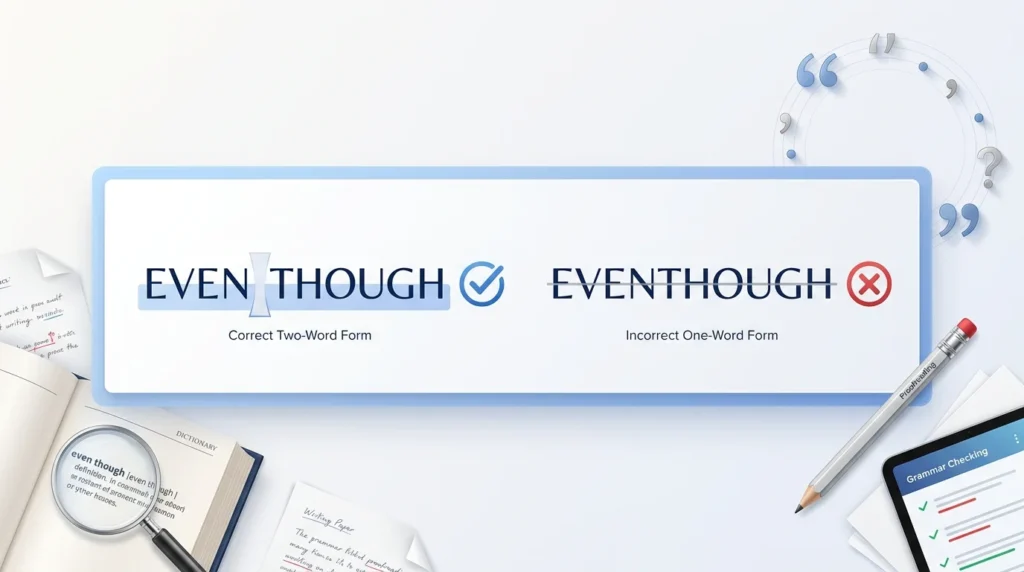

Even though is correct. Eventhough is not the standard English spelling and should be avoided in school, professional, academic, and other polished writing. Even though is a subordinating conjunction used to introduce a contrasting or unexpected fact, usually followed by a subject and verb: “Even though it was raining, we went outside.”
What Is the Difference Between Eventhough and Even Though?
The difference is mainly spelling, but understanding the grammar behind even though makes the correct form easier to remember.
Even though consists of two separate words:
- even — adds emphasis
- though — introduces a contrast
Together, even though means something close to “although,” “despite the fact that,” or “in spite of the fact that.” It connects two ideas when the second idea is surprising or happens despite the first fact.
For example:
Even though Maya was tired, she finished her assignment.
Being tired would normally make finishing an assignment more difficult. The phrase even though highlights that contrast.
By contrast, eventhough is not the standard spelling of this expression. It may appear in online writing, messages, comments, or other informal material, but seeing it written as one word does not make it an accepted alternative.
The easiest comparison is:
| Form | Correct? | Explanation |
|---|---|---|
| even though | ✅ Yes | Standard English |
| eventhough | ❌ No | Nonstandard spelling/misspelling |
The important point is that even though is not simply a preference between two spelling styles. You should not choose eventhough for casual writing and even though for formal writing. The standard form remains even though regardless of register.
Why Does This Difference Matter?
A one-word spelling mistake may look minor, but it can affect how polished your writing appears.
Consider these sentences:
❌ I went to work eventhough I was sick.
✅ I went to work even though I was sick.
The meaning is still understandable in the first sentence, but the spelling is incorrect in standard English. In an email to a client, school assignment, application, report, article, or professional document, that small error can make the writing look less carefully edited.
This is especially important because eventhough feels believable. When spoken quickly, even though can sound like a tightly connected unit. Writers may therefore spell it the way they hear it.
The mistake is also easy to overlook during proofreading because the sentence still makes perfect sense.
Correct spelling matters most when the reader expects standard written English. Examples include:
- Job applications and resumes
- School and university assignments
- Professional emails
- Business reports
- Website content
- Academic writing
- Formal letters
- Exams
- Published articles
The good news is that this is an easy mistake to eliminate once you remember one rule: keep “even” and “though” separate.
The Core Rule
RULE: Always write the expression as “even though” — two separate words.
Use even though + subject + verb to introduce a dependent clause that contrasts with the main clause.
For example:
Even though the road was crowded, we arrived on time.
The structure is:
Even though + subject + verb, main clause
You can also reverse the order:
We arrived on time even though the road was crowded.
The spelling does not change when the position changes.
The easiest way to remember it
Think of though as an independent word that already exists:
though
Then add even to strengthen the contrast:
even + though
You do not need to combine them into a new word.
How to Use “Even Though”
Even though is a subordinating conjunction. In simple terms, that means it introduces a dependent clause and connects it to a main clause.
A dependent clause contains a subject and verb but depends on another clause to form a complete idea.
For example:
Even though she was nervous, she gave the presentation.
The dependent clause is:
Even though she was nervous
The main clause is:
she gave the presentation.
The two ideas contrast because nervousness might normally prevent someone from giving a confident presentation, yet she did it anyway.
“Even though” at the beginning of a sentence
When the even though clause comes first, a comma normally follows it.
Even though it was late, we continued working.
Even though he had little experience, he got the position.
Even though the restaurant was busy, we found a table.
Even though I disagreed with her, I respected her opinion.
The comma separates the introductory dependent clause from the main clause.
“Even though” after the main clause
When the main clause comes first, a comma is normally unnecessary.
We continued working even though it was late.
He got the position even though he had little experience.
We found a table even though the restaurant was busy.
I respected her opinion even though I disagreed with her.
This is one of the most useful punctuation patterns to remember.
Correct Examples of “Even Though”
Here are examples from different types of everyday and professional writing.
Conversation
Even though I was exhausted, I stayed up to talk to my brother.
This sounds natural when explaining why you did something despite a difficult condition.
Text Message
I went anyway even though you told me not to.
The expression works perfectly well in casual digital communication.
Social Media
Even though the trip was short, it gave me some great memories.
The phrase can introduce an unexpected positive result.
Even though the deadline was tight, our team completed the project on time.
This is appropriate in professional communication.
Workplace
We approved the proposal even though several details still need clarification.
Here, even though introduces information that contrasts with the decision.
School Assignment
Even though the experiment failed, the results provided useful information.
The failure did not prevent the experiment from being valuable.
Academic Writing
Even though the sample size was relatively small, the findings suggest a possible relationship between the variables.
The construction works in formal writing when the relationship between the two ideas is clear.
Interview
Even though I had no previous management experience, I successfully led the project.
This can help explain an achievement despite a limitation.
Personal Writing
Even though we had very little time together, I will always remember that summer.
The phrase emphasizes the contrast between limited time and a lasting effect.
Everyday English
She went for a walk even though it was freezing outside.
The cold weather would normally discourage the activity.
Incorrect vs. Correct
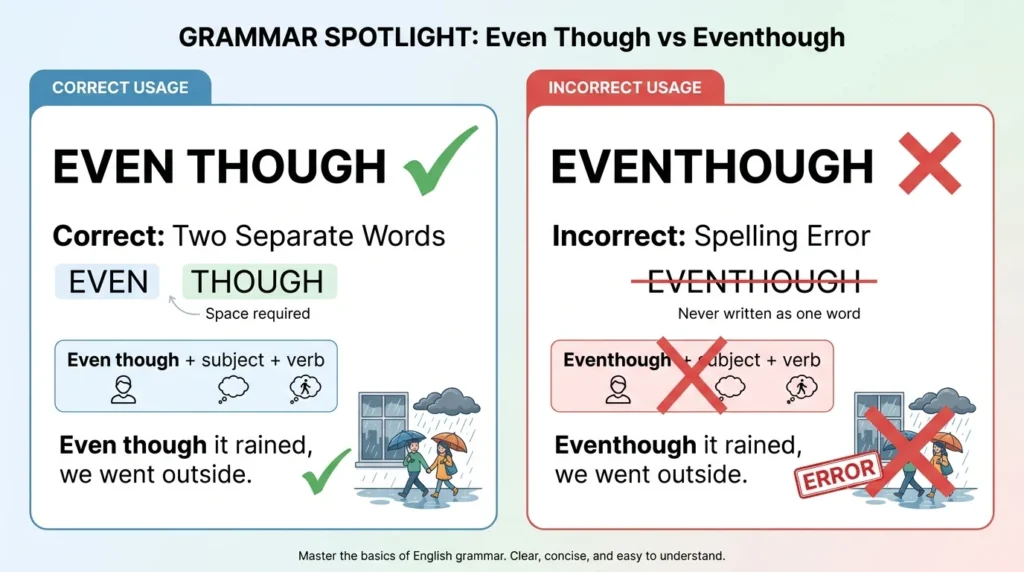
| ❌ Incorrect | ✅ Correct | Why |
|---|---|---|
| Eventhough I was tired, I kept working. | Even though I was tired, I kept working. | The standard expression has two words. |
| I went outside eventhough it was raining. | I went outside even though it was raining. | Eventhough is not the standard spelling. |
| Eventhough she was nervous, she spoke clearly. | Even though she was nervous, she spoke clearly. | Separate even and though. |
| He smiled eventhough he was upset. | He smiled even though he was upset. | The phrase remains two words in all contexts. |
| Eventhough the test was difficult, I passed. | Even though the test was difficult, I passed. | The conjunction is spelled even though. |
| We stayed eventhough everyone else left. | We stayed even though everyone else left. | The one-word form is incorrect. |
| Eventhough they disagreed, they worked together. | Even though they disagreed, they worked together. | The contrast is introduced by even though. |
| She attended eventhough she felt sick. | She attended even though she felt sick. | Correct the spelling, not the meaning. |
| Eventhough the price increased, demand remained strong. | Even though the price increased, demand remained strong. | Use the standard two-word form. |
| I enjoyed it eventhough it was expensive. | I enjoyed it even though it was expensive. | Even though introduces the contrasting clause. |
Notice that the problem in these sentences is not usually the meaning. Readers can understand what the writer intended. The problem is the spelling of the conjunction.
Why Do People Write “Eventhough”?
The mistake is understandable because English contains many compound words.
Words such as although, whenever, everywhere, and sometimes are written as single words. That can make learners wonder whether even though has also become one word.
It has not.
Phonetic similarity
When people speak quickly, word boundaries can become less obvious.
Even though
may sound like one connected sound rather than two clearly separated words.
If someone learns English mainly through listening, they may naturally reproduce the sound as:
eventhough
This is a spelling issue caused partly by the difference between spoken and written English.
Spelling overlap
The beginning of even though can visually resemble a single longer word. Because even ends in a consonant sound and though begins immediately afterward, the phrase can feel tightly connected.
Overgeneralization
English learners often discover that common expressions eventually become compound words. They may apply that pattern too broadly.
For example, they may think:
If these words are commonly used together, perhaps they should be joined.
That reasoning does not work for every phrase.
Autocomplete and spellcheck
Typing tools do not always prevent mistakes. A sentence can remain understandable even when one word is incorrectly formed, and not every typing environment catches every nonstandard expression immediately.
Spellcheck should therefore be treated as a helpful tool, not as a substitute for knowing the basic spelling.
Translation interference
Learners who speak another language may mentally map a single-word expression from their first language onto English. If the equivalent concept is written as one word in another language, eventhough may feel more natural.
The safest approach is to learn the English expression as a fixed form:
even though
Also Read: SS Meaning in Text Messages: Simple Explanation You Need To Know
Common Mistakes Checklist
Mistake 1: Joining the two words
❌ Eventhough I was busy, I answered the call.
✅ Even though I was busy, I answered the call.
Why it happens: The phrase can sound connected when spoken.
How to avoid it: Memorize even though as two words.
Mistake 2: Thinking “eventhough” is informal
It is not simply an informal version of even though.
If you want a more conversational alternative, though can sometimes work depending on the sentence.
I was tired, though I finished the work.
But that does not turn eventhough into a valid spelling.
Mistake 3: Using the wrong punctuation
❌ Even though I was tired I finished the report.
✅ Even though I was tired, I finished the report.
When the introductory dependent clause comes first, a comma normally separates it from the main clause.
Mistake 4: Confusing “even though” with “even if”
These expressions are related but not identical.
Even though generally introduces something presented as a fact.
Even though it was raining, we went outside.
Even if introduces a condition, whether it happens or not.
Even if it rains, we will go outside.
Cambridge specifically distinguishes even though from even if: even if has the sense of “whether or not.”
Mistake 5: Confusing “even though” with “despite”
The grammar after them is different.
Even though she was tired, she continued working.
Despite being tired, she continued working.
You normally use even though + clause, while despite + noun phrase or -ing form.
“Even Though” in Real English
Grammatically correct
Even though the meeting started late, we finished everything on the agenda.
This is standard and natural. Even though introduces a full clause containing a subject and verb, and the contrast is clear.
Grammatically possible but less natural
A sentence can be technically understandable yet feel unnecessarily complicated if the writer uses even though where a simpler construction would communicate the same idea more directly.
For example, if the contrast is already obvious from the surrounding sentence, repeating a long concessive clause may make the writing heavier than necessary. Good editing is not only about grammatical correctness; it is also about choosing the clearest structure for the context.
Natural everyday English
I went even though I didn’t really feel like it.
This is a natural conversational pattern because even though efficiently explains why the action was unexpected or contrary to the speaker’s feelings.
The important distinction is that “eventhough” is not an alternative natural spoken form. The words may sound closely connected in speech, but standard writing keeps them separate.
American vs. British English
There is no meaningful American-versus-British spelling difference between even though and eventhough.
In both American and British standard English, the correct form is:
even though
The punctuation and surrounding grammar can vary according to broader style preferences, but neither major English variety treats eventhough as the standard spelling of this conjunction.
So you do not need to remember an American version and a British version. One form works for both:
Even though it was difficult, she continued.
Also Read: LMBO Meaning in Text Explained: Full Guide, Uses, Examples & Slang Meaning
Formal vs. Informal Usage
Even though is versatile. It can appear in casual conversation, text messages, professional writing, academic work, and formal documents.
Examples:
Informal:
I went even though I didn’t want to.
Professional:
Even though the schedule was revised, the project remained on track.
Academic:
Even though the initial results were inconclusive, the subsequent analysis revealed a significant pattern.
The phrase itself does not make a sentence informal. The overall vocabulary, sentence structure, and context determine the level of formality.
If you want a shorter alternative in some contexts, though or although may work. Though is particularly common in speech, while although is often more common in writing.
Even Though vs. Although vs. Though vs. Despite
These expressions overlap in meaning, but their grammar and emphasis are not identical.
| Expression | What normally follows? | Main function | Example |
|---|---|---|---|
| even though | Subject + verb | Strong contrast/concession | Even though she was tired, she worked. |
| although | Subject + verb | Contrast/concession | Although she was tired, she worked. |
| though | Subject + verb | Contrast; often conversational | Though she was tired, she worked. |
| despite | Noun phrase / -ing form | Contrast/concession | Despite being tired, she worked. |
| in spite of | Noun phrase / -ing form | Contrast/concession | In spite of being tired, she worked. |
| even if | Subject + verb | Hypothetical condition | Even if she is tired, she will work. |
The biggest grammar distinction is between even though and despite.
Compare:
Even though he was inexperienced, he got the job.
and:
Despite his lack of experience, he got the job.
The meaning is similar, but the structures differ.
You should not normally write:
❌ Despite he was inexperienced, he got the job.
Instead, use:
✅ Even though he was inexperienced, he got the job.
Or:
✅ Despite being inexperienced, he got the job.
Even Though vs. Even If
This is one of the most useful distinctions to understand.
Even though = a fact
Even though Sarah was tired, she finished the report.
The sentence presents Sarah’s tiredness as a real situation.
Even if = a possibility or condition
Even if Sarah is tired, she will finish the report.
The speaker is considering a condition. Sarah may or may not be tired.
A simple memory trick is:
though = despite a fact
if = despite a possibility
This distinction is important because replacing one with the other can change the meaning of a sentence.
Can You Start a Sentence With “Even Though”?
Yes.
Starting a sentence with even though is completely standard.
Even though the weather was poor, the event continued.
Even though I had studied carefully, the question surprised me.
Even though the instructions looked simple, the task was difficult.
When the even though clause comes first, a comma normally follows the dependent clause.
You can also put the clause after the main clause:
The event continued even though the weather was poor.
Both structures are grammatically correct.
Also Read: Confused About PPL Meaning in Text? Here’s the Clear Answer
Real-Life Situations
In a job interview
Even though I was new to the industry, I learned the software quickly.
The candidate acknowledges a limitation while emphasizing a positive result.
In a business meeting
Even though the original proposal was rejected, the team developed a stronger alternative.
The phrase clearly connects the setback with the later outcome.
In an email
Even though we received the documents late, we were able to complete the review today.
This gives the reader useful context without sounding overly dramatic.
In a text message
I’ll come even though I’m really tired.
The construction works naturally in casual communication.
In an exam
Even though the question was challenging, the student answered it correctly.
This is appropriate in formal educational writing.
In an essay
Even though technology has improved communication, it has also created new challenges.
The phrase is useful when presenting a balanced argument.
How to Remember “Even Though”
Use this simple memory rule:
Even + though = two words.
Do not try to memorize eventhough as a possible alternative. Instead, train yourself to recognize the phrase as:
even / though
Another useful trick is to replace it temporarily with although.
If your sentence works with although, you are probably dealing with the conjunction even though:
Even though it was expensive, I bought it.
Although it was expensive, I bought it.
The replacement does not mean the two expressions are always identical in emphasis, but it can help you recognize the grammatical structure.
A Simple Editing Test
When proofreading, search your document for:
eventhough
If you find it, replace it with:
even though
Then check the punctuation around the clause.
For example:
❌ Eventhough the product was expensive we purchased it.
Correct both issues:
✅ Even though the product was expensive, we purchased it.
This two-step check catches both the spelling problem and a common punctuation problem.
Quick Practice Quiz
Choose the correct option.
- ___ it was raining, they played outside.
A. Eventhough
B. Even though - I went to the meeting ___ I felt sick.
A. even though
B. eventhough - ___ she was nervous, she gave a great presentation.
A. Eventhough
B. Even though - We finished the project ___ the deadline was very short.
A. even though
B. eventhough - Which sentence is correct?
A. Eventhough he was late, he joined the meeting.
B. Even though he was late, he joined the meeting.
Answers
- B — Even though
- A — even though
- B — Even though
- A — even though
- B — Even though
Frequently Asked Questions
Is “eventhough” one word?
No. Eventhough is not the standard English spelling. The correct form is even though, written as two words.
Which is correct: eventhough or even though?
Even though is correct. Use it in standard English writing.
Is “eventhough” ever acceptable?
You may encounter eventhough online or in informal user-generated writing, but its appearance does not make it a standard spelling. For correct English, use even though.
Does “even though” mean “although”?
Yes, they can have the same basic concessive meaning. Even though often adds stronger emphasis to the contrast.
Can “even though” begin a sentence?
Yes.
Even though I was tired, I continued working.
This is a normal grammatical construction.
Do you need a comma before “even though”?
It depends on its position. When the even though clause comes first, a comma normally follows it:
Even though it was late, we continued.
When the main clause comes first, a comma is generally unnecessary:
We continued even though it was late.
Is “even though” formal or informal?
It works in both formal and informal English. The surrounding sentence determines the overall register.
What is the difference between “even though” and “even if”?
Even though generally introduces a real or presented fact, while even if introduces a condition or possibility.
Even though it rained, we went out.
Even if it rains, we will go out.
What is the difference between “even though” and “despite”?
Even though normally introduces a clause:
Even though she was tired, she worked.
Despite normally comes before a noun phrase or an -ing form:
Despite being tired, she worked.
Can I use “though” instead of “even though”?
Often, yes, but the emphasis can change. Even though generally makes the contrast stronger. Though can sound more conversational.
Why does “eventhough” look correct?
It likely feels natural because the two words are frequently spoken together and can sound closely connected. English also contains many genuine compound words, so writers may assume this phrase works the same way. It does not.
Quick Summary
Even though is the correct standard form, and eventhough should be treated as a spelling error. Even though is a subordinating conjunction used to connect a contrasting or unexpected fact with a main idea. It can appear at the beginning or middle of a sentence. When the even though clause comes first, a comma normally follows it; when it comes after the main clause, a comma is usually unnecessary. Even though works in casual, professional, and academic English. Remember the simplest rule: even + though = two words. Do not join them together as eventhough.
Also Read: THO Meaning in Text Explained – Simple Definition & Real Examples