

If you are wondering whether the correct spelling is choosing or chosing, the answer is simple: choosing is correct, while chosing is a misspelling.
The confusion usually comes from the verb choose and its other forms. When choose becomes an -ing form, the final silent e is removed, but the two o’s remain:
choose → choos + ing → choosing
You should not form choosing from chose, which is the simple past form of choose. That is why chosing is incorrect.
This small spelling difference matters in emails, school assignments, resumes, professional writing, websites, and everyday communication. Once you understand how the word is formed, it becomes much easier to spell correctly every time.
Quick Answer
Choosing is the correct spelling. Chosing is incorrect in standard English. Choosing is the -ing form of the verb choose, meaning selecting something, deciding between possibilities, or picking an option. To spell it correctly, start with choose, remove only the final e, and add -ing: choose → choosing. The two o’s stay in the word.
What Is Choosing?
Choosing is the standard -ing form of the verb choose. It refers to the act of selecting, deciding, or picking one person, thing, action, or possibility from available options.
The base verb choose means to decide what you want from two or more possibilities. For example:
- I need to choose a new laptop.
- She has to choose between two universities.
- They will choose a winner tomorrow.
When the action is presented as ongoing, the -ing form is used:
- I am choosing a new laptop.
- She is choosing between two universities.
- They are choosing a winner.
Cambridge identifies choosing as the present participle of choose, while choose itself means deciding what you want from two or more things or possibilities.
The word choosing can also appear in a sentence where the -ing form behaves in a noun-like way:
Choosing the right career takes time.
Here, choosing the right career refers to the activity or process of making that decision.
So, choosing is not a separate word unrelated to choose. It is one of the grammatical forms of the same verb.
The important point is that the spelling is always:
C-H-O-O-S-I-N-G
Not:
C-H-O-S-I-N-G
The second version drops one of the two o’s, which is why chosing is considered a spelling mistake.
Why It Matters
At first, the difference between choosing and chosing may seem too small to matter. After all, they are pronounced very similarly. However, spelling errors can affect how polished and trustworthy your writing appears.
In a casual text message, a reader may understand chosing immediately. That does not make it a correct spelling. In more formal situations, the error becomes much more noticeable.
For example, compare these sentences:
We are choosing a new supplier for the company.
and
We are chosing a new supplier for the company.
The meaning is clear in both sentences, but only the first follows standard English spelling.
This matters particularly in:
- Job applications and resumes
- Business emails
- Academic assignments
- Reports and presentations
- Website content
- Professional documents
- Exams
- Formal letters
- Published articles
Correct spelling also helps when you are learning related forms of a word. If you understand choose → choosing, it becomes easier to understand why chose and chosen are different forms rather than spelling variations.
The goal is therefore not simply to memorize one word. It is to understand the word family well enough that the correct form becomes automatic.
Also Read: Quieter vs More Quiet: Which Is Correct?
The Core Rule
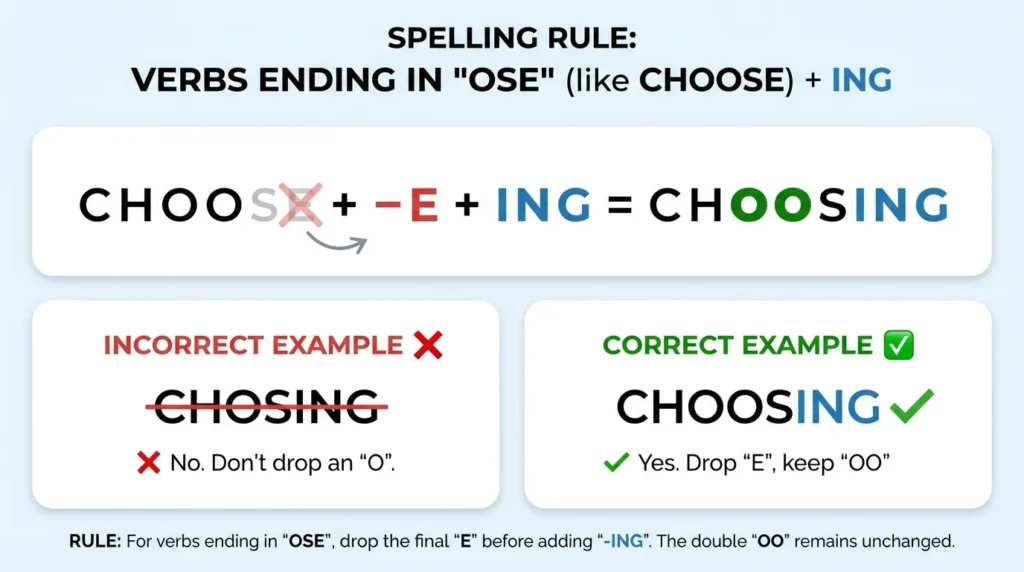
Rule: The correct -ing form of “choose” is “choosing.” Remove the final e from “choose,” but keep both o’s.
The formation is:
choose → choos → choosing
The final e disappears before -ing.
The oo does not disappear.
This follows the general spelling pattern in which many verbs ending in a final silent e drop that e before adding -ing. For example:
| Base Verb | -ing Form |
|---|---|
| make | making |
| write | writing |
| use | using |
| lose | losing |
| move | moving |
| choose | choosing |
Cambridge’s spelling guidance states that when a verb ends in -e, the e is generally dropped before -ing.
The important detail is that you remove only the final e.
So:
CHOOSE – E + ING = CHOOSING
Not:
CHOSE + ING = CHOSING
That second approach is where much of the confusion comes from.
How to Use Choosing
Choosing can be used in several common grammatical situations.
1. With a form of “be”
One of the most common uses is in a progressive verb construction:
I am choosing a new phone.
She is choosing her university courses.
We are choosing the final design.
They were choosing between several candidates.
Here, choosing describes an action that is happening or was happening around a particular time.
2. As a noun-like -ing form
An -ing form can also refer to an activity or process:
Choosing a career can be difficult.
Choosing the right words is important.
Choosing carefully can save money.
In these examples, choosing refers to the activity itself.
3. After certain words and structures
The -ing form can naturally appear after a preposition:
Think carefully before choosing.
She left without choosing anything.
They talked about choosing a new location.
The spelling remains choosing regardless of its grammatical role.
4. In questions
You can also use choosing in questions:
What are you choosing?
Why are you choosing that option?
Are you choosing between these two?
Have you decided what you are choosing?
The key is always the same: choose becomes choosing, not chosing.
Also Read: Eventhough vs Even Though: Which Is Correct?
Correct Examples
Here are examples showing how choosing works in different real-life settings.
Everyday conversation
- I’m choosing between pizza and pasta tonight.
- Are you choosing the blue one or the black one?
Text messages and social media
- I’m still choosing what to wear tonight.
- Choosing a profile picture is harder than it looks.
School
- Choosing the right subjects can affect your future plans.
- She is choosing a topic for her research project.
University
- Students should think carefully before choosing a major.
Workplace
- We are choosing a new software provider this week.
- The hiring committee is choosing between three finalists.
Business email
- Thank you for choosing our company for your project.
Academic writing
- Choosing an appropriate research method is an important part of the study.
Formal writing
- The committee spent several weeks choosing the most suitable candidate.
All of these examples use the same spelling: choosing.
Incorrect vs. Correct
| ❌ Incorrect | ✅ Correct | Why |
|---|---|---|
| I am chosing a new phone. | I am choosing a new phone. | Choosing is the correct -ing form of choose. |
| She is chosing a dress. | She is choosing a dress. | The two o’s from choose remain. |
| We are chosing a restaurant. | We are choosing a restaurant. | Remove only the final e from choose. |
| He is chosing between two jobs. | He is choosing between two jobs. | Chosing is a spelling error. |
| They are chosing a winner. | They are choosing a winner. | The correct form is choose + -ing. |
| Thank you for chosing us. | Thank you for choosing us. | The preposition for can be followed by an -ing form. |
| Chosing a career takes time. | Choosing a career takes time. | The activity is expressed with choosing. |
| She kept chosing the same option. | She kept choosing the same option. | The correct -ing form is choosing. |
| We had difficulty chosing a date. | We had difficulty choosing a date. | The word retains both o’s. |
| Before chosing a college, research it carefully. | Before choosing a college, research it carefully. | Choosing follows before here. |
The important lesson is that chosing is not an alternative spelling. It is simply an incorrect form of choosing.
Why People Make This Mistake
The mistake is understandable because several different forms of the verb choose look and sound related.
The word family includes:
- choose — base form
- chooses — third-person singular present
- choosing — -ing form
- chose — simple past
- chosen — past participle
- choice — noun
The biggest source of confusion is probably chose.
Look at these:
I choose the blue shirt.
I chose the blue shirt yesterday.
I am choosing the blue shirt now.
The past form chose has only one o after the ch, while choose has two.
A writer may remember chose and then incorrectly create:
chose + ing → chosing
But English does not form the -ing version from the past tense.
It forms it from the base verb:
choose → choosing
Pronunciation can also contribute to the mistake. English spelling is not always predictable from sound alone, and vowel combinations can create uncertainty for learners. Double letters and vowel clusters are recognized sources of English spelling errors.
Fast typing, autocorrect habits, and visual familiarity can make the error even easier to overlook.
Common Mistakes Checklist
1. Writing “chosing”
Mistake:
I am chosing a new car.
Why it happens: The writer removes one of the two o’s.
Fix: Remember:
choose → choosing
2. Building the word from “chose”
Mistake:
chose → chosing
Why it happens: Chose is the past form and looks like a shortened version of choose.
Fix: Build the -ing form from choose, not chose.
3. Writing “chooseing”
Mistake:
She is chooseing a dress.
Why it happens: The writer keeps the final e before adding -ing.
Fix:
choose – e + ing = choosing
4. Confusing “chosen” and “choosing”
Mistake:
She is chosen a dress.
Correct:
She is choosing a dress.
Why: Choosing describes the ongoing selection. Chosen is the past participle.
5. Using “choice” as a verb
Mistake:
I will choice the blue option.
Correct:
I will choose the blue option.
Why: Choice is normally a noun, while choose is the verb.
6. Assuming “chosing” is an informal version
It is not. Chosing is not a standard casual spelling of choosing. You may encounter it in online writing, but seeing a misspelling does not make it an accepted alternative.
Choosing in Real English
The most important real-English point is that choosing is completely normal in both everyday and formal English.
Natural and everyday
I’m choosing a movie for tonight.
This sounds natural because someone is describing an active decision.
Grammatically correct but context-dependent
I am choosing coffee every morning.
This can be grammatical, but if the intended meaning is a regular habit, I choose coffee every morning will usually be the more straightforward choice. The simple present is commonly used for habits, while the progressive form focuses on an action in progress or a temporary situation.
Natural after a preposition
Think carefully before choosing.
This is a normal construction because before can be followed by an -ing form.
Natural in formal writing
Choosing an appropriate methodology is essential to the study.
There is nothing informal about choosing. It works in academic, professional, and everyday English.
Natural with “to”
She is choosing to remain silent.
Here, choosing to + verb means deciding to do something. The important point is that the spelling remains choosing.
Less natural only because of context
I am choosing my favorite color every day.
The spelling is correct, but the sentence may sound unusual if the intended meaning is a repeated habit. A more natural sentence would depend on the intended meaning:
I choose my favorite color every day.
or:
I am choosing my favorite color for the project today.
The spelling question and the naturalness question are therefore separate. Choosing can be correctly spelled even when a different tense or construction would make a particular sentence more natural.
Choosing vs. Chosing: Comparison Table
| Feature | Choosing | Chosing |
|---|---|---|
| Standard English? | Yes | No |
| Correct spelling? | Yes | No |
| Base verb | Choose | Incorrectly based on a mistaken form |
| -ing form | Yes | No |
| Meaning | Selecting or deciding | No standard meaning |
| Used in formal writing | Yes | No |
| Used in informal writing | Yes | Not as a standard form |
| Contains “oo” | Yes | No |
| Example | She is choosing a dress. | She is chosing a dress. ❌ |
The comparison is straightforward: choosing is the only standard form of the two.
Choosing vs. Choose vs. Chose vs. Chosen
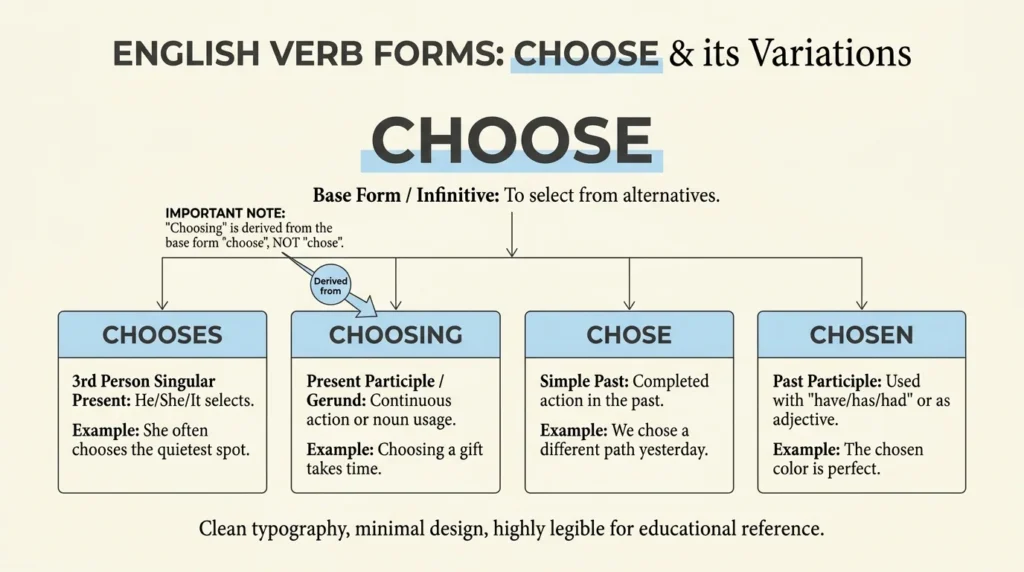
Understanding the whole verb family is one of the easiest ways to stop making this spelling mistake.
| Form | Grammatical Role | Example |
|---|---|---|
| choose | Base verb | I will choose later. |
| chooses | Present-tense form with he/she/it | She chooses carefully. |
| choosing | -ing form | She is choosing carefully. |
| chose | Simple past | She chose the blue one. |
| chosen | Past participle | She has chosen the blue one. |
| choice | Noun | That was a difficult choice. |
Notice the pattern:
choose → choosing
but:
choose → chose → chosen
The past forms are irregular, which is why you should not try to create choosing from chose.
Cambridge lists chose as the past tense and chosen as the past participle of choose.
American vs. British English
There is no meaningful American-versus-British spelling difference between choosing and chosing.
Both major varieties use:
choosing
American English:
She is choosing a new apartment.
British English:
She is choosing a new flat.
The vocabulary may differ in the second sentence, but the spelling of choosing does not.
Unlike words such as color/colour or center/centre, choosing does not have a standard British spelling that changes the number of o’s.
So you do not need to remember two versions.
Just remember:
choosing = correct
chosing = incorrect
Formal vs. Informal Usage
Choosing is appropriate in virtually every register.
Informal
I’m choosing what to watch tonight.
Professional
We are choosing a new supplier for the project.
Academic
Choosing an appropriate sample is essential to the research.
Formal
The committee is responsible for choosing the successful applicant.
There is no need to replace choosing with another word simply because your writing is formal.
However, you can sometimes use selecting when you want a more technical or deliberate tone:
The researchers are selecting participants for the study.
Both choosing and selecting can be correct, but they are not always identical in nuance. Selecting can suggest a more deliberate process, especially when a set of criteria is involved.
Real-Life Situations
Job interview
If you are talking about a career decision:
I’m choosing this position because it gives me more opportunities to grow.
The word describes an active decision.
Workplace meeting
We need to finish choosing the software before Friday.
Here, choosing refers to the selection process.
Business email
Thank you for choosing our services.
This is a common professional use of the word.
Text message
I’m still choosing between the two restaurants.
The person has not made a final decision yet.
School assignment
Choosing a strong research question is the first step.
Here, choosing functions in a noun-like way.
Social media
Choosing a caption takes longer than writing the post.
Again, choosing refers to an activity.
Academic writing
The researchers explained their reasons for choosing the sample.
This is a formal but completely natural use.
An Easy Way to Remember the Spelling
Use this three-step memory method:
- Start with CHOOSE.
- Remove only the final E.
- Add ING.
That gives you:
CHOOSE → CHOOS → CHOOSING
The easiest visual reminder is:
The final E goes; the OO stays.
So:
choose → choosing ✅
not:
chose → chosing ❌
Another useful comparison is:
lose → losing
You do not write losing as losing by removing one of the internal letters. You simply remove the final e.
The same basic spelling principle applies to choose.
Also Read: Kissed Horizontally Meaning: Full Explanation & Context 2026
Quick Test: Can You Get It Right?
Complete each sentence with the correct form.
- She is ______ a new laptop.
- We need to finish ______ a venue.
- Yesterday, he ______ the blue shirt.
- They have ______ their final candidate.
- ______ the right words can be difficult.
- Think carefully before ______.
- I usually ______ the cheaper option.
- She is ______ between two universities.
- Thank you for ______ our company.
- He ______ to stay home last night.
Answers
- choosing
- choosing
- chose
- chosen
- Choosing
- choosing
- choose
- choosing
- choosing
- chose
The test highlights an important point: choosing, choose, chose, and chosen are different forms of the same verb. The correct form depends on the grammatical structure and time of the action.
How to Check Yourself in Seconds
If you are unsure whether to write choosing or chosing, do not rely on how the word sounds.
Instead, go back to the base verb:
choose
Now remove the final e:
choos
Then add -ing:
choosing
If you remember only one formula from this article, make it this:
CHOOSE − E + ING = CHOOSING
This method is more reliable than trying to remember whether the word “looks right.”
It also helps you avoid the related error chooseing, because the formula clearly shows that the final e must disappear.
FAQ
Is “chosing” a correct spelling?
No. Chosing is a misspelling. The correct standard English form is choosing.
Why does choosing have two o’s?
Because the base verb is choose. When the final e is removed before adding -ing, the internal oo remains:
choose → choos → choosing
Is “choosing” a verb?
It is the -ing form of the verb choose. Depending on how it is used in a sentence, it can function as part of a verb phrase or in a noun-like construction. Cambridge identifies choosing as the present participle of choose.
Is “chooseing” correct?
No. Chooseing is also incorrect. The final e in choose is removed before -ing is added.
Correct:
choose → choosing
What is the past tense of choose?
The simple past tense is chose.
She chose the red dress yesterday.
What is the past participle of choose?
The past participle is chosen.
She has chosen the red dress.
What is the difference between choosing and chose?
Choosing is the -ing form, while chose is the simple past form.
I am choosing a book.
I chose a book yesterday.
What is the difference between choosing and chosen?
Choosing normally describes an ongoing selection or the activity of selecting. Chosen is the past participle.
They are choosing a winner.
They have chosen a winner.
Is choosing formal or informal?
Both. Choosing is standard English and can be used in casual conversations, professional emails, academic writing, and formal documents.
Is “chosing” acceptable in texting?
It may appear as a typo in casual messages, but it is not a standard alternative spelling. If you want correct English, use choosing.
How do I remember choosing?
Remember:
CHOOSE − E + ING = CHOOSING
The final e disappears, but the oo stays.
Is “choice” the same as “choose”?
No. Choose is a verb, while choice is normally a noun.
You must choose one.
You have a choice.
Cambridge similarly distinguishes choose as a verb from choice as a noun.
Quick Summary
Choosing is the correct spelling, while chosing is a misspelling. The word comes from the verb choose, meaning to select or decide between possibilities. To form its -ing form, remove only the final silent e and add -ing: choose → choos + ing → choosing. The two o’s remain. Do not create choosing from chose, because chose is the simple past form of choose. Choosing works naturally in casual, professional, academic, and formal English. It can describe an ongoing action, such as “She is choosing a dress,” or an activity, such as “Choosing carefully takes time.” The simplest memory rule is: the final E goes; the OO stays.