
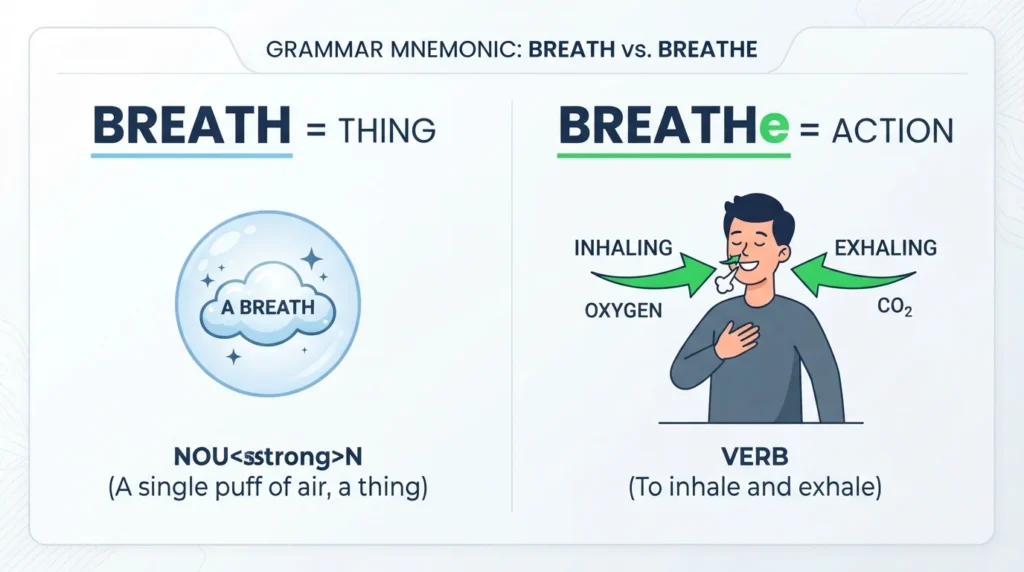

Breath is a noun that refers to the air you take in or let out, or to one act of breathing. Breathe is a verb that describes the action of taking air into your lungs and letting it out. Use breath in phrases such as “take a deep breath” and breathe in sentences such as “remember to breathe slowly.” The extra e in breathe also changes its pronunciation.
What Is the Difference Between Breath and Breathe?
The difference between breath and breathe is mainly grammatical.
Breath is a noun. It names the air involved in breathing or a single act of breathing.
Breathe is a verb. It describes the action of taking air into and out of your lungs.
The words are closely related, which is why they are easy to confuse. They differ by only one letter, but that final e changes both the word’s grammatical function and its pronunciation.
Compare these sentences:
- Take a deep breath.
- Take a moment to breathe.
In the first sentence, breath names something you take. In the second, breathe describes an action.
A useful way to think about the difference is:
Breath = a thing or a single act.
Breathe = an action.
This distinction works in everyday conversation, professional writing, academic English, emails, social media, and most other forms of standard English.
Why It Matters
Confusing these words usually does not make your meaning impossible to understand, but it can make your writing look careless.
For example:
- ❌ I need to breath.
- ✅ I need to breathe.
The first sentence uses a noun where a verb is required.
Another common mistake is:
- ❌ Take a deep breathe.
- ✅ Take a deep breath.
Here, breathe is a verb, but the sentence needs a noun after a deep.
These errors are particularly noticeable because breath and breathe are common words. They can appear in emails, essays, instructions, captions, messages, workplace documents, and creative writing.
The good news is that you do not need to memorize dozens of complicated rules. Once you understand the noun-versus-verb distinction, most cases become straightforward.
The Core Rule
Use “breath” when you need a noun. Use “breathe” when you need a verb.
The easiest test
Ask yourself:
Am I naming something, or am I describing an action?
- A thing or one act → breath
- An action → breathe
For example:
She took a deep breath.
Here, breath is something she took.
She tried to breathe slowly.
Here, breathe describes what she tried to do.
Another quick test is to replace the word with inhale or exhale.
If inhale or exhale works naturally, you probably need breathe:
Please breathe slowly.
→ Please inhale/exhale slowly.
But:
Please take a breath.
You cannot replace breath with inhale without changing the grammatical structure.
How to Use Breath
Breath is a noun.
It commonly refers to:
- Air moving into or out of the lungs
- A single act of breathing
- A pause to recover normal breathing
- A small amount of air
- Breath as part of certain expressions and idioms
Common examples
Take a breath.
This means to take one act of breathing, often as a short pause.
I need a minute to catch my breath.
Here, breath refers to normal breathing after exertion or excitement.
He was out of breath after the race.
The expression out of breath describes someone who is breathing heavily or having difficulty returning to a normal breathing rhythm.
She held her breath underwater.
Here, breath refers to the air held in the lungs.
I could see my breath in the cold air.
Here, breath refers to the air coming from the lungs.
He spoke under his breath.
The expression under your breath means speaking very quietly.
Also read: Requester or Requestor
How to Use Breathe
Breathe is a verb.
It describes the action of moving air into and out of the lungs.
It can be used in several forms:
- breathe — present/base form
- breathes — third-person singular present
- breathed — past tense and past participle
- breathing — present participle
Examples:
I breathe slowly when I want to relax.
She breathes through her nose.
He breathed deeply before speaking.
They were breathing heavily after the workout.
Notice that breathe changes according to tense and subject because it is a verb.
There are also expressions where breathe has a broader meaning.
For example:
The manager needs to breathe new life into the project.
Here, breathe is being used figuratively to mean bringing new energy or vitality to something.
Don’t breathe a word about the surprise.
This expression means not to reveal or tell the secret.
Breath vs Breathe: Pronunciation
Spelling is not the only difference.
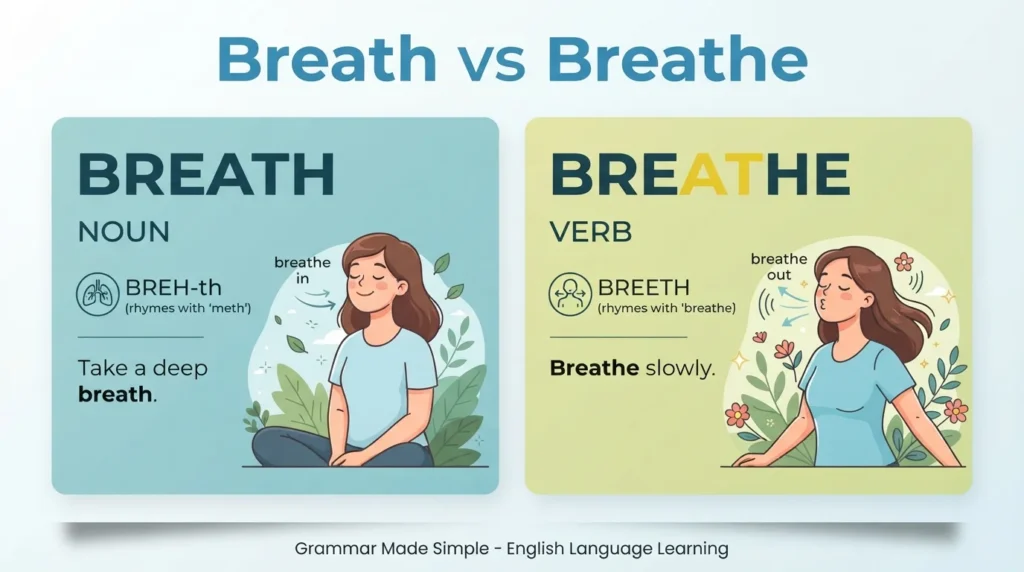
Breath is generally pronounced /breθ/. The vowel is short, and the final th has the unvoiced sound heard in words such as think.
Breathe is generally pronounced /briːð/. It has a long ee sound, and its final th is voiced, similar to the sound in this or they.
A simple comparison is:
| Word | Pronunciation | Rhymes approximately with | Part of speech |
|---|---|---|---|
| breath | /breθ/ | death | Noun |
| breathe | /briːð/ | seethe | Verb |
This pronunciation difference can help you identify the correct spelling when speaking or listening.
Correct Examples of Breath
Here are original examples showing how breath works in different situations:
- Conversation: “Give me a second to catch my breath.”
- Email: “I had to take a breath before responding to the difficult message.”
- School: “The swimmer held her breath during the final part of the exercise.”
- Workplace: “After presenting for an hour, the speaker paused to catch his breath.”
- Social media: “That mountain view literally took my breath away.”
- Academic writing: “A normal breath involves the movement of air into and out of the lungs.”
- Storytelling: “He took one deep breath before opening the door.”
- Everyday speech: “I could see my breath because it was so cold outside.”
- Description: “She spoke under her breath so nobody else could hear.”
- Instruction: “Take a slow breath before you continue.”
In each sentence, breath functions as a noun.
Also read: Hustle or Hussle
Correct Examples of Breathe
- Conversation: “Just breathe and try again.”
- Email: “Remember to breathe and take your time during the presentation.”
- School: “Fish use their gills to breathe underwater.”
- Workplace: “It can be difficult to breathe comfortably in a crowded room.”
- Social media: “Sometimes you just need to breathe and reset.”
- Academic writing: “Most humans breathe continuously without consciously controlling every breath.”
- Exercise: “Try to breathe steadily while walking uphill.”
- Everyday speech: “I can finally breathe normally again.”
- Instruction: “Breathe in slowly and breathe out through your mouth.”
- Creative writing: “She stopped to breathe before continuing her speech.”
In these examples, breathe describes an action.
Incorrect vs. Correct
| ❌ Incorrect | ✅ Correct | Why |
|---|---|---|
| I can’t breath. | I can’t breathe. | The sentence needs a verb describing an action. |
| Take a deep breathe. | Take a deep breath. | After “a deep,” the sentence needs a noun. |
| Remember to breath slowly. | Remember to breathe slowly. | “Remember to” is followed by a verb. |
| She took a deep breathe. | She took a deep breath. | A deep breath is the thing being taken. |
| He could hardly breath after running. | He could hardly breathe after running. | “Could” requires the base verb. |
| I held my breathe. | I held my breath. | “Held” takes the noun breath here. |
| Try to take a breathe. | Try to take a breath. | “A” signals a noun. |
| We need room to breath. | We need room to breathe. | “To” is followed by the base verb. |
| She was trying to breath normally. | She was trying to breathe normally. | “Trying to” requires a verb. |
| He was out of breathe. | He was out of breath. | “Out of breath” is the standard expression. |
Why Do People Confuse Breath and Breathe?
The confusion is understandable because the words are closely related in meaning and spelling.
Phonetic similarity
The two words contain almost the same sounds and letters. However, the vowel and final th sound differ.
Learners who primarily encounter the words in writing may not immediately connect the pronunciation difference with the spelling difference.
Spelling overlap
Breath and breathe share the letters b-r-e-a-t-h. The only spelling difference is the final e.
That makes typing errors particularly easy.
Overgeneralization
A learner may learn that both words relate to breathing and then assume they can be used interchangeably.
They cannot.
Knowing the meaning is not enough; you also need to identify the grammatical role of the word.
Autocomplete and spellcheck
Spellcheck tools can identify some spelling errors, but they do not always understand the intended meaning of a sentence.
For example, if you type:
I need to breath.
A writing tool may recognize the problem, but context-sensitive software is not a substitute for understanding the noun/verb distinction.
Translation interference
Some languages use one word or a different grammatical structure for ideas that English expresses with breath and breathe separately.
For English learners, translating word-for-word can therefore produce errors.
The safest approach is to learn common English patterns such as take a breath, hold your breath, catch your breath, and breathe deeply as complete expressions.
Common Mistakes Checklist
1. Writing “breath” after “to”
Mistake:
I need to breath.
Correct:
I need to breathe.
After to in this structure, English uses the base form of the verb.
2. Writing “breathe” after “a”
Mistake:
Take a deep breathe.
Correct:
Take a deep breath.
The article a is followed by the noun breath.
3. Confusing “out of breath”
The established expression is:
She was out of breath.
Not:
She was out of breathe.
The expression describes a state of having difficulty breathing normally.
4. Confusing “hold your breath”
The correct phrase is:
Hold your breath.
Not:
Hold your breathe.
Here, breath is the noun being held.
5. Writing “breathe” in “take a breath”
The correct phrase is:
Take a breath.
The verb take is followed by the noun breath.
6. Forgetting the final “e” in the verb
The correct form is:
Breathe slowly.
Not:
Breath slowly.
The missing e changes the word into the noun breath.
7. Adding an unnecessary “e” to the noun
The noun is:
breath
Not:
breathe
This is one of the most common spelling errors between the pair.
8. Misspelling “breathing”
The correct spelling is:
breathing
Not:
breatheing
When -ing is added to breathe, the final silent e is dropped.
9. Confusing “breathed” with “breath”
Compare:
He breathed deeply.
with:
He took a deep breath.
The first uses the past-tense verb. The second uses the noun.
10. Relying only on pronunciation
Pronunciation helps, but context is more reliable.
If you know whether the sentence needs a noun or verb, the spelling becomes much easier to choose.
Also Read: Incomplete or Uncomplete
Breath and Breathe in Real English
“Take a breath”
This is both grammatically correct and highly natural everyday English. It commonly appears when someone needs to pause, calm down, recover after exertion, or prepare to speak. The phrase is also common in instructions and supportive conversation because breath functions naturally as the noun after take a.
“Breathe slowly”
This is grammatically correct and natural when giving an instruction or describing controlled breathing. It commonly appears in exercise, relaxation, medical, and everyday contexts. Because breathe is an action verb, it works naturally after expressions such as try to, remember to, and need to.
“Catch your breath”
This is a standard and very natural English expression. It usually means pausing to recover normal breathing after physical activity, surprise, or another situation that leaves someone breathing hard. The phrase is fixed enough that learners should remember it as catch your breath, not catch your breathe.
“I need to breathe”
This is grammatically correct and completely natural. The structure need to + base verb makes breathe necessary. Replacing it with breath produces an incorrect sentence because breath cannot function as the verb in this construction.
“I need a breath”
This sentence is grammatically possible, but its naturalness depends on the intended meaning and context. In everyday English, speakers often choose I need to catch my breath, I need to take a breath, or I need some air when they mean they need a pause or easier breathing.
“Take a deep breath”
This is extremely natural everyday English. It can refer literally to inhaling deeply, but it is also commonly used as advice to pause before doing something difficult, stressful, or important. The noun breath is required because it follows the determiner a.
“Breathe in and breathe out”
This is natural instructional English. Breathe functions as a verb, while in and out indicate the direction of the air movement. In contrast, when you refer to the air or one act of breathing, you can use breath: Hold your breath before you breathe out.
“A breath of fresh air”
This is a natural fixed expression. Literally, it can refer to a small amount of fresh air, while figuratively it can describe someone or something refreshing or pleasantly different. The noun breath is part of the established expression, so breathe of fresh air is incorrect.
How to Remember Breath vs Breathe
Use this simple three-step method:
- Look for the grammar role.
If you need an action, use breathe. If you need a noun, use breath. - Look for nearby words.
“To breathe,” “can breathe,” “try to breathe,” and “will breathe” all point to the verb. “A breath,” “my breath,” “your breath,” and “the breath” point to the noun. - Listen to the vowel sound.
Breath has a shorter vowel sound. Breathe has the long ee sound.
A compact memory aid is:
Breath is the thing. Breathe is the action.
Common Expressions With Breath
The noun breath appears in many established expressions.
- Take a breath — pause and inhale.
- Take a deep breath — inhale deeply.
- Hold your breath — keep the air in your lungs without releasing it.
- Catch your breath — pause to recover normal breathing.
- Out of breath — breathing hard after exertion or excitement.
- Short of breath — having difficulty breathing normally.
- Under your breath — spoken very quietly.
- A breath of fresh air — literally fresh air; also something refreshing.
- Take someone’s breath away — greatly surprise, impress, or amaze someone.
- In the same breath — while saying or mentioning something at the same time.
Learning these expressions as complete phrases can reduce spelling mistakes because you become familiar with the natural pattern.
Common Expressions With Breathe
The verb breathe also appears in several useful expressions.
- Breathe in — move air into the lungs.
- Breathe out — expel air from the lungs.
- Breathe deeply — take deeper breaths.
- Breathe easily — breathe without difficulty; also used figuratively to mean feeling relieved.
- Breathe a sigh of relief — show or express relief.
- Breathe new life into something — give something new energy or vitality.
- Breathe down someone’s neck — watch or pressure someone closely.
- Don’t breathe a word — do not reveal information.
Some of these are literal, while others are idiomatic or figurative.
Also Read: Simpler vs More Simple
Breath vs Breathe Comparison Table
| Feature | Breath | Breathe |
|---|---|---|
| Part of speech | Noun | Verb |
| Main idea | Air or one act of breathing | The action of moving air |
| Final e | No | Yes |
| Common sound | Short “e” | Long “ee” |
| Example | Take a deep breath. | Breathe deeply. |
| Common phrase | Hold your breath. | Breathe in slowly. |
| Can it take “a”? | Yes: a breath | No: a breathe |
| Can it follow “to” as a base verb? | No | Yes |
| Past form | Not applicable as a verb | breathed |
| -ing form | Not applicable | breathing |
Breath vs Breathe in Real-Life Situations
In an interview
Before answering a difficult question, you might say:
“Let me take a breath before I answer.”
If you are describing the action, you could say:
“I took a moment to breathe before answering.”
Both words can appear in the same situation because they perform different grammatical jobs.
In a meeting
A manager might tell an employee:
“Take a breath and look at the problem again.”
Here, breath is the noun.
A training guide might say:
“Remember to breathe normally while presenting.”
Here, breathe is the verb.
In an email
Correct:
“I had to take a deep breath before replying to the customer.”
Incorrect:
“I had to take a deep breathe before replying to the customer.”
In a text message
A friend might write:
“Just breathe. Everything will be okay.”
The word is a verb because it describes what the person should do.
In an exam
A student might write:
“The athlete took a deep breath before beginning the race.”
That sentence uses breath correctly as a noun.
Breath, Breathe, Breathing, and Breathed
These related forms can create another layer of confusion.
Breath
Breath is the noun.
She took a deep breath.
Breathe
Breathe is the base verb.
Try to breathe slowly.
Breathing
Breathing is a form of the verb breathe.
He was breathing heavily.
Notice the spelling:
breathe → breathing
The final e is removed before -ing is added.
Breathed
Breathed is the past tense and past participle of breathe.
She breathed deeply before speaking.
The spelling changes differently here:
breathe → breathed
Understanding these forms helps prevent mistakes such as breatheing or using breath where a verb is required.
Does Breath Have a Plural Form?
Yes.
When breath refers to individual acts of breathing, it can have the plural form breaths.
Examples:
She took three slow breaths.
Take several deep breaths before starting.
However, when breath refers more generally to air or the concept of breathing, it can also be used as an uncountable noun depending on the context.
The important point is that breaths remains a noun.
Can Breathe Be Used in the Past Tense?
Yes.
The past tense is breathed.
Examples:
He breathed slowly before answering.
She breathed a sigh of relief.
They breathed in the cold morning air.
Do not change breathe into breath when talking about the past. The words remain grammatically different.
Is “Breathe” Always About the Lungs?
No.
The most familiar meaning involves inhaling and exhaling, but breathe can also appear in figurative and specialized uses.
For example:
The new director breathed life into the organization.
Here, nobody is literally using lungs to give the organization air. The expression means that someone brought new energy or vitality to it.
There are also specialized uses such as allowing wine to “breathe,” meaning exposing it to air for a period before drinking.
The main grammar rule remains unchanged: breathe is a verb.
Also Read: Taken vs Taking
Is “Breath” Always About Air?
Not necessarily.
Although its main meaning concerns air and breathing, breath appears in figurative expressions and can refer to a small amount or suggestion of something.
For example:
There wasn’t a breath of wind.
And:
The proposal offered a breath of fresh thinking.
In both cases, breath remains a noun.
This is why focusing only on the dictionary definition is not enough. Recognizing the grammatical role of the word is the more useful long-term skill.
American vs. British English
There is no major American-versus-British spelling distinction between breath and breathe. The standard spellings are the same in both varieties.
The core grammar is also the same:
- breath = noun
- breathe = verb
Pronunciation can vary slightly between individual speakers and accents, but this does not create a different spelling rule for American and British English.
Formal vs. Informal Usage
Both breath and breathe are standard words used across formal and informal English.
You can use them in:
- Academic writing
- Professional emails
- Reports
- School assignments
- Conversations
- Text messages
- Social media
- Creative writing
The words themselves do not belong specifically to formal or informal English.
What can change by context is the expression around them. For example, catch your breath is perfectly normal in everyday conversation and can also appear in polished writing, while a technical document may use more specialized language when discussing respiration.
The Easiest Way to Remember the Difference
If you remember only one rule, remember this:
Breath = noun. Breathe = verb.
Then use the sentence structure as a clue.
Look for “a”
a breath
a deep breath
one breath
another breath
These all use the noun.
Look for “to”
to breathe
try to breathe
need to breathe
remember to breathe
These structures use the verb.
Look for modal verbs
After can, could, should, would, may, might, must, use the base verb:
I can breathe.
You should breathe slowly.
She could barely breathe.
Not:
I can breath.
Mini Quiz: Breath or Breathe?
Choose the correct word in each sentence.
- Take a deep ______ before you begin.
- Try to ______ slowly.
- I could hardly ______ after running.
- She held her ______ underwater.
- Remember to ______ normally.
- He was out of ______ after climbing the stairs.
- Take a ______ and relax.
- The doctor asked him to ______ deeply.
- She took several deep ______.
- It was difficult to ______ in the smoky room.
Answers
- breath
- breathe
- breathe
- breath
- breathe
- breath
- breath
- breathe
- breaths
- breathe
The fastest way to check your answer is to identify whether the blank needs a noun or a verb.
Frequently Asked Questions
Is breath a noun or a verb?
Breath is a noun. It refers to air moving into or out of the lungs or to a single act of breathing. For example: “She took a deep breath.”
Is breathe a noun or a verb?
Breathe is a verb. It describes the action of taking air into the lungs and letting it out. For example: “Try to breathe slowly.”
What is the easiest way to remember breath vs breathe?
Remember: breath is a noun, breathe is a verb. You can also associate the extra e in breathe with the longer “ee” sound.
Which is correct: “take a breath” or “take a breathe”?
The correct expression is “take a breath.” Breath is the noun that follows a.
Which is correct: “I can’t breath” or “I can’t breathe”?
The correct sentence is “I can’t breathe.” The modal verb can’t is followed by the base form of the verb.
Is it “hold your breath” or “hold your breathe”?
The correct expression is “hold your breath.” Breath is the noun being held.
Is “breathing” spelled with an e?
No. The correct spelling is breathing, not breatheing. The final e in breathe is dropped before -ing is added.
Is “breathed” the past tense of breathe?
Yes. Breathed is the past tense and past participle of breathe.
Do breath and breathe sound different?
Yes. Breath generally has a short vowel sound, while breathe has a long “ee” sound. Their final th sounds also differ.
Can breath be plural?
Yes. The plural is breaths when referring to individual acts of breathing, as in “She took three deep breaths.”
Can breathe have different meanings?
Yes. Besides literal breathing, breathe can occur in figurative and specialized expressions, such as breathe new life into something or let wine breathe.
Is there a difference between breath and breathe in American and British English?
The basic spelling and grammar distinction is the same in both varieties: breath is a noun and breathe is a verb.
Quick Summary
Breath and breathe are related words, but they perform different grammatical jobs. Breath is a noun that refers to air, one act of breathing, or something connected with breathing. Breathe is a verb that describes the action of taking air in and letting it out. The spelling difference also affects pronunciation: breath has a shorter vowel sound, while breathe has a long “ee” sound. Use take a breath, hold your breath, and out of breath. Use breathe slowly, try to breathe, and I can breathe. The simplest rule is: breath is the thing; breathe is the action
Also read: Shiny vs Shiney