
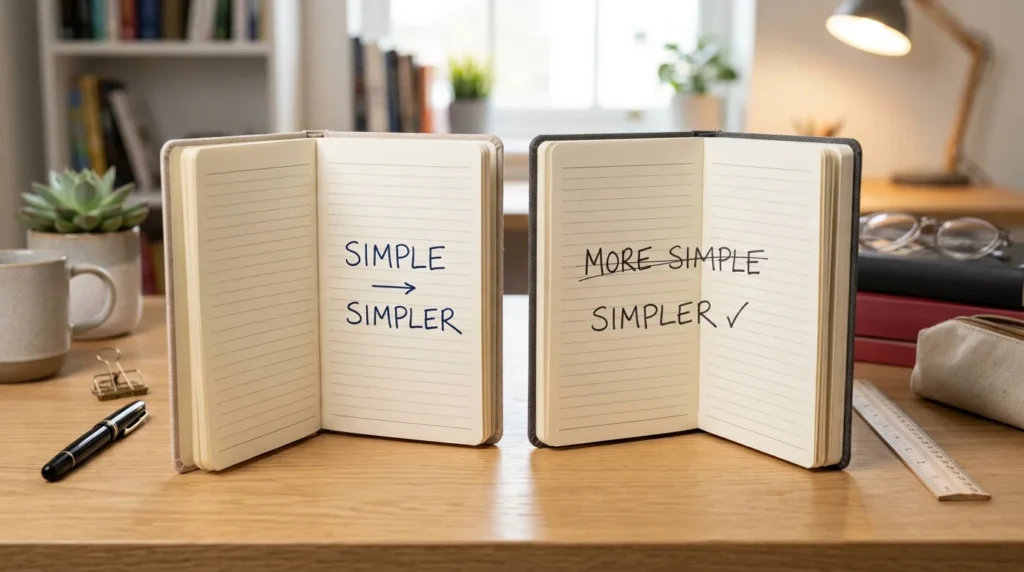

Both “simpler” and “more simple” can be grammatically correct comparative forms of simple. However, “simpler” is generally the more common and natural choice, especially in everyday English. “More simple” is also possible and may be chosen for emphasis, rhythm, contrast, or particular sentence structures. For most learners and most situations, simpler is the safest default: “This explanation is simpler than the previous one.”
What Is the Difference Between “Simpler” and “More Simple”?
Simpler and more simple both compare the degree of simplicity of two things. In other words, both can mean that one thing is less complicated, easier to understand, easier to use, or easier to do than another.
The main difference is how the comparative form is constructed and how commonly each form is used.
Simpler is formed by adding -er to simple. More simple places more before the adjective. Modern English allows both forms with simple, although standard grammar references specifically recognize simple as one of the two-syllable adjectives that can take either form.
For example:
- “This method is simpler than the old one.”
- “This method is more simple than the old one.”
Both sentences can communicate the same basic comparison.
In normal everyday writing and conversation, however, simpler usually sounds more direct and natural.
Why It Matters
Choosing between these forms is rarely a question of whether your sentence is understandable. Both forms are understood. The more useful question is which form fits natural English and the style of your sentence.
This matters particularly in:
- Academic writing
- Professional emails
- Reports and instructions
- School assignments
- Technical explanations
- Job interviews
- Everyday conversation
- English-learning exercises
If you are writing a sentence such as “We need a ___ solution,” simpler will usually be the straightforward choice:
We need a simpler solution.
Using more simple is not automatically a grammar error, but it may sound less natural in many ordinary sentences. Grammar references specifically list simple among two-syllable adjectives that can use either -er or more.
See Also: Loosing vs Losing Differences: Meaning, Spelling & Examples
The Core Rule
RULE: Simple has two syllables and can form its comparative as either simpler or more simple. In ordinary English, simpler is generally preferred, but more simple is not inherently incorrect.
English comparative formation is not governed by a single absolute rule based only on syllable count. One-syllable adjectives commonly take -er, while many longer adjectives take more. Some two-syllable adjectives allow both patterns, and simple is one of them.
A useful pattern is:
- simple → simpler
- simple → more simple
- simplest → superlative
- most simple → alternative superlative form
For most learners, the easiest practical rule is:
When you mean “less complicated” or “easier,” choose “simpler” unless you have a specific reason to use “more simple.”
How to Use “Simpler”

Simpler is the comparative adjective formed from simple. Use it when comparing two things, two methods, two explanations, two situations, or two levels of difficulty.
Comparing two things
This exercise is simpler than the previous one.
The new process is simpler than the old process.
Her explanation was simpler than mine.
The word than is common when the second item in the comparison is stated.
Describing an easier solution
We need a simpler solution.
The engineer suggested a simpler design.
There must be a simpler way to solve this problem.
Here, the comparison may be understood from context even though the second thing is not explicitly mentioned.
Describing easier instructions
Could you give me simpler instructions?
The updated guide uses simpler language.
Students need simpler examples at the beginning of the lesson.
Using modifiers with “simpler”
Comparative adjectives can be modified with words such as much, far, slightly, a little, a bit, and even.
Examples:
This version is much simpler.
The new process is slightly simpler than the previous one.
We need an even simpler explanation.
These modifiers make the degree of difference clearer.
How to Use “More Simple”
More simple is also possible because simple is one of the two-syllable adjectives that can use either the -er or more comparative pattern.
However, it is generally less common than simpler in ordinary usage.
For example:
The second explanation is more simple than the first.
This sentence is grammatically possible. But many speakers and writers would naturally choose:
The second explanation is simpler than the first.
When “more simple” can work naturally
There is no single rule saying that more simple must always be avoided. It can appear when the writer wants to maintain a particular rhythm or structure.
For example:
The new design is more simple, more practical, and more affordable.
Here, repeating more before each adjective creates a parallel structure:
- more simple
- more practical
- more affordable
A writer may prefer this structure because it gives the sentence a particular rhythm.
This does not mean that more simple has a completely different dictionary meaning from simpler. The basic comparative meaning remains the same.
Correct Examples
Here are examples covering different real-life situations.
Conversation
“Can you explain it again in simpler terms?”
“I have attached a simpler version of the instructions for the team.”
School
“The second question is simpler than the first.”
Workplace
“We need a simpler process for approving these requests.”
Social Media
“Sometimes a simpler design works better.”
Academic Writing
“The study uses a simpler model to explain the relationship.”
Technical Writing
“This update provides a simpler method for managing user accounts.”
Customer Service
“We can offer a simpler way to complete your payment.”
Presentation
“Let me give you a simpler example.”
Personal Writing
“Life seemed simpler before I had so many responsibilities.”
More Simple in a Parallel Structure
“The new system is more simple, more flexible, and more affordable.”
More Simple in a Deliberate Comparison
“The second explanation is more simple than the technical version.”
The final two examples show why it would be inaccurate to call more simple universally wrong. Both major grammar references and usage resources recognize the alternative form.
See Also: Content vs Context Differences: Meaning & Examples
Incorrect vs. Correct
| ❌ Incorrect | ✅ Correct | Why |
|---|---|---|
| This is more simpler. | This is simpler. | More and -er are both comparative markers, so using them together is redundant. |
| The method is more simpler than the old one. | The method is simpler than the old one. | Use one comparative construction, not both. |
| This is more simpler to understand. | This is simpler to understand. | Simpler already expresses the comparative. |
| We need a more simpler solution. | We need a simpler solution. | More is unnecessary before simpler. |
| The instructions are more easier now. | The instructions are easier now. | Easier already contains the comparative ending. |
| This explanation is simpler than that one. | This explanation is simpler than that one. | Correct comparative form. |
| This explanation is more simple than that one. | This explanation is more simple than that one. | Also grammatically possible, although simpler is generally more common. |
| Give me a simpler example. | Give me a simpler example. | Natural comparative usage. |
| Give me a more simpler example. | Give me a simpler example. | Double comparative. |
| The process became more simple. | The process became simpler. | Simpler is generally the more natural choice here. |
| We need more simple instructions. | We need simpler instructions. | Simpler is usually preferred in ordinary usage. |
| The new version is much more simpler. | The new version is much simpler. | Much can modify a comparative, but more simpler combines two comparative forms. |
Why People Make This Mistake
Confusion About the “More” Rule
Many learners are taught a simplified rule:
One syllable → -er
Two or more syllables → more
That rule is useful as a starting point, but it is not absolute. Some two-syllable adjectives allow both forms. Simple is one of them.
Because learners often memorize the rule without learning its exceptions, they may wonder why both simpler and more simple appear in real English.
Thinking “More Simple” Must Be Wrong
Another common mistake is assuming that every adjective ending in -er can never appear after more.
That is too broad.
The important distinction is between:
- simpler — valid comparative
- more simple — also possible
- more simpler — incorrect double comparative
So the problem is not the word more itself. The problem occurs when more and -er are unnecessarily combined.
Spelling and Visual Similarity
Learners may see:
simple → simpler
and then wonder whether the adjective is long enough to require more.
Since simple has two syllables, it does not fit neatly into the beginner rule for one-syllable adjectives. That creates uncertainty.
Autocomplete and Spellcheck
Spellcheck tools are not grammar teachers. Both simpler and more simple can be legitimate English, so a spelling or grammar tool may not always explain which form is more natural for the context.
Likewise, a tool may accept more simple without telling a learner that simpler would usually be the more natural everyday choice.
Translation Interference
Some languages form comparative adjectives mainly by placing a word equivalent to more before the adjective. Learners who translate directly may therefore produce more simple more often.
The safest approach is to learn the English pattern as a complete expression rather than translating the comparative structure word for word.
Common Mistakes Checklist
Using “more simpler”
Problem: The sentence contains two comparative markers.
Why it happens: The writer adds more for emphasis even though simpler already contains the comparative ending.
Avoid it: Use simpler or more simple, but not more simpler.
Assuming “more simple” is always wrong
Problem: The writer treats more simple as ungrammatical in every situation.
Why it happens: Many basic grammar lessons simplify comparative rules.
Avoid it: Remember that simple can take either comparative pattern.
Using “simpler” and “more simply” as if they were the same
Problem: The writer confuses an adjective with an adverb.
Correct distinction:
The explanation is simpler.
She explained it more simply.
Simpler describes a noun or subject. More simply describes how an action is performed.
Forgetting “than” when a comparison is explicit
A comparative often appears with than when the second item is stated:
This method is simpler than the old one.
However, than is not required when the comparison is understood:
This method is simpler.
Using “simple” when a comparison is intended
❌ This method is simple than the old one.
✅ This method is simpler than the old one.
The adjective needs a comparative form when you are explicitly comparing two things.
“Simpler” vs. “More Simple” in Real English
“Simpler” in everyday English
Simpler is the form you are most likely to choose when talking naturally about something being easier or less complicated. It works comfortably in conversation, workplace communication, instructions, education, and ordinary writing.
“Can you make this simpler?”
This sounds direct and natural because the comparative form is compact and familiar.
“More simple” is grammatically possible
More simple should not automatically be labeled incorrect. Current grammar guidance explicitly lists simple among adjectives that can take either -er or more.
For example:
“It’s more simple to live in the city because everything you need is there.”
This construction is grammatically possible. However, in many ordinary contexts, “It’s simpler…” will sound more conventional.
“More simple” can support parallel structure
There are situations where a writer may deliberately repeat more:
“The new system is more simple, more flexible, and more affordable.”
The repeated construction gives the sentence parallel rhythm. In such a sentence, replacing the first more simple with simpler is also possible:
“The new system is simpler, more flexible, and more affordable.”
Neither construction changes the basic comparison of simplicity.
“Simpler” is usually the practical default
If you are an English learner and you are unsure which form to choose, simpler is the practical default.
It is concise, widely used, and clearly recognized as the comparative form of simple. Oxford’s dictionary entry lists simpler as the comparative while also noting that more simple can be used.
American vs. British English
There is no major American-versus-British spelling difference between simpler and more simple.
Both varieties of English use simpler, and more simple can also occur. The important distinction is not geography but usage and preference.
So you do not need to change your choice simply because you are writing for an American or British audience.
Formal vs. Informal Usage
Both simpler and more simple can occur in formal and informal English.
For most professional, academic, and everyday writing, simpler is an easy choice:
“The revised procedure provides a simpler method for collecting data.”
More simple can also appear in formal prose, especially where the writer wants parallel structure or a particular rhythm. It should not be treated as an informal-only form.
The key issue is therefore not formality. It is naturalness and sentence structure.
Comparison Table
| Feature | Simpler | More Simple |
|---|---|---|
| Base adjective | Simple | Simple |
| Comparative structure | simple + -r | more + simple |
| Grammar | Correct | Correct |
| Basic meaning | Less complicated/easier | Less complicated/easier |
| Commonness | Generally more common | Less common |
| Everyday speech | Very natural | Possible, but less usual |
| Professional writing | Natural | Possible |
| Academic writing | Natural | Possible |
| Can be used with “than”? | Yes | Yes |
| Can be modified by “much”? | Yes | Yes |
| Double comparative | ❌ more simpler | ❌ more simpler |
| Best default for learners | Yes | Usually no need |
The important takeaway is that the forms are not a simple correct-versus-incorrect pair. Grammar references explicitly recognize both comparative patterns for simple.
Real-Life Situations
In an Interview
“I try to explain technical concepts in a simpler way.”
This is a natural choice because the speaker is describing a clearer and less complicated method of communication.
In a Meeting
“Can we find a simpler way to handle this process?”
This is concise and professional.
In an Email
“I have prepared a simpler version of the document for the new employees.”
Here, simpler means easier for the employees to understand.
In a Text Message
“Can you explain it in simpler words?”
This is natural and conversational.
In an Exam
“Choose the simpler explanation.”
The comparative adjective identifies the explanation that is less complicated.
In Academic Writing
“The researchers used a simpler model for the second analysis.”
The comparative form works naturally in formal writing as well.
In Technical Documentation
“This update provides a simpler way to configure the application.”
The sentence compares the new method with a previous or alternative method.
In a Presentation
“Let me use a more simple example before we move to the technical details.”
This is possible, although many writers would choose simpler example instead.
See Also: WB Meaning in Text Explained – Full Guide, Examples & Chat Slang
Simpler vs. More Simply
One related confusion deserves special attention.
Simpler is an adjective.
The new explanation is simpler.
It describes the explanation.
More simply is the comparative form of the adverb simply.
She explained the concept more simply this time.
It describes how she explained the concept.
Compare:
The instructions are simpler.
He explained the instructions more simply.
Do not substitute one for the other simply because both relate to the idea of simplicity.
Simpler vs. Simple
Simple describes something without making a comparison.
This is a simple explanation.
Simpler makes a comparison or indicates a change toward greater simplicity.
This is a simpler explanation than the previous one.
Compare:
| Form | Function | Example |
|---|---|---|
| Simple | Describes something as uncomplicated | This is a simple task. |
| Simpler | Compares two things or indicates greater simplicity | This is a simpler task. |
| More simple | Alternative comparative form | This is a more simple task. |
| Simplest | Superlative | This is the simplest option. |
| Most simple | Alternative superlative form | This is the most simple option. |
| More simply | Comparative adverb | She explained it more simply. |
How to Remember the Difference
Use this simple memory rule:
Simple → simpler
When you are comparing two things, simpler should be your first choice.
For example:
simple → simpler
simple → simplest
You can also remember that more simple is possible, but it is not necessary simply because simple has two syllables.
A useful three-step check is:
- Am I comparing two things?
If yes, you need a comparative form. - Can I naturally use “simpler”?
In most cases, yes. - Am I writing “more simpler”?
If yes, remove one comparative marker.
The most important pattern is:
simpler ✅
more simple ✅
more simpler ❌
Quick Practice Quiz
Choose the best option for each sentence.
- This explanation is ___ than the first one.
a) simpler
b) more simpler - We need a ___ way to organize the files.
a) simpler
b) more simpler - The new system is ___ than the old one.
a) simpler
b) more simpler - The teacher explained the concept ___.
a) simpler
b) more simply - The design is more simple, more practical, and ___.
a) more affordable
b) affordabler
Answers
- simpler
- simpler
- simpler
- more simply
- more affordable
Remember that more simple can also be grammatically possible in comparative sentences. The quiz mainly tests the safest and most common everyday choice.
Frequently Asked Questions
Is “simpler” grammatically correct?
Yes. Simpler is the standard comparative form commonly used for simple. It is widely used in both spoken and written English.
Is “more simple” grammatically correct?
Yes. Simple is one of the two-syllable adjectives that can take either -er or more, so more simple is grammatically possible.
Is “simpler” more common than “more simple”?
Generally, yes. Simpler is usually the more common and natural choice in ordinary English, while more simple is less common but still possible.
Should I use “simpler” in formal writing?
Yes. Simpler is completely appropriate for formal writing, including academic and professional contexts. There is no need to avoid it because it has the -er ending.
Is “more simpler” correct?
No. More simpler combines two comparative markers. Choose simpler or, where appropriate, more simple, but do not combine them.
Can I say “much simpler”?
Yes. Much can modify a comparative adjective:
This version is much simpler.
Other modifiers include far, slightly, a little, and even.
Can I say “much more simple”?
Yes. Because more simple can function as a comparative construction, it can be modified by much:
The new process is much more simple.
However, much simpler will generally be the more natural choice in ordinary English.
Is “simpler” only used when comparing two things?
Not necessarily. A comparative can be used when the second item is understood from context:
We need something simpler.
The comparison is implied rather than explicitly stated.
What is the difference between “simpler” and “more simply”?
Simpler is an adjective, while more simply is an adverbial expression.
This explanation is simpler.
She explained it more simply.
Can I use “simplest” instead of “simpler”?
No, not when you are making an ordinary comparison between two alternatives. Simpler is comparative; simplest is superlative and normally identifies the highest degree of simplicity within a group or set.
This option is simpler than that one.
This is the simplest option available.
Is “more simple” more formal than “simpler”?
There is no general rule that makes more simple more formal. Both can occur in formal writing. The choice is mainly about comparative formation, usage, sentence rhythm, and style.
Which should English learners use: “simpler” or “more simple”?
Simpler is the best practical default. It is common, concise, and natural in a wide range of situations. You should still recognize more simple as a legitimate alternative so that you are not confused when you encounter it.
Quick Summary
Simpler and more simple can both function as comparative forms of simple. The main difference is usage rather than basic meaning. Simpler is generally more common and is the practical default for everyday conversation, professional writing, academic work, instructions, and most other situations. More simple is also grammatically possible, particularly when sentence rhythm, emphasis, or parallel structure makes it useful. Never combine the two forms as more simpler, because that creates a double comparative. The easiest pattern to remember is simple → simpler. If you are comparing two things and are unsure which form to choose, use simpler.
See Also: POS Meaning in Text Explained – Full Guide, Slang & Real Usage Examples