
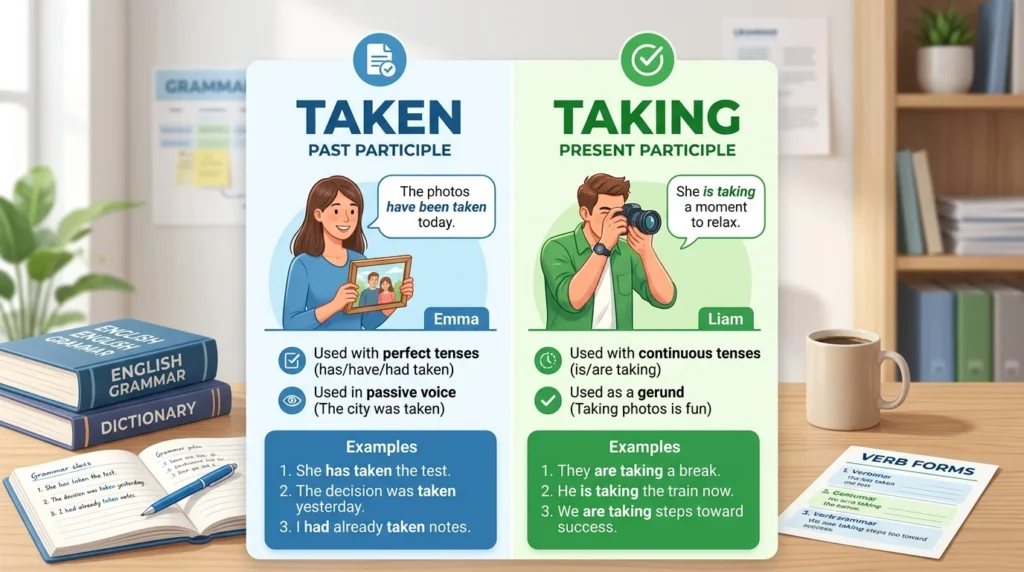

Taken and taking are both correct forms of the verb take, but they perform different grammatical jobs. Taken is the past participle and is commonly used with has, have, or had, and in passive constructions such as “The photo was taken.” Taking is the present participle or -ing form, used in continuous tenses and sometimes as a gerund, as in “I am taking notes” or “Taking notes helps me remember.”
What Is the Difference Between Taken and Taking?
The main difference between taken and taking is their grammatical form and the sentence structure around them.
Both come from the irregular verb take:
| Verb form | Example |
|---|---|
| Base form | take |
| Past simple | took |
| Past participle | taken |
| -ing form | taking |
Taken is the past participle of take. It is used in perfect constructions and passive voice, and it can also function as an adjective in expressions such as “The seat is taken.”
Taking is the present participle or -ing form of take. It is used in continuous tenses and can also function as a gerund, meaning the activity itself is treated like a noun.
So, the choice is not simply about “past” versus “present.” It depends on what grammatical structure the sentence requires.
Why It Matters
Using the wrong form can make a sentence grammatically incorrect or change what you mean.
Compare:
She is taking the exam.
This presents the exam as an activity in progress.
She has taken the exam.
This uses the present perfect and tells us that the exam has already been completed.
The difference becomes especially important in emails, academic writing, workplace communication, exams, and everyday conversation. Understanding the structure around the verb makes it much easier to choose the correct form.
See Also: Challenge or Challange Differences: Which Spelling Is Correct?
The Core Rule
Use “taking” with continuous/progressive structures and when the -ing form functions as a noun. Use “taken” as the past participle, especially after “have/has/had” and in passive constructions.
A quick pattern to remember:
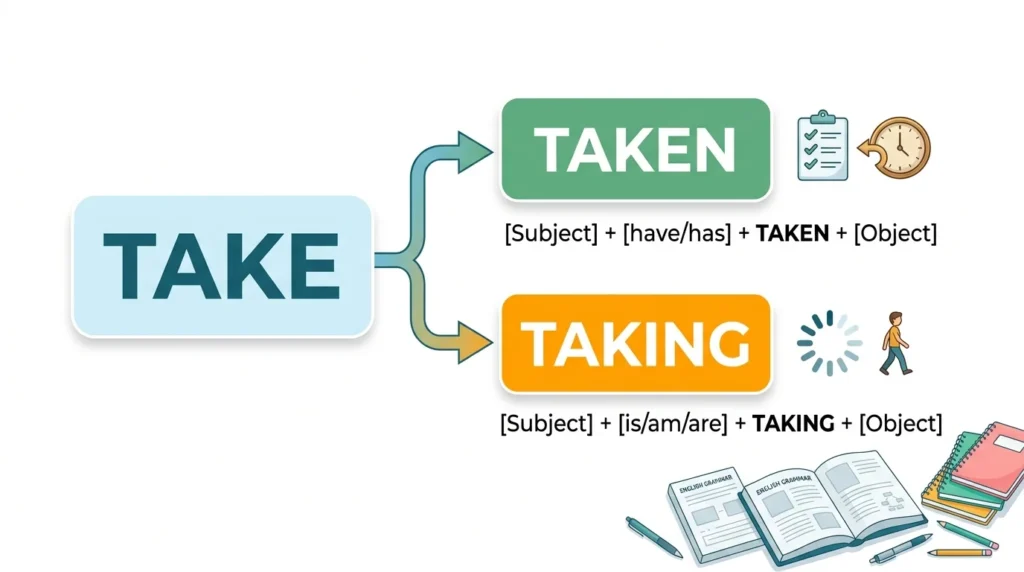
am/is/are + taking
→ She is taking a class.
was/were + taking
→ They were taking pictures.
have/has/had + taken
→ He has taken the test.
was/were/is/are + taken in a passive or adjective construction
→ The photo was taken yesterday.
→ All the seats are taken.
The important point is that taken does not simply mean “past” and taking does not simply mean “present.” Their grammatical functions are more specific.
How to Use Taken
Taken in Perfect Tenses
Taken is the past participle used after forms of have in perfect constructions.
Examples:
I have taken the test.
She has taken my advice.
They had taken the wrong train.
We will have taken care of everything by then.
The perfect construction connects an earlier action or state with a particular point in time. It does not always mean that the result is simply “finished”; the exact meaning depends on the tense and context.
Taken in Passive Voice
The past participle taken is also used when take appears in the passive voice.
The photograph was taken yesterday.
The documents were taken from the office.
The samples have been taken for testing.
In these sentences, the subject receives the action rather than performing it.
Taken as an Adjective
Taken can also function as an adjective in certain contexts.
Is this seat taken?
Here, taken means that someone is already using or occupying the seat.
It can also describe someone who is already in a romantic relationship:
Sorry, I’m taken.
This use is different from the simple idea that taken always represents a completed action. Context matters.
How to Use Taking
Taking in Continuous Tenses
Taking is used with forms of be to create continuous or progressive constructions.
I am taking notes.
She is taking a shower.
They are taking the bus.
We were taking pictures when it started raining.
The -ing form presents the action as ongoing or unfolding during the relevant time period.
Taking as a Gerund
The word taking can also function as a gerund. A gerund is an -ing form that functions as a noun-like element in a sentence.
Taking notes helps me study.
I enjoy taking photographs.
Taking responsibility is important.
In the first sentence, taking notes is the subject of the sentence. It refers to the activity itself rather than describing what someone is doing at this exact moment.
Taking After Certain Verbs
Some verbs are naturally followed by an -ing form.
I enjoy taking walks.
She avoids taking unnecessary risks.
They considered taking another route.
Here, taking is not necessarily describing an action happening right now. It is functioning as part of a phrase referring to an activity.
This is one reason why the simple rule “taking means happening now” is useful for beginners but incomplete.
Correct Examples
Conversation
“I’m taking a break right now.”
“I have taken your suggestions into account.”
School
“The students are taking their final exam today.”
Workplace
“The company has taken several steps to improve security.”
Social Media
“I’m taking a few days off from social media.”
Academic Writing
“The researchers have taken several factors into consideration.”
Everyday Life
“She is taking the train home.”
Completed Experience
“I’ve taken this course before.”
Passive Construction
“The photograph was taken during the ceremony.”
Gerund Use
“Taking** regular breaks can improve concentration.”
Incorrect vs. Correct
| ❌ Incorrect | ✅ Correct | Why |
|---|---|---|
| I am taken the test. | I am taking the test. | A continuous action needs am/is/are + taking. |
| She has taking the exam. | She has taken the exam. | After has, the perfect construction requires the past participle taken. |
| They were taken pictures. | They were taking pictures. | The active past continuous uses were + taking. |
| He had taking the wrong bus. | He had taken the wrong bus. | Had is followed by the past participle in the past perfect. |
| We are taken notes. | We are taking notes. | The action is presented as ongoing. |
| The photo was taking yesterday. | The photo was taken yesterday. | This is passive voice, so the past participle taken is required. |
| I have taking your advice. | I have taken your advice. | Have + past participle forms the present perfect. |
| She is taken a shower. | She is taking a shower. | The active continuous form is is + taking. |
| Taken notes is helpful. | Taking notes is helpful. | The activity used as the subject requires the gerund taking. |
| He was taking by surprise. | He was taken by surprise. | “Taken by surprise” is a passive/adjectival expression using the past participle. |
Why People Make This Mistake
The Words Come From the Same Verb
The biggest source of confusion is simple: taken and taking both come from take.
Learners may know what take means but not remember which form belongs after a particular helping verb.
The solution is to learn the sentence pattern, not just the individual words.
English Uses Irregular Verb Forms
Take does not follow the regular pattern of simply adding -ed.
Its main forms are:
take → took → taken → taking
Because taken looks different from take and took, learners may need extra practice with it.
Helping Verbs Cause Confusion
Compare:
She is taking the course.
She has taken the course.
The helping verb gives you an important clue.
Be + taking commonly creates a progressive construction.
Have + taken creates a perfect construction.
“Finished” Is Not a Complete Rule
Many explanations simplify the distinction to:
taking = happening now
taken = finished
That can help beginners, but it is not enough for accurate English.
For example:
Taking notes is useful.
This sentence is not necessarily about something happening right now.
Likewise:
The seat is taken.
This describes a current state, not merely an action completed in the past.
Autocomplete Can Hide the Problem
Typing tools may correct or suggest forms automatically, but they do not teach you why one form belongs in a particular sentence.
Learning the patterns is taking, has taken, was taken, and taking notes is more reliable than depending on automatic correction.
Translation Interference
Learners may try to translate a sentence directly from their first language. This can cause problems because languages do not always organize verb forms in the same way.
Instead of translating word-for-word, identify the English structure first:
be + -ing → continuous/progressive
have + past participle → perfect
be + past participle → often passive
Common Mistakes Checklist
Using “taken” after am, is, or are for an active ongoing action
❌ I am taken a class.
✅ I am taking a class.
The continuous active construction requires the -ing form.
Using “taking” after have or has
❌ She has taking the test.
✅ She has taken the test.
The present perfect requires have/has + past participle.
Assuming “taken” always means past
Taken is a past participle, but it appears in several constructions, including present perfect and passive sentences.
I have taken the course.
The auxiliary have places the sentence in the present perfect.
Assuming “taking” always means “right now”
It does not.
Taking notes is useful.
Here, taking refers to an activity and functions as a gerund.
Confusing active and passive structures
Compare:
The photographer is taking the picture.
The photographer performs the action.
The picture is being taken.
The picture receives the action.
The grammatical structure changes, so the verb form changes too.
Taken vs Taking in Real English

Grammatically Correct: “I am taking the test.”
This is natural when someone is currently sitting for or completing an exam. The structure is present progressive: am + taking. It focuses on the activity in progress. If the test has already happened, “I have taken the test” is a better choice when the present perfect is appropriate.
Grammatically Correct: “I have taken the test.”
This is natural when the speaker wants to say that the test has already been completed, often with present relevance. The sentence uses the present perfect: have + taken. It does not necessarily specify exactly when the test happened. If a finished past time is stated, simple past may be more appropriate: “I took the test yesterday.”
Grammatically Correct: “Taking notes helps.”
Here, taking is not describing an action that is necessarily happening at the moment. The entire phrase taking notes functions as the subject of the sentence. This is a standard gerund construction and shows why “taking always means happening now” is too broad as a grammar rule.
Grammatically Correct: “The photo was taken yesterday.”
This is passive voice. The photo does not perform the action; someone takes the photo. Because passive voice uses the past participle, the correct form is taken. The sentence is completely natural in everyday conversation, professional writing, news reporting, and academic contexts.
American vs. British English
There is no meaningful American-versus-British difference in the forms “taken” and “taking.”
Both varieties use:
take → took → taken → taking
The same basic grammatical structures apply in both:
I am taking the train.
I have taken the train before.
The photograph was taken yesterday.
Pronunciation and preferred vocabulary can vary by speaker or context, but the choice between taken and taking is not an American/British spelling distinction.
Formal vs. Informal Usage
Both taken and taking are standard in formal and informal English.
Formal
The researchers have taken several variables into consideration.
The organization is taking additional measures to improve safety.
Informal
I’m taking the bus home.
I’ve taken care of it already.
The forms themselves do not become more or less formal. The surrounding vocabulary and sentence structure determine the register.
Comparison Table
| Feature | Taken | Taking |
|---|---|---|
| Base verb | Take | Take |
| Verb form | Past participle | Present participle / -ing form |
| Common use | Perfect and passive constructions | Continuous/progressive constructions |
| Common pattern | have/has/had + taken | am/is/are/was/were + taking |
| Can function as a gerund? | No | Yes |
| Can function as an adjective? | Yes, in some contexts | Yes, in limited uses |
| Example | She has taken the test. | She is taking the test. |
| Main grammatical focus | Past participle function | Ongoing action or activity |
| American spelling | Same | Same |
| British spelling | Same | Same |
Real-Life Situations
Job Interview
Question: “What steps have you taken to improve your skills?”
Natural answer:
“I have taken several online courses and practiced my communication skills.”
The question uses have + taken because it asks about actions completed or undertaken with relevance to the present.
Workplace Meeting
“We are taking several steps to solve the problem.”
The company is describing an ongoing process, so taking fits.
Professional Email
“We have taken your concerns seriously and are reviewing the issue.”
Notice that both forms can appear naturally in one sentence:
have taken → action already undertaken
are reviewing → current ongoing action
Text Message
“I’m taking the train tonight.”
The speaker is referring to a planned or ongoing arrangement, so taking is natural.
Exam
“I have taken three practice tests this week.”
The present perfect have taken connects completed experiences with the current time period.
Photography
“She is taking a photo.”
The photographer is performing the action.
“The photo was taken yesterday.”
The second sentence is passive because the photo receives the action.
See Also: BSFR Meaning in Text: What It Really Means & How to Use
An Easy Way to Remember Taken vs Taking
Use the helper-verb test.
Step 1: Look at the word before the blank
If you see:
am / is / are / was / were
and the sentence describes an active action in progress, taking is often the correct form.
She is taking notes.
Step 2: Look for have, has, or had
If you see:
have / has / had
you generally need the past participle taken.
She has taken notes.
Step 3: Check for passive voice
If the subject receives the action, taken may be required.
The picture was taken yesterday.
Step 4: Ask whether “taking” is functioning as an activity
Taking notes improves memory.
Here, taking is being used as a gerund.
Quick Practice
Choose taken or taking.
- I am ___ notes during the lecture.
- She has ___ the wrong train.
- The photograph was ___ last summer.
- They are ___ a break.
- He had ___ the medicine before dinner.
- ___ regular breaks can improve concentration.
- We were ___ pictures at the event.
- I have ___ this course before.
- The company is ___ steps to improve service.
- The seats have already been ___.
Answers
- taking
- taken
- taken
- taking
- taken
- Taking
- taking
- taken
- taking
- taken
Frequently Asked Questions
Is “taken” the past tense of “take”?
Not exactly. Took is the simple past form of take, while taken is the past participle.
I took the exam yesterday.
I have taken the exam before.
Is “taking” present tense?
Taking is the -ing form of take, not a tense by itself. It is commonly used to form progressive tenses, but it can also function as a gerund.
Which is correct: “I have taken” or “I am taking”?
Both can be correct, but they mean different things. I have taken uses the present perfect, while I am taking uses the present progressive.
Can “taken” be used without “have”?
Yes. A common mistake is believing that taken must always follow have. It can also occur in passive constructions:
The picture was taken yesterday.
It can also function as an adjective:
The seat is taken.
Can “taking” refer to something that already happened?
Yes, depending on the construction.
For example:
I remember taking that photograph.
The photographing happened in the past, but taking is used after remember as part of an -ing construction.
Why do we say “has taken” but “is taking”?
Because these are different grammatical constructions. Has taken is a perfect construction, while is taking is a progressive construction.
Is “taken” always passive?
No. It can be active in perfect constructions:
She has taken the exam.
It can be passive:
The exam was taken by all the students.
Is “taking” always an ongoing action?
No. It can also function as a gerund:
Taking notes is helpful.
It can also appear after verbs that take an -ing complement:
I enjoy taking photographs.
What is the easiest way to remember the difference?
Look at the structure:
is taking → progressive
has taken → perfect
was taken → passive
Learning these patterns is more reliable than trying to remember only “taking = now” and “taken = past.”
Can taken and taking appear in the same sentence?
Yes.
After she had taken the exam, she started taking a new course.
The two forms perform different grammatical functions in the same sentence.
Quick Summary
Taken and taking are two different forms of the irregular verb take. Taken is the past participle and commonly appears in perfect constructions such as “has taken” and passive constructions such as “was taken.” Taking is the -ing form and is commonly used in progressive constructions such as “is taking.” It can also function as a gerund, as in “Taking notes helps.” Neither form simply means “past” or “present” in every situation. The most useful approach is to look at the sentence structure around the word: be + taking, have + taken, and passive be + taken are reliable patterns.
See Also: 🥰 Meaning From a Girl in Text: What She Really Means When Sending It