
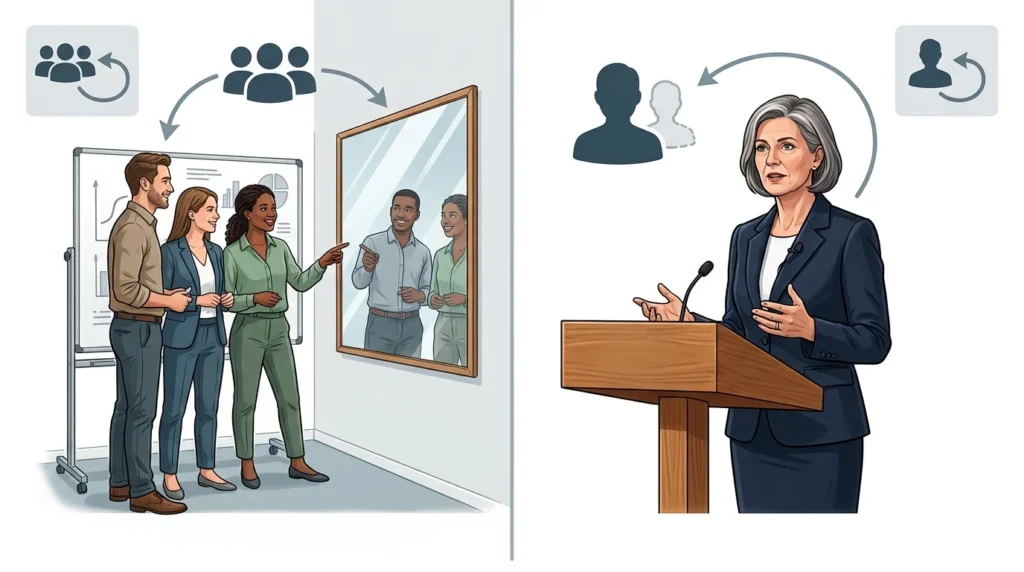

Ourselves is the standard reflexive pronoun used with we when we refers to more than one person. For example, “We prepared ourselves for the meeting.” Ourself is much rarer and is used in special situations where we refers to one person, such as certain royal, editorial, or other formal uses. In ordinary modern English, especially everyday writing and speech, ourselves is the normal choice.
What Is the Difference Between Ourselves and Ourself?
Ourselves and ourself are reflexive pronouns. A reflexive pronoun refers back to the subject of a sentence. The important difference is grammatical number and the special meaning of we.
When we means two or more people, the normal reflexive form is ourselves:
“We taught ourselves how to use the software.”
Here, we refers to a group, and ourselves refers back to that same group.
Ourself has a much narrower use. It can occur when a single person uses we to refer to themselves, traditionally in certain royal, editorial, or formal styles. Some dictionaries also record other specialized uses, but it is not the ordinary replacement for ourselves.
Why It Matters
Choosing between ourselves and ourself is mainly a question of matching the reflexive pronoun to what we means in the sentence.
Using ourselves when you mean a normal group is straightforward and natural:
“We introduced ourselves to the new team.”
Using ourself for an ordinary plural group can sound unusual or nonstandard to many readers. That matters in school assignments, professional writing, business communication, formal documents, and other situations where conventional English is expected.
At the same time, saying that ourself is simply “always wrong” would be too broad. Dictionaries recognize specialized uses, particularly where we has a singular reference.
The Core Rule

Use “ourselves” when “we” refers to a group. Use “ourself” only in rare contexts where “we” refers to one person or where a specialized usage specifically calls for it.
- We = multiple people → ourselves
- We = one person in a special singular use → ourself may be possible
The normal reflexive-pronoun pattern is:
| Subject | Reflexive Pronoun |
|---|---|
| I | myself |
| you | yourself |
| he | himself |
| she | herself |
| it | itself |
| we | ourselves |
| you | yourselves |
| they | themselves |
This is why ourselves is the form learners should normally expect after we. Cambridge describes ourselves as the reflexive form used when the subject is we and the object refers to the same group.
See Also: Less Then or Less Than: Differences and Correct Usage
How to Use Ourselves
Ourselves has several standard uses in modern English. It can function as a reflexive pronoun, an intensive pronoun for emphasis, or appear in expressions such as by ourselves.
Ourselves as a Reflexive Pronoun
Use ourselves when the people performing the action are also affected by the action.
For example:
“We reminded ourselves about the deadline.”
The subject is we, and the reminder is directed back at the same people. Therefore, ourselves is the appropriate reflexive form.
Other examples include:
- We prepared ourselves for the interview.
- We introduced ourselves to the visitors.
- We taught ourselves the basics of coding.
- We congratulated ourselves after finishing the project.
Ourselves for Emphasis
Ourselves can also emphasize that the people represented by we personally performed an action.
“We ourselves checked every document.”
This means that we, rather than somebody else, checked the documents.
Another common structure is:
“We completed the entire project ourselves.”
Here, ourselves emphasizes personal involvement or the fact that no outside help was used. Cambridge lists this emphatic use of reflexive pronouns as a standard function.
Ourselves After a Preposition
Ourselves can follow a preposition when it refers back to the same group.
Examples include:
- We kept the information to ourselves.
- We were proud of ourselves.
- We agreed among ourselves.
- We went by ourselves.
In “We went by ourselves,” the expression means that the group went alone or without other people’s help. This is a standard use of ourselves.
How to Use Ourself
Ourself requires more care because it is not the normal plural reflexive form of we. It is a rare form that can be used when we has a singular reference or in certain specialized varieties of English.
Ourself With a Singular “We”
One historical and formal use occurs when a single person uses we instead of I. This is sometimes called the royal we when associated with a monarch, although similar singular uses of we can occur in other formal or institutional contexts.
In such a construction, ourself can correspond to the singular meaning of we.
This is a specialized use, not the normal pattern for everyday English. The American Heritage Dictionary specifically records ourself as a reflexive used when we is used instead of I by a singular speaker or author, while also noting a nonstandard use as a substitute for ourselves.
See Also: Pronounciation or Pronunciation Differences: Which Is Correct?
Ourself in Contemporary Specialized Usage
You may also encounter ourself in contemporary writing where a speaker uses we in an unusual singular or generalized way. Oxford marks ourself as nonstandard and gives examples where we refers to people in general rather than a specific group. This shows why the word cannot simply be labeled nonexistent, even though it is not the normal choice for standard everyday writing.
For ordinary writing, however, changing the sentence to a clearer construction is often better than forcing a rare ourself form.
Correct Examples
The following examples show the normal use of ourselves in different situations.
- Conversation: “We bought ourselves some coffee before the meeting.”
- Email: “We have prepared ourselves for the upcoming presentation.”
- School: “We challenged ourselves to finish the assignment early.”
- Workplace: “We reminded ourselves to check the figures twice.”
- Social media: “We treated ourselves to a quiet weekend.”
- Academic writing: “We must ask ourselves whether the evidence supports this conclusion.”
- Travel: “We organized the entire trip ourselves.”
- Conversation: “We found ourselves discussing the same problem again.”
- Business: “We introduced ourselves to the new clients.”
- Everyday English: “We told ourselves not to worry.”
- Formal writing: “We ourselves reviewed the final version.”
- Group activity: “We divided the tasks among ourselves.”
In all of these examples, we represents a group, so ourselves is the ordinary reflexive or emphatic form.
Incorrect vs. Correct
| ❌ Incorrect or Unnatural | ✅ Correct | Why |
|---|---|---|
| We prepared ourself for the interview. | We prepared ourselves for the interview. | The subject “we” refers to a group, so the standard reflexive form is “ourselves.” |
| We introduced ourself to the clients. | We introduced ourselves to the clients. | The action refers back to multiple people. |
| We taught ourself how to use the software. | We taught ourselves how to use the software. | A plural “we” requires the normal plural reflexive pronoun. |
| We congratulated ourself after the victory. | We congratulated ourselves after the victory. | The group is both the subject and the object of the action. |
| We reminded ourself about the deadline. | We reminded ourselves about the deadline. | “Ourselves” is the standard reflexive form for a plural group. |
| We completed the project ourself. | We completed the project ourselves. | “Ourselves” provides the normal emphatic meaning here. |
| We should ask ourself what went wrong. | We should ask ourselves what went wrong. | The ordinary “we” refers to multiple people. |
| We kept the information to ourself. | We kept the information to ourselves. | The group is the object of the preposition “to.” |
| We were proud of ourself. | We were proud of ourselves. | The prepositional phrase refers back to the plural subject. |
| We went by ourself. | We went by ourselves. | The standard expression for a group going without others is “by ourselves.” |
| We checked the documents ourself. | We checked the documents ourselves. | “Ourselves” is the standard emphatic form for plural “we.” |
| John and I introduced ourself. | John and I introduced ourselves. | “John and I” represents two people, so the reflexive pronoun must be plural. |
There is one important qualification: ourself is not automatically ungrammatical in every possible context. It can be appropriate in specialized situations where we has a singular reference. The examples above are incorrect or unnatural specifically because they use ourself for ordinary plural we.
See Also: Hustle or Hussle Differences: Which Spelling Is Correct?
Why People Make This Mistake
The “Self” Pattern Seems More Regular
Learners often notice forms such as myself, yourself, and himself. Because ourself looks like the same pattern with our, it can seem logical to use it after we. English, however, normally uses ourselves because we ordinarily refers to more than one person.
Confusion About Singular and Plural
The key difficulty is that we can sometimes have unusual meanings. Most of the time, we means the speaker plus at least one other person. But in some contexts, one person may use we to represent a role, office, institution, or formal identity.
That unusual use is one reason ourself exists.
Spelling Similarity
Ourself and ourselves begin with exactly the same letters. The difference comes at the end: self versus selves. Learners may remember the beginning but overlook the grammatical number expressed by the ending.
Autocomplete and Spellcheck
Digital writing tools do not always explain the grammatical choice behind a word. Because ourself exists in dictionaries and appears in real writing, a spellchecker may not simply treat it as a spelling error. Context and grammatical meaning still matter.
Translation Interference
Some learners may choose ourself because their first language uses a different system for reflexive pronouns or does not mark number in the same way. The safest approach is to learn the English subject-to-reflexive pattern rather than translate the form word for word.
Common Mistakes Checklist
1. Using “Ourself” for a Normal Group
If we means two or more people, use ourselves.
❌ “We blamed ourself.”
✅ “We blamed ourselves.”
2. Assuming “Ourself” Is Always Wrong
This goes too far. Ourself is a real English word with recorded specialized uses. The important question is what we refers to and what kind of English the sentence represents.
3. Treating Ourselves as a Singular Form
Ourselves is the ordinary plural reflexive form. If one person is simply saying I, the normal reflexive pronoun is myself, not ourselves.
4. Confusing Ourselves With Us
Us is the ordinary object form of we, while ourselves is a reflexive or emphatic form.
Compare:
“The manager helped us.”
“We helped ourselves.”
You should not automatically replace us with ourselves.
5. Confusing Ourselves With Our
Our shows possession:
“Our office is nearby.”
Ourselves refers back to the people represented by we:
“We cleaned the office ourselves.”
6. Using Ourself to Sound More Formal
Ourself should not be used simply because you want your writing to sound formal. In ordinary formal English, ourselves remains the standard form when we refers to a group.
Ourselves vs. Ourself in Real English

Ourselves is grammatically correct and natural in ordinary English when we refers to a group. It is used in conversation, professional writing, academic work, instructions, and formal prose. Sentences such as “We prepared ourselves,” “We did it ourselves,” and “We reminded ourselves” are completely normal. This is the form learners should use when the subject is an ordinary plural we.
Ourself is grammatically possible in restricted contexts but is not the normal everyday form. It can appear when a single speaker uses we instead of I, particularly in traditional royal or formal styles. Some modern dictionaries also record broader specialized uses. Because these uses are unusual, replacing ourselves with ourself in ordinary group sentences can sound marked or nonstandard.
For natural everyday English, choose ourselves whenever we means the speaker plus other people. If a sentence seems to require ourself because we refers to one person, first consider whether rewriting the sentence with I would make the meaning clearer. In ordinary communication, clarity is usually more useful than preserving a rare reflexive construction.
See Also: GTA Meaning in Text: Definition, Uses & Real Gaming Examples
American vs. British English
The basic distinction is not a major American-versus-British spelling difference. Both varieties use ourselves as the normal reflexive form when we refers to a group.
Ourself has specialized or marked uses in English, including historical and formal uses, but it should not be treated as an ordinary British or American alternative to ourselves.
Oxford labels one contemporary use of ourself as nonstandard, while the American Heritage Dictionary records a specific singular use when we substitutes for I. This variation is better understood as a difference in grammatical context and usage than as a simple US-versus-UK spelling rule.
Formal vs. Informal Usage
Ourselves works in both informal and formal English.
- Informal: “We treated ourselves to dinner.”
- Workplace: “We prepared ourselves for the presentation.”
- Academic: “We must ask ourselves whether the results are reliable.”
- Formal: “We ourselves reviewed the evidence.”
Ourself is not simply the “formal version” of ourselves. Its use depends on the meaning and grammatical role of we. A rare formal context may permit ourself, but ordinary formal writing still uses ourselves when the subject refers to a group.
Comparison Table
| Feature | Ourselves | Ourself |
|---|---|---|
| Basic grammatical role | Reflexive or intensive pronoun | Rare reflexive pronoun |
| Normal reference | Plural we | Usually a special singular use of we |
| Everyday English | Standard and common | Rare |
| Used for a normal group | Yes | Normally no |
| Used for emphasis | Yes | Not the normal choice |
| Formal writing | Yes | Only in specialized contexts |
| Academic writing | Standard | Generally avoided unless specifically justified |
| Royal or singular “we” | Not normally the singular form | Can occur |
| Common learner choice | Recommended for ordinary plural we | Usually avoid |
| Example | “We prepared ourselves.” | Specialized: “We … ourself.” |
Ourselves vs. Ourself vs. Myself
Adding myself to the comparison helps make the number distinction clearer.
| Subject | Normal Reflexive Form | Example |
|---|---|---|
| I | myself | I taught myself. |
| We, referring to a group | ourselves | We taught ourselves. |
| We, referring to one person in a special use | ourself may occur | Specialized formal usage. |
This comparison reveals the main principle: the reflexive form should match the grammatical meaning of the subject. If one ordinary speaker says “I,” the natural reflexive is myself. If a group says “we,” the natural reflexive is ourselves.
Ourselves vs. Us
Another common problem is using ourselves where ordinary English requires us.
Us is the object form of we:
“The teacher gave us extra time.”
Ourselves is reflexive when the object refers back to the subject:
“We gave ourselves extra time.”
The difference is the relationship between the subject and object. In the first sentence, the teacher and the recipients are different. In the second, the people represented by we are also the recipients.
Ourselves vs. Our
Our is a possessive determiner. It comes before a noun:
“Our team won the competition.”
Ourselves is a pronoun and refers back to the people represented by we:
“We organized the event ourselves.”
A useful test is to look at what follows the word. If it directly describes ownership before a noun, our may be required. If it refers back to the group that performed an action, ourselves may be required.
See Also: IDK Meaning in Text Explained Simply (With Real Examples)
Real-Life Situations
In an Interview
Correct: “We prepared ourselves for questions about the project.”
The interview team or group is preparing itself, so ourselves is the natural reflexive form.
In a Business Meeting
Correct: “We should remind ourselves of the original deadline.”
The people in the group are reminding the same group represented by we.
In an Email
Correct: “We have given ourselves enough time to review the proposal.”
The group has given time to itself, so ourselves is correct.
In a Text Message
Correct: “We treated ourselves to dinner after the exam.”
The speaker and other people treated their own group to dinner.
In an Exam
Correct: “We should ask ourselves whether the evidence supports the claim.”
The reflexive pronoun refers back to the plural subject we.
In a Formal Statement
Correct: “We ourselves reviewed the final documents.”
Here, ourselves is used for emphasis to show that the group personally performed the review.
How to Remember Ourselves vs. Ourself
The easiest memory rule is:
Group = ourselves. Special singular we = ourself may be possible.
Use this three-step test:
- Find the subject. Is it we?
- Ask what we means. Does it refer to two or more people?
- If it refers to a normal group, use ourselves. If it refers to one person in a specialized use, ourself may be possible.
For ordinary English, this simple rule will solve almost every situation you encounter.
Practice Quiz
Choose the form that best fits each sentence.
- We introduced ______ to the new manager. (ourselves / ourself)
- We reminded ______ to submit the report. (ourselves / ourself)
- We completed the assignment ______. (ourselves / ourself)
- John and I congratulated ______ after the presentation. (ourselves / ourself)
- We should ask ______ whether the plan is realistic. (ourselves / ourself)
- We went to the conference by ______. (ourselves / ourself)
- We taught ______ how to use the new program. (ourselves / ourself)
- We kept the information to ______. (ourselves / ourself)
- In an unusual singular use of “we,” ______ may appear in specialized formal writing. (ourselves / ourself)
- We were proud of ______ after finishing the project. (ourselves / ourself)
Answers
- ourselves — “we” refers to a group.
- ourselves — the reminder comes back to the same group.
- ourselves — it emphasizes that the group completed the assignment.
- ourselves — John and the speaker are two people.
- ourselves — the reflexive refers to the plural subject.
- ourselves — “by ourselves” is the standard expression for a group acting alone.
- ourselves — the group taught the same group.
- ourselves — the prepositional object refers back to the group.
- ourself — this describes the rare singular use of “we.”
- ourselves — the group is proud of itself.
Frequently Asked Questions
Is “ourselves” or “ourself” correct?
Ourselves is correct for ordinary plural we and is the form used in normal modern English. Ourself is a rare form with specialized uses, particularly when a singular speaker uses we in a special formal or traditional way.
Is “ourself” a real word?
Yes. Ourself is recorded in dictionaries, but it is much less common than ourselves. Its uses are restricted or marked, and some dictionary sources label certain modern uses nonstandard.
Can I say “we did it ourself”?
For a normal group, standard English uses “We did it ourselves.” “We did it ourself” would be unusual and may sound nonstandard unless the sentence belongs to a specialized context involving a singular or otherwise exceptional use of we.
Can “ourselves” refer to one person?
In ordinary standard usage, ourselves refers to the plural subject we. If one person is simply referring to themselves with I, the normal reflexive form is myself.
Why does “ourself” exist if “ourselves” is standard?
English has historically allowed we to represent a single speaker in certain contexts, including royal and formal uses. A singular reflexive form corresponding to that use developed and survives as ourself. Dictionaries continue to record it, although it is uncommon in ordinary modern English.
Is “ourself” formal English?
It can occur in certain formal, traditional, or specialized constructions, but it is not simply a more formal version of ourselves. When we refers to a normal group, ourselves remains appropriate even in highly formal writing.
Should I use “ourselves” in an English exam?
Yes, when we refers to a group. For example, “We prepared ourselves for the exam” is standard and natural. Using ourself for an ordinary plural group would be unusual and could be marked as incorrect depending on the context and marking standard.
What is the difference between “we ourselves” and “we ourself”?
We ourselves is the normal emphatic construction when we refers to a group. “We ourselves checked the figures” emphasizes that the group personally checked them. We ourself is restricted to unusual contexts in which we has a special singular meaning.
Is “ourselves” a reflexive pronoun?
Yes. Ourselves is the reflexive form associated with we. It can be used when the subject and object refer to the same group, as in “We prepared ourselves,” and it can also be used for emphasis, as in “We ourselves checked the records.”
What is the difference between “ourselves” and “us”?
Us is the ordinary object pronoun, while ourselves is reflexive or emphatic. Compare “The coach encouraged us” with “We encouraged ourselves.” The second sentence uses the reflexive form because the subject and object refer to the same group.
Is “by ourselves” correct?
Yes. By ourselves is a standard expression meaning alone or without help from other people. For example, “We completed the project by ourselves.”
What is the easiest way to remember the difference?
Remember: normal group = ourselves. If we means the speaker plus other people, use ourselves. Ourself is reserved for rare or specialized cases where we has a singular or otherwise unusual reference.
Quick Summary
Ourselves is the standard reflexive pronoun for ordinary plural we. Use it when the speaker is referring to themselves together with one or more other people: “We prepared ourselves,” “We taught ourselves,” or “We did it ourselves.” Ourself is a real but uncommon form. It can appear when a single person uses we in a special context, particularly certain royal, editorial, historical, or formal constructions. Some dictionaries also record broader specialized uses, while labeling some of them nonstandard. For normal conversation, schoolwork, business writing, and academic writing, use ourselves when we refers to a group. The easiest rule is: plural we → ourselves; unusual singular we → ourself may be possible.
See Also: WDH Meaning in Text Explained – Full Guide, Usage & Examples