


Less than is the correct phrase when you are comparing an amount, number, value, degree, measurement, or duration. Less then is normally a mistake because then does not introduce comparisons. Instead, then commonly refers to a time, sequence, or result. For example, write “The package weighs less than 5 kg,” but “Finish the work, then send it.”
Quick Answer
Use less than when comparing something with another amount, number, degree, or value: “The meeting lasted less than an hour.” Use then when referring to time, the next step, or a consequence: “We finished the meeting, then we went home.” Therefore, less then is usually incorrect when you mean “a smaller amount or degree than.” The easiest rule is: than = comparison; then = time, sequence, or result. Cambridge specifically lists than as the word used with more or less to compare amounts.
What Is the Difference Between Less Then and Less Than?
Less than is a standard English comparative expression. It shows that one amount, number, degree, or value is smaller than another. For example, “This phone costs less than $500” compares the phone’s price with $500.
Less then is not the standard expression for this meaning. The confusion comes from mixing up than and then. Although the two words are similar in spelling and can sound similar in some varieties of English, they have different grammatical functions.
Than connects parts of a comparison, including comparisons made with less and more. Then is commonly an adverb referring to a particular time, the next event in a sequence, or a result.
Why It Matters
The difference between than and then involves only one letter, but the words perform different jobs. Choosing the wrong one can make a sentence look careless even when its intended meaning is obvious.
This distinction is especially useful in writing where accuracy matters, such as:
- School and university assignments
- Business emails and reports
- Professional documents
- Resumes and cover letters
- Academic writing
- Technical instructions
- Web content and blog posts
- Social media posts
For example, “The project took less then two weeks” is easy for a reader to understand, but less than is the correct comparative form.
The Core Rule
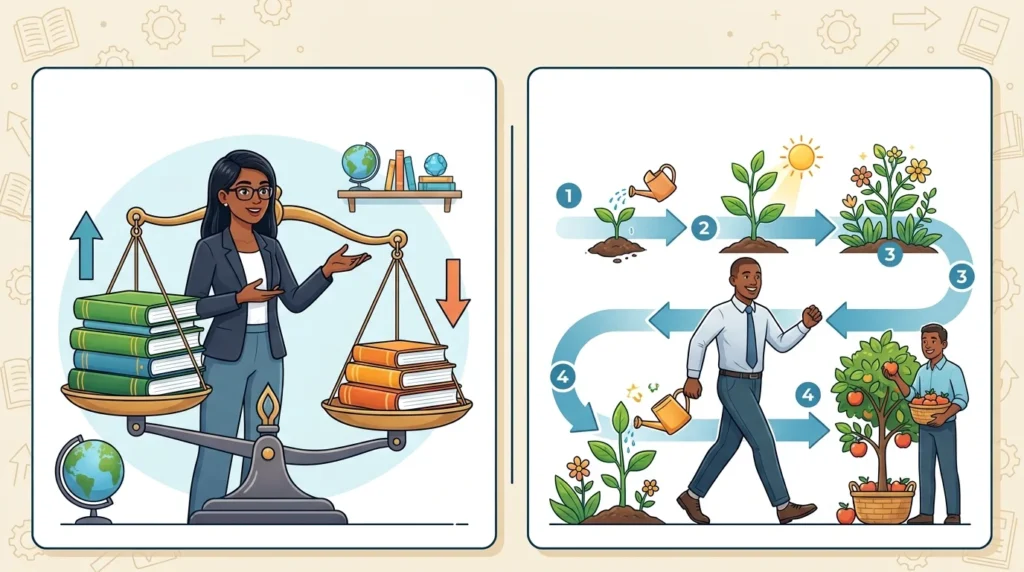
Use THAN for comparison. Use THEN for time, sequence, or result.
Think of the two words this way:
- Than → compares two things or amounts.
- Then → tells you when something happens, what happens next, or what follows as a result.
Examples:
Comparison: “The new laptop is less expensive than the old one.”
Sequence: “Save the document, then close the program.”
Result: “If the payment fails, then contact support.”
Cambridge identifies than as the word used to join parts of a comparison and specifically gives examples with less. It describes then as having uses connected with time, what happens next, and results.
See Also: Pronounciation or Pronunciation Differences: Which Is Correct?
How to Use Less Than
Use less than when the sentence compares one amount, measurement, value, degree, or quantity with another.
Less Than With Numbers
Use less than when saying that one number is smaller than another.
Examples:
- Seven is less than ten.
- The score was less than 50 points.
- The temperature fell to less than 5 degrees.
Less Than With Money
Use less than to compare prices or amounts of money.
- The jacket costs less than $80.
- I spent less than $30 on lunch.
- The repair should cost less than $200.
Less Than With Time
Less than is also used to compare a duration with a specific amount of time.
- The meeting lasted less than an hour.
- The delivery arrived in less than two days.
- You can finish the form in less than ten minutes.
Less Than With Degree or Quality
The phrase can compare the degree to which something has a particular quality.
- The second option was less effective than the first.
- The final result was less impressive than expected.
- The new process is less complicated than the old one.
See Also: Occasion or Ocassion Differences: Which Spelling Is Correct?
Less Than With Expected Amounts
You can also use less than when comparing an actual amount with an expected, estimated, or previously mentioned amount.
- We spent less than expected.
- The repair took less than we were told it would.
- The company received less than the original estimate.
How to Use Then
Then has several common uses, but comparison is not one of them. It is generally used as an adverb.
Then for Time
Use then to refer to a particular time, especially a time already mentioned or understood.
“I lived there then.”
Here, then means approximately “at that time.”
Then for Sequence
Use then to show what happens next or after another action.
“First, check the settings, then restart the device.”
The sentence presents two actions in order.
Then for a Result
Then can also introduce a result or consequence, particularly after an if clause.
“If the file is missing, then contact the administrator.”
Here, then means roughly “in that case” or introduces what follows from the condition.
Correct Examples
Here are examples showing how less than works in different types of writing.
- Conversation: “I’ll be there in less than ten minutes.”
- Email: “The updated document should take less than an hour to prepare.”
- School: “The assignment must be less than 1,000 words.”
- Workplace: “The new system costs less than the previous one.”
- Social media: “It took less than five minutes to set up.”
- Academic writing: “The experiment lasted less than three hours.”
- Shopping: “I found this bag for less than $40.”
- Travel: “The journey takes less than two hours by train.”
- Technical writing: “Keep the temperature below, or less than, the specified limit.”
- Everyday English: “She has less than a week to finish the project.”
In every example, than introduces or completes a comparison. That is the central reason it is correct.
See Also: Hoodie or Hoody Differences: Which Spelling Is Correct?
Incorrect vs. Correct
| ❌ Incorrect | ✅ Correct | Why |
|---|---|---|
| The car costs less then $20,000. | The car costs less than $20,000. | The price is being compared with $20,000. |
| The meeting lasted less then an hour. | The meeting lasted less than an hour. | The duration is being compared with one hour. |
| She spent less then $50. | She spent less than $50. | The amount spent is being compared with $50. |
| The box weighs less then five kilograms. | The box weighs less than five kilograms. | The weight is being compared with five kilograms. |
| This option is less expensive then the other. | This option is less expensive than the other. | The two options are being compared. |
| The trip took less then three days. | The trip took less than three days. | The duration is compared with three days. |
| He is less experienced then his manager. | He is less experienced than his manager. | The experience levels are being compared. |
| The report contains less then 2,000 words. | The report contains less than 2,000 words. | The word count is compared with 2,000. |
| The result was less successful then expected. | The result was less successful than expected. | The actual result is compared with what was expected. |
| This laptop is less powerful then mine. | This laptop is less powerful than mine. | The performance of two laptops is being compared. |
| Finish the form, than send it. | Finish the form, then send it. | Then shows that sending comes after finishing. |
| First check the account, than contact support. | First check the account, then contact support. | The sentence describes a sequence of actions. |
Why People Make This Mistake
Similar Pronunciation
Than and then can sound very similar, especially in fast or casual speech. Cambridge gives than strong and weak pronunciations, while then has a pronunciation beginning with the same voiced “th” sound. This can make the distinction harder to notice by ear.
Spelling Similarity
The words differ by only one vowel: than has “a,” while then has “e.” Because both are short, frequent English words, it is easy to type the wrong one without noticing.
Typing Habits
When typing quickly, people may automatically select then because it is a familiar word. The resulting sentence can still look normal at first glance because then is a correctly spelled English word. The problem is its grammatical function, not its spelling.
See Also: LBS Meaning in Text Explained – Hidden Meaning You Need to Know Today
Spellcheck Limitations
Spellcheck does not always catch this mistake. Both than and then are correctly spelled words, so software may not know that you selected the wrong one for the meaning of the sentence.
Translation Interference
English learners may also confuse the words when their first language does not use separate words or structures for comparison and sequence in the same way English does. Learning the function of each English word is more reliable than translating the two words directly.
Common Mistakes Checklist
1. Using “then” After “less”
❌ “The project took less then two weeks.”
✅ “The project took less than two weeks.”
Ask whether you are comparing the duration with two weeks. If you are, use than.
2. Choosing the Word by Sound Alone
If you rely only on pronunciation, than and then can be easy to confuse. Instead, identify the meaning first.
3. Assuming Spellcheck Will Catch It
Both words are legitimate English words. A spellchecker may therefore accept either one even when the context requires the other.
4. Treating Than and Then as Interchangeable
They are not interchangeable. Than belongs to comparisons, while then has common uses involving time, sequence, addition, and result.
5. Changing “Then” to “Than” Everywhere
The opposite mistake is also possible. Do not replace every then with than. For example, “Finish the report, then send it” is correct because then shows sequence.
6. Forgetting That “Less Than” Can Compare More Than Numbers
Comparisons can involve time, money, distance, degree, quality, experience, effort, and other measurable or gradable ideas.
Less Than and Less Then in Real English
“Less than” is natural everyday English whenever a speaker or writer compares a smaller amount, degree, value, or measurement with something else. Expressions such as “less than an hour,” “less than $20,” and “less than expected” are ordinary constructions. They work in casual conversation as well as professional and academic writing. The phrase does not need to be replaced with a more formal alternative.
“Less then” is not a natural alternative spelling of “less than.” In a sentence such as “It costs less then $50,” readers normally interpret then as an accidental substitution for than. However, the words less and then can appear next to each other when they have separate functions. For example: “The noise became less, then stopped.” Here, then means what happened next.
American vs. British English
There is no meaningful American-versus-British spelling difference in the standard use of less than.
Both American and British English use than when less introduces a comparison.
- American English: “It costs less than $100.”
- British English: “It costs less than £100.”
The currency can change according to location, but the comparative word remains than. Similarly, then retains its ordinary meanings related to time, sequence, and result in both varieties.
Formal vs. Informal Usage
There is no special formal or informal version of less than. The phrase is standard in everyday conversation, professional writing, academic writing, technical documents, and formal reports.
For example:
- Everyday: “I’ll be there in less than ten minutes.”
- Business: “The repair should take less than one day.”
- Academic: “The study lasted less than six months.”
- Technical: “The device consumes less than 5 watts.”
The important issue is not formality. It is choosing than when you are making a comparison.
See Also: Period Meaning in Text Messages: Simple Guide with Real Chat Examples
Comparison Table
| Feature | Less Than | Less Then |
|---|---|---|
| Standard comparative expression | ✅ Yes | ❌ No |
| Used to compare amounts | ✅ Yes | ❌ No |
| Used with numbers | ✅ Yes | ❌ No |
| Used with prices | ✅ Yes | ❌ No |
| Used with durations | ✅ Yes | ❌ No |
| Used to compare degrees | ✅ Yes | ❌ No |
| Refers to a particular time | ❌ No | Then can |
| Shows what happens next | ❌ No | Then can |
| Can introduce a result | ❌ No | Then can |
| Correct in “less ___ $50” | ✅ than | ❌ then |
Less Than vs. Then: The Important Difference
The easiest way to avoid this mistake is to stop thinking of than and then as spelling variations. They are different words with different functions.
Than is connected with comparison:
“This computer is cheaper than that one.”
Then is connected with sequence:
“Buy the computer, then install the software.”
Then can also refer to a time:
“I was living there then.”
And it can indicate a result:
“If the problem continues, then restart the device.”
This functional distinction is more useful than trying to remember the spelling in isolation.
How to Remember Less Than
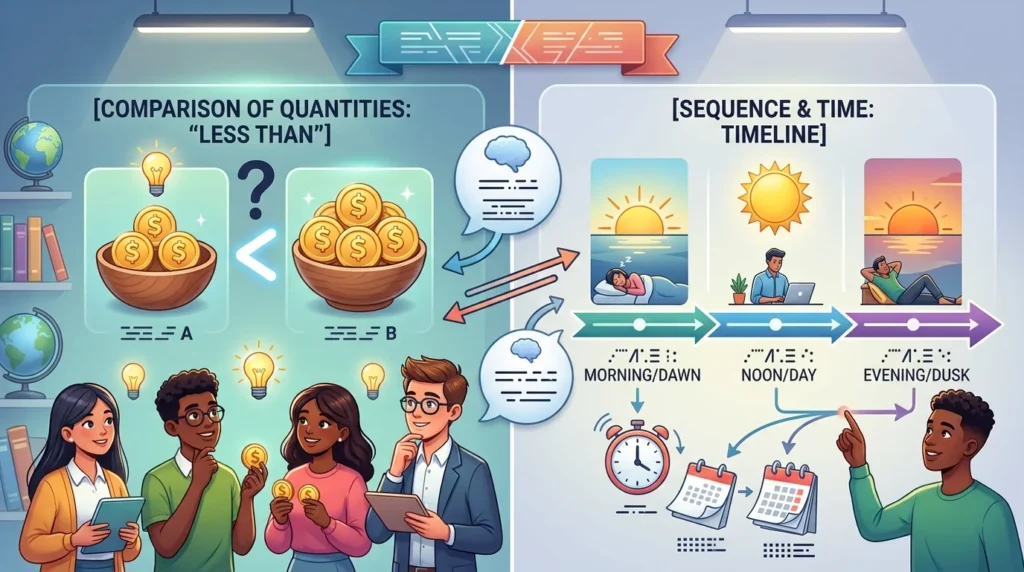
Use this simple memory rule:
THAN = comparison.
THEN = time or what comes next.
Another quick test is to ask yourself:
- Am I comparing two amounts, values, degrees, or things? → Use than.
- Am I talking about what happened next? → Use then.
- Am I referring to a particular time? → Use then.
- Am I describing a result or consequence? → Then may be appropriate.
For example, “The job took less than three hours” is a comparison. “Finish the job, then call me” describes sequence.
Real-Life Situations
In an Interview
Correct: “I can complete the task in less than two hours.”
The speaker compares the expected completion time with two hours.
In a Business Meeting
Correct: “The new software costs less than the current system.”
The sentence compares two prices.
In an Email
Correct: “We expect the repair to take less than a day.”
The repair duration is being compared with one day.
In a Text Message
Correct: “I’ll be there in less than 15 minutes.”
The arrival time is being compared with 15 minutes.
In an Exam
Correct: “Write an answer of less than 200 words.”
The required word count is compared with 200 words.
In Instructions
Correct: “Save the file, then close the application.”
Here, then is correct because closing the application comes after saving the file.
Practice Quiz
Choose than or then in each sentence.
- The package weighs less ___ five kilograms.
- Finish the form, ___ submit it.
- The repair took less ___ an hour.
- If the problem continues, ___ contact support.
- She spent less ___ $100.
- We finished dinner and ___ went home.
- This option is less expensive ___ the other one.
- The course lasted less ___ six weeks.
- I lived there ___.
- The report contains less ___ 1,500 words.
Answers
- than — comparison with five kilograms.
- then — shows the next action.
- than — compares the duration with one hour.
- then — introduces the consequence.
- than — compares the amount with $100.
- then — shows what happened next.
- than — compares the two options.
- than — compares the course duration with six weeks.
- then — refers to a particular past time.
- than — compares the word count with 1,500.
Frequently Asked Questions
Is “less than” correct?
Yes. Less than is the standard English expression used to compare a smaller amount, number, degree, value, or measurement with another. For example, “The package weighs less than 5 kg.”
Is “less then” ever correct?
Not when then is being used as a substitute for comparative than. However, the separate words less and then can appear next to each other when each has its own function, such as “The noise became less, then stopped.”
Should I write “less than 10” or “less then 10”?
Write less than 10. The sentence compares an amount or number with 10, so the comparative word than is required.
Why do people confuse than and then?
The words have similar spelling and can sound similar in speech. Fast pronunciation, typing mistakes, and the fact that both are very common English words can make the confusion easy to miss.
Does “than” always indicate a comparison?
In standard modern English, than is strongly associated with comparisons. It commonly joins two parts of a comparison, including constructions with more and less.
What does “then” mean in English?
Then has several common meanings. It can refer to a particular time, indicate what happens next, add another point, or introduce a result or consequence.
Is “less than” used with time?
Yes. You can use less than to compare a duration with a time measurement: “The trip took less than three hours” or “The task will take less than ten minutes.”
Is “less than” formal or informal?
It is standard in both formal and informal English. You can use it in everyday conversation, professional emails, academic writing, reports, and technical documents.
Is there an American and British difference between “less than” and “less then”?
No meaningful regional spelling difference exists for this distinction. Standard American and British English use less than for comparisons, while then retains its separate meanings.
What is the easiest way to remember than and then?
Remember: than = comparison and then = time, sequence, or result. If you can replace the idea with “compared with,” choose than.
Why doesn’t spellcheck always catch “less then”?
Because then is a correctly spelled English word. Basic spellcheck may not understand that the sentence requires than because the error is one of word choice and grammar rather than spelling.
What is the difference between “less than” and “fewer than”?
Less than is commonly used with amounts and uncountable quantities, while fewer than is traditionally used with plural countable nouns. For example, “less than five minutes” and “fewer than five people.” The choice between less and fewer is a separate issue from the than/then distinction.
Quick Summary
Less than is the correct phrase when you are making a comparison. Use it for numbers, amounts, prices, measurements, durations, degrees, values, and similar comparisons: “The package weighs less than five kilograms.” Less then is normally an error because then does not function as the comparative word. Then has different uses, including referring to a time, showing what happens next, or indicating a result: “We finished the meeting, then we went home.” The easiest memory rule is simple: than = comparison; then = time, sequence, or result. This distinction applies in both American and British English and in both formal and informal writing.
See Also: EMPHASIZED Meaning in Text Messages: Complete Guide with Real Examples