
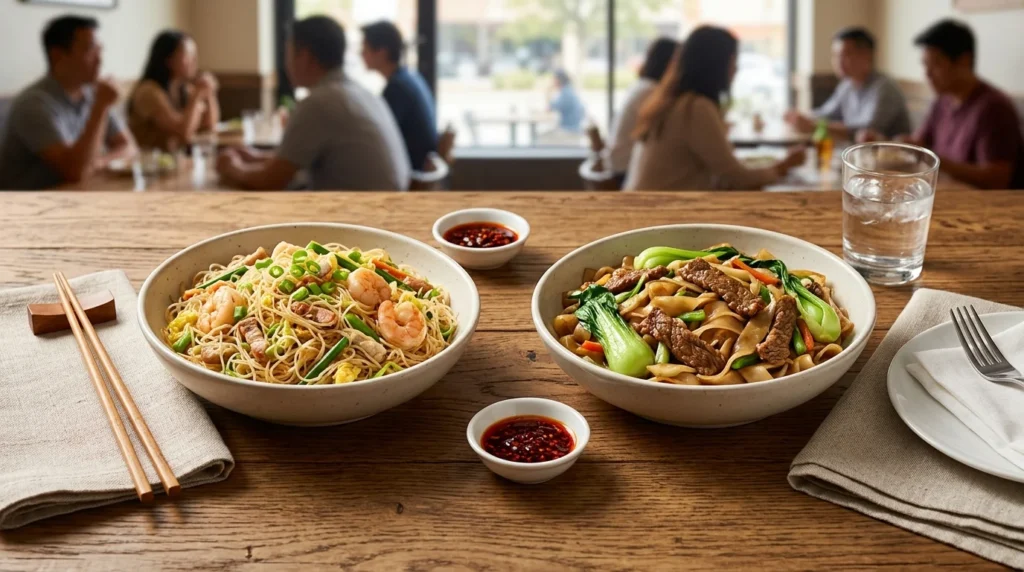

Mei fun and chow fun are different types of Chinese rice-noodle dishes, not two names for exactly the same noodle. Mei fun generally uses thin, round rice vermicelli, while chow fun uses wide, flat rice noodles. That difference changes the noodles’ texture, appearance, cooking behavior, and the dishes in which they are commonly used. Both can be stir-fried with meat, seafood, vegetables, eggs, and savory seasonings, but they produce very different eating experiences.
Quick Answer
The easiest way to remember mei fun vs chow fun is to look at the noodle shape. Mei fun uses thin rice vermicelli, similar to fine strands, while chow fun uses wide, flat rice noodles that resemble soft ribbons. Mei fun is commonly used in stir-fries, soups, and other rice-noodle preparations, while chow fun is strongly associated with Cantonese-style dishes such as beef chow fun. They are both rice-based, but they are not interchangeable in every recipe.
What Is Mei Fun?
Mei fun is a term commonly used for thin rice vermicelli. The noodles are narrow, round strands made primarily from rice, and they are often sold dried. Once cooked or rehydrated, they become soft and relatively delicate while retaining some springiness.
The exact preparation varies by cuisine and restaurant. Mei fun can appear in stir-fries, soups, cold noodle preparations, and other dishes. In North American Chinese restaurants, you may also see dishes such as Singapore mei fun, which commonly combines thin rice noodles with vegetables, egg, seafood or meat, and curry-seasoned flavors.
The important point is that mei fun identifies the thin rice-noodle style, rather than one single fixed recipe. Ingredients, sauces, spices, and cooking methods can vary considerably.
What Does Mei Fun Look Like?
Dry mei fun usually looks like a bundle of very thin, pale strands. After soaking or cooking, the noodles become soft and flexible.
A useful visual comparison is fine spaghetti or vermicelli, although the ingredients and culinary traditions are different.
The thin strands give mei fun a relatively light appearance and allow sauces, seasonings, vegetables, and other ingredients to become distributed throughout the dish.
What Does Mei Fun Taste Like?
Mei fun itself tends to have a relatively mild rice-noodle flavor. Much of the final taste comes from the ingredients and seasoning used in the particular dish.
For example, one restaurant’s chicken mei fun might be seasoned primarily with soy sauce and vegetables, while Singapore-style mei fun may have a noticeable curry flavor.
So it is more accurate to describe mei fun as a type of noodle used in different preparations rather than saying every mei fun dish has one specific taste.
What Is Chow Fun?
Chow fun generally refers to dishes made with wide, flat rice noodles, particularly in Cantonese cooking. These noodles are much broader than mei fun and have a soft, slippery, substantial texture when cooked.
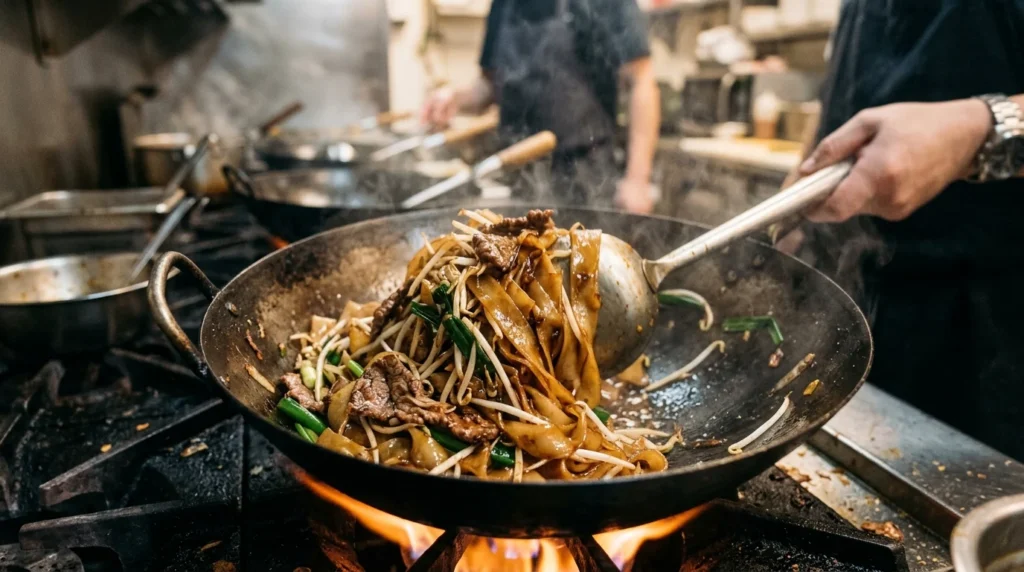
One of the best-known examples is beef chow fun, a Cantonese-style stir-fried dish featuring wide rice noodles, beef, vegetables or bean sprouts, and savory seasonings. High-heat wok cooking can contribute a characteristic smoky, toasted quality to the finished dish.
Chow fun is also associated with names such as ho fun or hor fun, especially when referring to the broad rice noodles themselves in Cantonese contexts. Naming and romanization can vary between restaurants and regions.
What Do Chow Fun Noodles Look Like?
Chow fun noodles are wide and flat, usually resembling ribbons.
This makes them immediately different from the thin strands of mei fun.
The broad surface gives chow fun a distinctive mouthfeel and allows the noodles to pick up sauces and wok flavors while remaining substantial enough to handle stir-frying.
What Does Chow Fun Taste Like?
The noodles themselves have a mild rice flavor, so the finished taste depends heavily on the cooking method and accompanying ingredients.
A classic beef chow fun can have savory soy-based seasoning, beef, vegetables, and the toasted flavor created by cooking ingredients over high heat.
This is why chow fun is often described as having a more substantial, savory eating experience than a typical thin-noodle mei fun dish. The difference comes from the noodle shape as well as the preparation.
The Core Rule
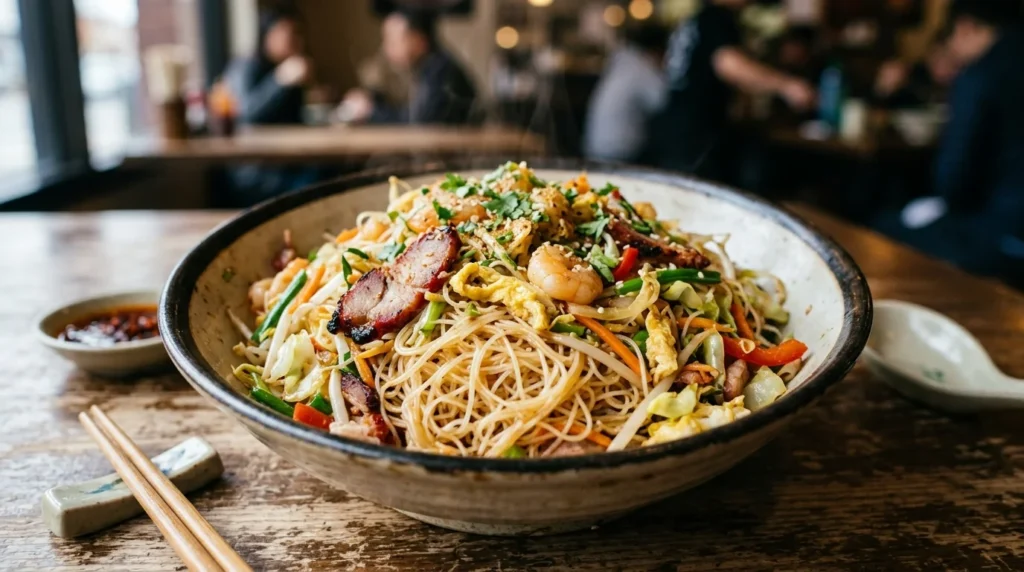
Thin and round = Mei Fun. Wide and flat = Chow Fun.
If you remember only one thing, remember the noodle shape.
- Mei fun: thin rice vermicelli
- Chow fun: wide, flat rice noodles
- Both: rice-based noodles
- Both: can be stir-fried
- Both: can be combined with meat, seafood, vegetables, and sauces
- Neither: is simply another spelling of the other
The shape is the fastest way to identify them on a restaurant menu or in a grocery store.
How to Tell Mei Fun and Chow Fun Apart
Look at the Width
This is the quickest test.
If the noodles are extremely thin strands, you are probably looking at mei fun.
If they are broad, flat ribbons, you are looking at chow fun.
Look at the Texture
Mei fun generally has a lighter, more delicate noodle structure.
Chow fun has a broader, softer, and often chewier or more substantial texture.
The exact texture depends on preparation, cooking time, and whether the noodles are fresh or dried.
Consider the Dish
A dish called beef chow fun will generally use wide, flat rice noodles.
A dish called shrimp mei fun will generally use thin rice vermicelli.
Restaurant terminology can vary, so looking at the noodles themselves is still the most reliable practical clue.
Consider How the Noodles Are Sold
Mei fun is commonly available as dried rice vermicelli.
Fresh chow fun noodles are often sold refrigerated because their broad, soft structure is different from dried vermicelli. However, packaging and availability vary by market.
Mei Fun vs Chow Fun: Main Differences
| Feature | Mei Fun | Chow Fun |
|---|---|---|
| Noodle shape | Thin and round | Wide and flat |
| Common description | Rice vermicelli | Flat rice noodles |
| Appearance | Fine strands | Broad ribbons |
| Texture | Delicate, soft, sometimes springy | Soft, slippery, substantial |
| Common preparation | Stir-fried, soups, salads and other dishes | Especially stir-fried dishes and soups |
| Famous restaurant example | Singapore mei fun | Beef chow fun |
| Typical noodle format | Often dried | Often fresh |
| Rice-based | Yes | Yes |
| Can contain meat or seafood | Yes | Yes |
| Can contain vegetables | Yes | Yes |
| Can be stir-fried | Yes | Yes |
The exact recipe is not fixed. Restaurants and regional cuisines use these noodles in different ways, so the table describes common characteristics rather than absolute rules.
Correct Examples
Restaurant Conversation
“I usually order chicken mei fun because I like thin rice noodles.”
Ordering Beef Chow Fun
“Could I have the beef chow fun with extra bean sprouts?”
Talking About Texture
“Chow fun has much wider noodles than mei fun.”
Grocery Shopping
“I need mei fun for this recipe, not the wide chow fun noodles.”
Describing a Dish
“The shrimp mei fun was lightly seasoned and full of vegetables.”
Discussing Cantonese Food
“Beef chow fun is a well-known Cantonese-style noodle dish.”
Comparing Two Plates
“The mei fun is made with thin strands, while the chow fun uses flat noodles.”
Restaurant Review
“The chow fun had soft, wide noodles with a strong wok-cooked flavor.”
Cooking at Home
“I soaked the mei fun before adding it to the stir-fry.”
Menu Recommendation
“If you prefer wide, chewy noodles, you may want to try chow fun.”
Food Discussion
“Both dishes use rice noodles, but their shapes are completely different.”
Asking a Server
“Does your chow fun come with wide flat rice noodles?”
Common Mistakes
Mistake: Thinking Mei Fun and Chow Fun Are the Same Noodle
They are both rice-based, but their shapes are different.
Mei fun uses thin rice vermicelli.
Chow fun uses wide, flat rice noodles.
The shared rice base is probably the main reason they are sometimes confused.
Mistake: Assuming “Chow” Means a Particular Noodle Shape
The terminology can be confusing because words used in Chinese food names can describe either a preparation, a noodle style, or both depending on the expression and language context.
It is better to identify the actual noodle rather than assuming that every dish containing “chow” uses the same shape.
Mistake: Confusing Chow Fun With Chow Mein
Chow fun and chow mein are not the same thing.
Chow fun is associated with broad rice noodles.
Chow mein generally refers to Chinese stir-fried noodles that are typically wheat-based.
The names sound similar in English, but the noodle types can be very different.
Mistake: Assuming Singapore Mei Fun Is a Different Noodle
Singapore mei fun is a particular dish preparation using thin rice noodles. The name does not mean that the noodles suddenly become a different type of noodle.
The dish is commonly associated with curry-seasoned flavors in Chinese restaurant menus, although recipes vary.
Mistake: Assuming Every Mei Fun Dish Is Dry
Many restaurant versions are relatively dry compared with saucy noodle dishes, but mei fun can also be used in soups and other preparations.
The noodle name alone does not dictate one universal cooking method.
Why People Confuse Mei Fun and Chow Fun
They Are Both Rice-Based
This is the biggest source of confusion.
Both use rice-based noodles, so someone unfamiliar with Chinese noodle varieties may reasonably assume they are simply different names for the same thing.
The crucial distinction is shape.
See Also: Steam or Steem Differences: Which Word Is Correct?
The Names Sound Similar
Both terms end in fun, and both commonly appear on Chinese restaurant menus.
That shared terminology makes them look more closely related than they are from a diner’s perspective.
Restaurant Menus Vary
Chinese food names can appear in different romanizations and English descriptions.
You may encounter terms such as mei fun, mai fun, rice vermicelli, chow fun, ho fun, or hor fun.
This variation can make menu comparisons more difficult.
They Share Many Ingredients
Both dishes may contain:
- Chicken
- Beef
- Pork
- Shrimp
- Egg
- Bean sprouts
- Onions
- Peppers
- Other vegetables
- Soy-based seasonings
Because the ingredients can overlap, the noodles themselves become the main visual distinction.
Mei Fun in Real English
“Mei fun” is a natural English-language food term, especially in restaurant menus, Chinese-American food discussions, recipes, and descriptions of Asian noodles. It is commonly used as a borrowed culinary term rather than translated every time into “rice vermicelli.” In ordinary writing, either mei fun or rice vermicelli may be appropriate depending on whether you are referring to a specific menu dish or explaining the noodle to someone unfamiliar with the term.
“I ordered mei fun.”
This is natural when talking about a restaurant meal.
The listener may understand it as a particular dish made with thin rice noodles.
“I bought rice vermicelli.”
This is useful when discussing the noodle as an ingredient rather than a finished restaurant dish.
“I bought mei fun noodles.”
This is also understandable and natural in cooking contexts, particularly when shopping for ingredients.
“I ordered chow fun.”
This is natural when referring to the restaurant dish.
If greater clarity is needed, you can say “I ordered beef chow fun” or describe it as a dish made with wide flat rice noodles.
Chow Fun in Real English
“Chow fun” is a natural culinary term in English, especially in restaurant menus and discussions of Chinese food. The term is commonly associated with wide, flat rice noodles and dishes made from them. Depending on the restaurant or regional naming convention, related terms such as ho fun or hor fun may also appear. These variations reflect differences in transliteration and culinary terminology rather than simple spelling errors.
“Beef chow fun”
This is one of the clearest ways to use the term because it identifies both the dish and its main protein.
“Wide rice noodles”
This is useful when explaining chow fun to someone who does not know the term.
“Chow fun noodles”
This can be used when referring specifically to the noodles rather than the finished dish.
Is There a Difference Between Mei Fun and Rice Vermicelli?
In many English-language food contexts, mei fun is used for thin rice vermicelli or rice-stick noodles. However, food terminology is not perfectly standardized across every region, manufacturer, or restaurant.
That means rice vermicelli is the clearer descriptive term when explaining the noodle to a general audience.
If a restaurant menu says mei fun, it generally signals the thin rice-noodle style rather than the wide flat noodles associated with chow fun.
Is Chow Fun the Same as Ho Fun or Hor Fun?
The terms are closely related.
Ho fun and hor fun are common English romanizations associated with the broad, flat rice noodles used in Cantonese cuisine. Chow fun is commonly used for dishes prepared with these wide rice noodles, particularly stir-fried preparations.
Romanization varies because Chinese words can be represented in English in different ways.
Therefore, you may encounter several spellings on menus without those spellings necessarily representing completely different foods.
Mei Fun vs Chow Fun for Different Preferences
If You Like Thin Noodles
Mei fun is the obvious style to consider because its noodles are thin and delicate.
The fine strands also work well with vegetables, seafood, meat, eggs, and different seasoning styles.
If You Like Wide Noodles
Chow fun is the better match for someone who prefers broad, flat noodles.
Its substantial shape creates a very different bite from thin vermicelli.
If You Like Wok-Cooked Flavor
Chow fun is strongly associated with high-heat stir-frying, particularly in dishes such as beef chow fun. High-temperature wok cooking can create the smoky character often associated with Cantonese stir-fried noodles.
If You Want Versatility
Both are versatile.
Mei fun can be stir-fried, added to soups, or used in other preparations.
Chow fun is especially well known in stir-fries but can also appear in soup-based dishes.
Which One Should You Choose?
There is no universal “better” option because the two noodles provide different textures and culinary experiences.
Use this simple decision guide:
- Want very thin rice noodles? Choose mei fun.
- Want wide, flat rice noodles? Choose chow fun.
- Want a classic beef-and-flat-noodle combination? Consider beef chow fun.
- Want a thin noodle stir-fry? Consider mei fun.
- Cooking a recipe that specifically calls for one? Use the specified noodle because changing the shape can change the texture and cooking behavior.
- Not sure at a restaurant? Ask whether the dish uses thin vermicelli or wide flat rice noodles.
Real-Life Situations
At a Chinese Restaurant
Customer: “What’s the difference between the mei fun and chow fun?”
Server: “The mei fun has thin rice vermicelli, while the chow fun has wide flat rice noodles.”
At an Asian Grocery Store
Customer: “I’m looking for the noodles used in mei fun.”
Employee: “Look for thin rice vermicelli or rice-stick noodles.”
The exact labeling will depend on the store and brand.
Cooking a Recipe
A recipe specifically calling for mei fun should generally not be replaced with chow fun without expecting a major texture change.
The noodles have very different widths and cooking characteristics.
Ordering for Someone Else
If someone says they prefer wide, chewy rice noodles, chow fun is the more relevant menu term to investigate.
If they prefer thin rice vermicelli, mei fun is the closer match.
Writing a Food Description
A clear description would be:
“Mei fun is made with thin rice vermicelli, while chow fun uses wide, flat rice noodles.”
This gives the reader the essential distinction immediately.
Mei Fun vs Chow Fun and Nutrition
It is tempting to declare one automatically healthier than the other, but that would be too simplistic.
The nutritional profile of a finished noodle dish depends on much more than noodle shape. Portion size, oil, sauce, meat, seafood, vegetables, and other ingredients can substantially change the final meal.
For example, a heavily oil-coated mei fun dish is not automatically a lighter choice simply because the noodles are thin. Likewise, a vegetable-heavy chow fun dish may have a different nutritional profile from a meat-heavy version.
So the most reliable comparison is:
Mei fun and chow fun differ primarily in noodle shape and culinary use, not because one is universally “healthy” and the other is not.
Can You Substitute Mei Fun for Chow Fun?
Sometimes, but the result will not be the same.
If a recipe calls for wide, flat chow fun noodles and you substitute thin mei fun, the noodles will have a different texture and will interact with the sauce and other ingredients differently.
The reverse is also true.
Substitution may work if your main goal is simply to create a rice-noodle dish, but it should not be expected to reproduce the original recipe exactly.
For recipes where noodle texture is central, using the specified noodle is the safer choice.
See Also: LLS Meaning in Text Messages – Definition & Explained Simply
Can You Substitute Chow Fun for Mei Fun?
You can experiment, but you should expect a different dish.
Chow fun’s broad noodles are substantially different from the thin strands used in mei fun.
They require different handling and produce a different bite.
If a recipe depends on thin noodles being quickly rehydrated and tossed with other ingredients, replacing them with wide fresh noodles can change both the cooking process and final texture.
A Simple Memory Trick
Use this visual memory trick:
Mei fun = fine noodles.
Think of the noodles as fine, thin strands.
Chow fun = broad noodles.
Think of the noodles as wide, flat ribbons.
The goal is not to memorize every regional terminology difference. If you can identify thin versus wide, you can solve most menu and grocery-store confusion immediately.
Frequently Asked Questions
Are mei fun and chow fun made from the same ingredient?
Both are generally rice-based noodles, but they have different shapes and culinary uses. Mei fun is typically thin rice vermicelli, while chow fun uses wide, flat rice noodles.
Is mei fun the same as rice noodles?
Mei fun is a type of rice noodle, specifically the thin vermicelli style commonly identified as rice vermicelli or rice sticks. “Rice noodles” is a broader description that can include several different shapes and styles.
Is chow fun the same as rice noodles?
Chow fun uses rice noodles, but “rice noodles” is a broad category. Chow fun specifically refers to the wide, flat style associated with the dish.
Is chow fun usually made with beef?
Beef chow fun is a particularly well-known preparation, but chow fun can also be made with chicken, pork, shrimp, seafood, vegetables, or other ingredients. The name primarily identifies the noodle and dish style, not one required protein.
What is Singapore mei fun?
Singapore mei fun is a common restaurant-style preparation using thin rice noodles. It is often stir-fried with ingredients such as vegetables, egg, shrimp, pork, or other proteins and is commonly associated with curry-seasoned flavoring. Recipes vary between restaurants.
Why are chow fun noodles so wide?
The wide, flat shape is a defining feature of the noodle style and contributes to its characteristic soft, slippery, substantial texture. It also provides a broad surface for sauces and high-heat wok cooking.
Are mei fun noodles gluten-free?
Plain rice noodles are naturally gluten-free, but a prepared restaurant dish is not automatically gluten-free. Sauces, seasonings, shared cooking equipment, and other ingredients can introduce gluten. Anyone who needs to avoid gluten should check the specific product or restaurant preparation.
Are chow fun noodles gluten-free?
Plain chow fun noodles made from rice are generally gluten-free, but the complete dish may contain gluten through sauces or other ingredients. Always check the ingredients and preparation if gluten avoidance is medically necessary.
Can mei fun and chow fun be used interchangeably?
They can sometimes be substituted in experimental cooking, but they do not provide the same texture. Mei fun is thin and delicate, while chow fun is broad and substantial. A recipe designed around one noodle may not produce the intended result with the other.
Why does beef chow fun sometimes taste smoky?
High-heat wok cooking can produce the characteristic smoky, toasted flavor often associated with Cantonese stir-fried dishes. This quality is commonly called wok hei, although the intensity depends on the cooking technique, equipment, ingredients, and restaurant.
What is the easiest way to tell mei fun from chow fun?
Look at the noodles. Thin, round strands indicate mei fun; wide, flat ribbons indicate chow fun. This visual distinction is usually more useful than trying to remember every name or transliteration.
Are mei fun and chow fun the same as chow mein?
No. Chow mein is generally associated with wheat-based Chinese noodles, while mei fun and chow fun are rice-noodle styles. The similar names can cause confusion, but the noodles themselves are different.
Quick Summary
Mei fun and chow fun are different rice-noodle styles. Mei fun generally uses thin, round rice vermicelli, giving dishes a fine, delicate noodle texture. Chow fun uses wide, flat rice noodles, producing a broader, softer, and more substantial bite. Mei fun appears in many stir-fries, soups, and other preparations, while chow fun is strongly associated with Cantonese dishes such as beef chow fun. Both can include meat, seafood, vegetables, eggs, and savory seasonings, so the ingredients alone do not reliably distinguish them. The easiest rule is simple: thin strands = mei fun; wide, flat ribbons = chow fun. Related names such as ho fun and hor fun may also appear because Chinese food terms have multiple English romanizations.
See Also: GS Meaning in Text Explained Simply – Definition, Usage & Social Media Guide