
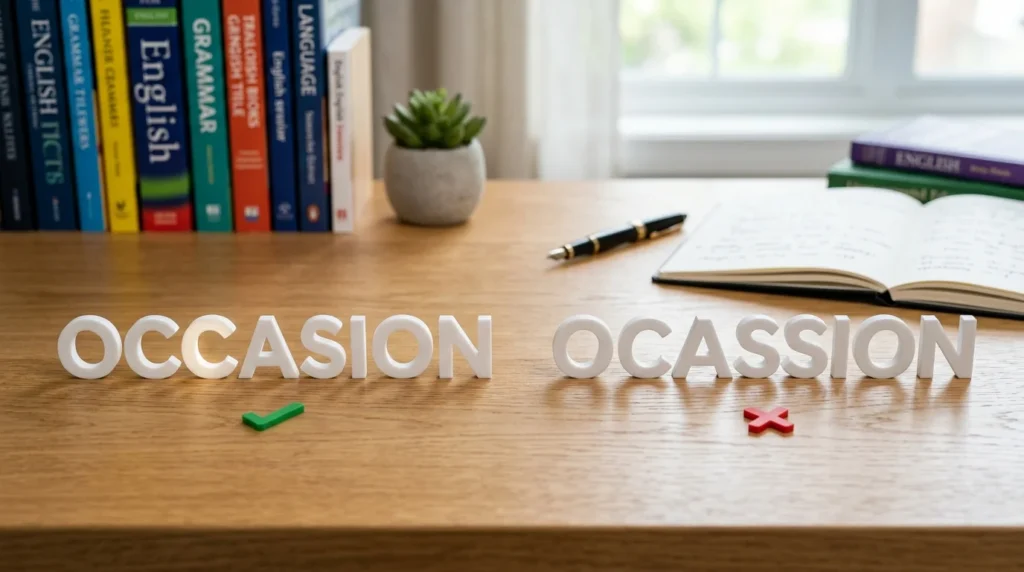

Occasion is the correct spelling. Ocassion is a common misspelling and is not a separate standard English word. The correct form contains two c’s and one s: occasion. It can mean a particular time, an event, a special event, or, in formal usage, a reason or cause. Both American and British English use the spelling occasion.
What Is the Difference Between Occasion and Ocassion?
The difference is straightforward: occasion is the standard English word, while ocassion is an incorrect spelling of that word. The two forms do not have different meanings or different grammatical roles.
Occasion is commonly used for a particular time when something happens, especially a special or formal event. It can also refer to a reason or opportunity in certain constructions. For example, you can say, “The wedding was a special occasion” or “We met on several occasions.”
Ocassion should not be treated as an alternative spelling. If you are writing an email, essay, invitation, report, resume, or social media post in standard English, use occasion.
Why It Matters
A spelling error may not change what a reader understands, but it can affect how polished and reliable your writing appears. This matters particularly in professional emails, academic assignments, invitations, applications, business documents, and published content.
The problem is especially easy to miss because ocassion looks plausible. The letters are almost identical to the correct word, and the pronunciation does not clearly reveal where the doubled letter belongs. That makes this a spelling-memory problem rather than a difference in meaning.
Knowing the correct form also helps with related words such as occasional and occasionally, which keep the same basic spelling pattern.
The Core Rule

Use “occasion” with two C’s and one S. Do not use “ocassion” in standard English.
Easy pattern: O C C A S I O N
- occasion = correct
- ocassion = incorrect
- occassion = incorrect
- ocasion = incorrect
A useful memory trick is to remember CC + ASION. The two C’s come before the A, while there is only one S later in the word.
How to Use Occasion
Occasion is mainly a noun. It has several related meanings, so it is useful to understand the context rather than memorizing only one definition.
1. A special or important event
Use occasion when talking about a celebration, ceremony, milestone, or other notable event.
Example: Her graduation was a memorable occasion.
2. A particular time when something happens
Occasion can refer to a specific instance or time when something happened.
Example: We discussed the issue on several occasions.
This is why phrases such as on several occasions, on that occasion, and on this occasion are common in English.
3. A reason or opportunity in certain expressions
In more formal constructions, occasion can refer to a reason or situation that makes an action appropriate or necessary. For example, I have never had occasion to complain means that I have never had a reason or need to complain.
This meaning should not be confused with opportunity. The two words can overlap in some contexts, but they are not interchangeable in every sentence.
See Also: Anual or Annual Differences: Which Spelling Is Correct?
4. Occasion as a verb
Occasion can also function as a verb, although this use is formal and much less common than the noun. As a verb, it means to cause something to happen.
Example: The unexpected decision occasioned considerable concern.
Modern dictionary guidance identifies this verb use as formal.
Correct Examples
- The wedding was a beautiful occasion.
- We have met on several occasions.
- She wore her favorite dress for the special occasion.
- The award ceremony was an important occasion for the school.
- I only visit that restaurant on special occasions.
- We discussed the problem on more than one occasion.
- Please bring a formal outfit for the occasion.
- The meeting provided an occasion to review the company’s progress.
- He has, on occasion, helped his colleagues after work.
- The professor used the occasion to explain the new research method.
- This is a good occasion to thank everyone who helped us.
- The announcement occasioned a great deal of discussion.
Incorrect vs. Correct
| ❌ Incorrect | ✅ Correct | Why |
|---|---|---|
| It was a special ocassion. | It was a special occasion. | Ocassion is a misspelling. The standard spelling has two C’s and one S. |
| The wedding was a memorable ocassion. | The wedding was a memorable occasion. | The noun for a special event is spelled occasion. |
| We met on several ocassions. | We met on several occasions. | The plural is occasions, retaining the double C. |
| She bought a dress for the ocassion. | She bought a dress for the occasion. | The correct spelling remains occasion after the article the. |
| This is a formal ocassion. | This is a formal occasion. | Ocassion is not a standard spelling variant. |
| We rarely celebrate on such an ocassion. | We rarely celebrate on such an occasion. | The word takes two C’s before the A. |
| It was an important ocassion for the team. | It was an important occasion for the team. | The correct noun is occasion. |
| I have seen him on many ocassions. | I have seen him on many occasions. | The plural form is spelled occasions, not ocassions. |
| They decorated the hall for the ocassion. | They decorated the hall for the occasion. | The standard spelling contains double C, single S. |
| She gave a speech on the ocassion. | She gave a speech on the occasion. | Ocassion has no separate meaning; it is simply a spelling error. |
| We celebrate this day on every ocassion. | We celebrate this day on every occasion. | The noun should be written occasion. |
| It was a rare ocassion to meet everyone. | It was a rare occasion to meet everyone. | The correct word uses two C’s and one S. |
Why People Make This Mistake
The mistake usually comes from the unusual visual pattern of the word. Occasion contains two C’s followed by a single S, while many familiar English words contain a doubled S. When writers remember the general sound of the word but not its exact spelling, they may place the double letter in the wrong position.
Pronunciation does not show the spelling clearly
Occasion is pronounced approximately /əˈkeɪ.ʒən/. The spoken form does not make the two C’s visually obvious, so spelling the word entirely from sound can lead to errors.
The spelling looks familiar
Ocassion is close enough to occasion that the eye may accept it during fast typing. Familiar-looking errors can survive if the writer does not proofread carefully.
Double-letter confusion
English contains many words with double consonants, but the location of the doubled letter differs from word to word. A writer may remember that occasion contains a doubled consonant but incorrectly place the double letter on the S.
Autocorrect is not a complete solution
Spellcheck tools can help identify many spelling errors, but writers should not depend on them as the only proofreading method. Different software has different dictionaries and correction behavior, and context-sensitive tools can also make mistakes.
Translation interference
Multilingual writers may also transfer spelling patterns from another language. This can make a familiar English word look different from the form expected in standard English. When writing in English, the safest approach is to learn the English spelling directly rather than relying on a translation pattern.
Common Mistakes Checklist
- Writing ocassion: Replace it with occasion.
- Writing occassion: Do not double the S; the word has only one S.
- Dropping one C: Remember that occasion begins with occ-.
- Writing ocasian: Do not spell the word purely from pronunciation.
- Writing ocassion in the plural: The correct plural is occasions.
- Forgetting related forms: occasional and occasionally also retain the double C.
- Assuming a regional spelling: ocassion is not a British or American spelling variant.
Occasion and Ocassion in Real English
Occasion is natural and standard in everyday English. It works in conversations, invitations, school writing, workplace communication, and formal documents. Phrases such as special occasion, on occasion, and on several occasions are established English expressions. The word can refer to an event, a particular time, or, in certain constructions, a reason or opportunity.
Ocassion is not an alternative form that native speakers choose for casual speech or informal writing. It is simply a spelling error. Because the error looks very similar to the correct word, readers can usually understand the intended meaning, but that does not make the spelling acceptable in standard edited English.
The verb occasion is grammatically correct but considerably less common than the noun. It is mainly found in formal writing and means “to cause.” In everyday conversation, speakers often choose simpler verbs such as cause or lead to. For example, “The decision caused concern” is more ordinary than “The decision occasioned concern.”
See Also: SMTH Meaning in Text: Definition, Examples & Real Usage
American vs. British English
There is no meaningful spelling difference between American and British English for this word. Both varieties use occasion with two C’s and one S.
| English Variety | Correct Spelling | Incorrect Form |
|---|---|---|
| American English | occasion | ocassion |
| British English | occasion | ocassion |
| International English | occasion | ocassion |
Formal vs. Informal Usage
Occasion is suitable in both formal and informal English. You can use it in a text message about a birthday, a business email about a ceremony, or an academic sentence about a particular event.
The noun is common across registers, while the verb occasion is more formal. In everyday English, cause is often more natural than the verb occasion. Cambridge specifically labels the verb use as formal.
Occasion vs. Ocassion Comparison Table
| Feature | Occasion | Ocassion |
|---|---|---|
| Standard English word? | Yes | No |
| Correct spelling? | Yes | No |
| Number of C’s | Two | One |
| Number of S’s | One | Two |
| Meaning | Event, particular time, or related formal uses | No separate standard meaning |
| Used in American English? | Yes | No |
| Used in British English? | Yes | No |
| Suitable for professional writing? | Yes | No |
Real-Life Situations
In an interview
Correct: “I had the occasion to work with several international clients during my previous role.”
Here, occasion is used in a relatively formal construction referring to a situation or opportunity.
In a meeting
Correct: “This meeting gives us an occasion to review the results.”
The word refers to a particular situation or event that provides a reason to do something.
In an email
Correct: “Thank you for inviting me to this special occasion.”
This is a natural use of occasion for an important event.
In a text message
Correct: “Hope you have a great time on this special occasion!”
The spelling remains occasion even in casual communication.
See Also: SMS Meaning in Text Explained | What Does SMS Stand For?
In an exam
Correct: “The ceremony was an important occasion for the entire community.”
Academic and examination writing should use the standard spelling occasion.
How to Remember the Correct Spelling

The easiest memory method is to focus on the first part of the word:
OCCASION = OCC + ASION
- Start with OCC.
- Add A.
- Then add SION.
- Check that there are two C’s and only one S.
Another useful connection is to remember the related words occasional and occasionally. They keep the same occ- beginning.
For example:
- occasion
- occasional
- occasionally
If you remember OCC at the beginning, you are much less likely to turn the word into ocassion.
Frequently Asked Questions
Is occasion or ocassion correct?
Occasion is correct. Ocassion is a misspelling and is not a standard English word.
How do you spell occasion correctly?
Spell it O-C-C-A-S-I-O-N. The word contains two C’s and one S.
Does occasion have one S or two S’s?
Occasion has one S. The doubled letter is C, not S.
Why do people spell occasion as ocassion?
The error can happen because pronunciation does not clearly reveal the spelling, and writers may remember the doubled consonant but place it on the wrong letter. The visually plausible form ocassion can also survive during fast typing.
Is ocassion a British spelling of occasion?
No. British English uses occasion, just like American English. Ocassion is not a British regional spelling.
Is occasion a noun or a verb?
Occasion is most commonly a noun, meaning a particular time or event. It can also be a formal verb meaning “to cause,” as in “The decision occasioned concern.”
What is the plural of occasion?
The plural is occasions. For example: “We have discussed this on several occasions.”
Is “occasional” spelled with two C’s?
Yes. Occasional begins with the same occ- pattern as occasion.
Is “occasionally” spelled with two C’s?
Yes. The correct spelling is occasionally, with two C’s near the beginning.
Can I use occasion in formal writing?
Yes. Occasion is completely appropriate in formal writing. It can describe an event, a particular time, or certain formal situations involving a reason or opportunity.
What does “on occasion” mean?
On occasion means sometimes or from time to time, but not frequently. For example: “He visits his old school on occasion.”
What is an easy way to remember occasion?
Remember OCCASION = two C’s, one S. Think of the beginning as OCC, then complete the word as ASION.
Quick Summary
Occasion is the correct English spelling, while ocassion is a misspelling. Write occasion with two C’s and one S: O-C-C-A-S-I-O-N. The word usually functions as a noun meaning a particular time, event, or special event, and it appears in phrases such as special occasion and on occasion. It can also function as a formal verb meaning “to cause.” American and British English use the same spelling, so there is no regional reason to choose ocassion. When proofreading, remember the simple pattern OCC + ASION. If you see two S’s in ocassion, replace the spelling with occasion.
See Also: IYK Meaning in Text Explained Simply – Definition, Examples & Online Usage