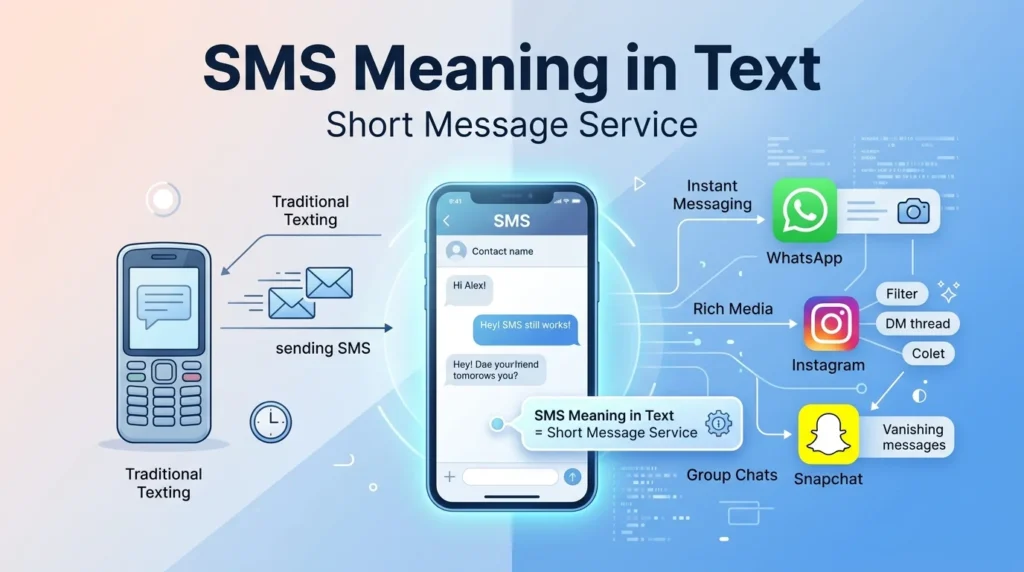

Have you ever seen someone mention “SMS” in a chat and wondered what it really means? Even though SMS is one of the oldest forms of mobile communication, many people still search for SMS meaning in text because it appears in conversations, social media posts, and messaging discussions.
In today’s world of WhatsApp, Snapchat, Instagram, and TikTok, most people use internet-based messaging apps. But SMS still exists and is widely used, especially for basic phone messaging, verification codes, and offline communication. Because of this, the term SMS is still very relevant in digital conversations.
At first glance, SMS might look like just another internet abbreviation, but it actually has a very important role in communication history. It represents one of the earliest ways people started texting on mobile phones before smartphones became popular.
Understanding SMS is important because it helps you understand how modern messaging evolved. Many people use the term without knowing its full meaning or origin, which can create confusion in technical or casual discussions.
In this guide, you will learn everything about SMS meaning in text, its definition, origin, usage in different contexts, examples, misconceptions, and how it is used in today’s digital world. By the end, you will clearly understand SMS and its role in modern communication.
Meaning & Definition
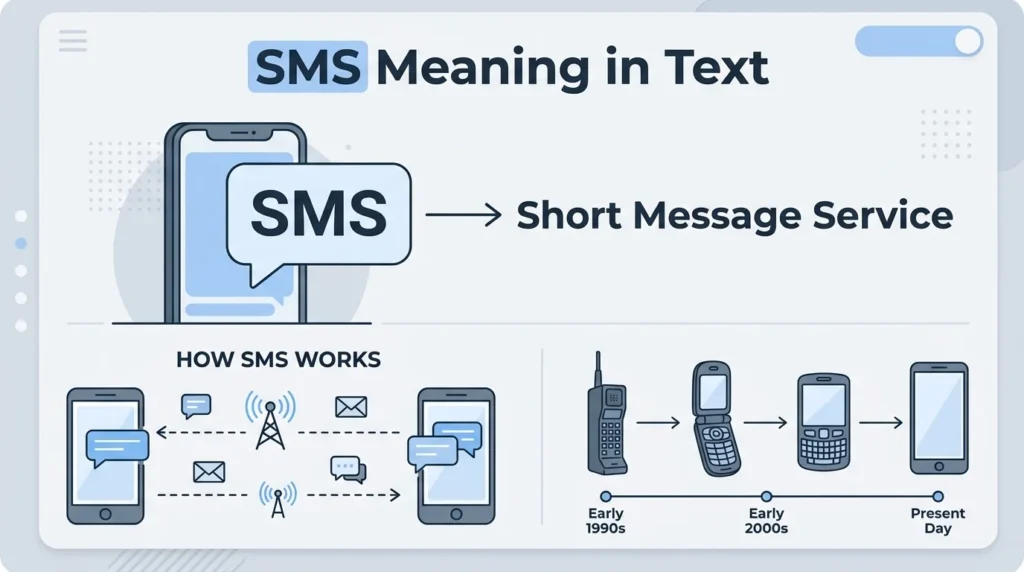
The SMS meaning in text stands for “Short Message Service.” It is a system used to send short text messages between mobile phones using cellular networks instead of the internet.
SMS is one of the earliest mobile communication technologies that allowed people to send text messages without needing apps or internet connections. It typically supports messages up to 160 characters, making it short and simple.
In simple terms, SMS is the original form of texting. Before apps like WhatsApp or Messenger existed, SMS was the main way people communicated through mobile phones.
Key features of SMS include:
- Works without internet
- Sent through mobile networks
- Limited character length
- Available on all mobile phones
- Used for basic messaging and alerts
Even today, SMS is widely used for:
- OTP verification codes
- Bank alerts
- Service notifications
- Emergency messages
Because of its reliability, SMS is still an important communication tool even in the age of internet messaging apps.
What Does SMS Meaning in Text?
SMS in text means Short Message Service, a mobile communication system used to send short text messages between phones without using the internet.
Background / Origin
The origin of SMS meaning in text dates back to the early 1980s, when mobile communication technology was still developing. Engineers working on GSM (Global System for Mobile Communications) wanted to create a simple way for users to send short messages over mobile networks.
The first SMS message was sent in 1992 by Neil Papworth, who sent the message “Merry Christmas” from a computer to a mobile phone. This moment marked the beginning of mobile texting history.
Initially, SMS was not very popular because mobile phones were expensive and messaging was limited. However, as mobile phones became more common in the late 1990s and early 2000s, SMS became extremely popular worldwide.
People started using SMS for personal conversations, business communication, and alerts. It became a major part of daily life before smartphones and internet-based apps took over.
Even today, SMS remains important for official communication, especially in banking, security verification, and government alerts. Its simplicity and reliability helped it remain relevant even after the rise of modern messaging apps.
Usage in Different Contexts
General Usage
In general communication, SMS is used to describe basic text messaging between mobile phones. It is often mentioned when talking about phone services, message delivery, or communication methods.
For example, people may say “Send me an SMS” when referring to a simple text message instead of using apps like WhatsApp or Messenger. SMS is especially useful when internet access is not available.
It is also used in discussions about mobile plans, telecom services, and messaging systems. Even though it is considered an older technology, it still plays an important role in communication systems around the world.
Formal vs Informal Usage
In formal contexts, SMS is used in technical, business, or professional communication. Companies use SMS for alerts, notifications, marketing messages, and security codes. It is considered a reliable and official communication method.
In informal contexts, SMS simply refers to sending a text message from one person to another. People may use it casually in conversations like “I’ll send you an SMS later.”
Key difference:
- Formal → Used in business, banking, and official alerts
- Informal → Used in casual texting and personal communication
SMS remains one of the most trusted messaging systems due to its simplicity and wide compatibility.
SMS Meaning on Social Media Platforms
- WhatsApp → Used when comparing traditional SMS with internet-based messaging. People often say “Send SMS instead of WhatsApp” when internet is unavailable.
- Snapchat → Rarely used directly, but mentioned when discussing old vs modern messaging systems.
- TikTok → Appears in educational or nostalgic videos explaining how texting used to work before apps.
- Instagram → Used in posts or comments discussing mobile communication history or tech comparisons.
Other Meanings in Different Fields
- Medical → SMS can sometimes refer to specific medical abbreviations depending on the context, but it is not a standard medical term.
- Physics → No direct meaning in physics; may appear only as shorthand in technical documentation.
- Technology → SMS stands for “Short Message Service,” a core part of mobile communication systems used worldwide.
Examples of SMS Meaning in Text in Sentences
- Example 1:
“I will send you the OTP via SMS.” - Example 2:
“My phone doesn’t have internet, so just send an SMS.” - Example 3:
“The bank sent me an SMS alert about my transaction.” - Example 4:
“Before WhatsApp, we used SMS to chat with friends.”
Common Misconceptions
- Misconception 1 → SMS is the same as WhatsApp
SMS does not require internet, while WhatsApp does. - Misconception 2 → SMS is outdated and useless
SMS is still widely used for banking and verification messages. - Misconception 3 → SMS is only for chatting
It is also used for alerts, notifications, and business communication.
Similar Terms & Alternatives
- MMS – Multimedia Messaging Service (supports images and videos)
- IM (Instant Messaging) – Real-time messaging over internet apps
- Chat Message – General term for online conversations
- Text Message – Casual term for SMS or messaging
- Push Notification – App-based alert messages
- DM (Direct Message) – Private message on social media
How to Respond to SMS Meaning in Text When Someone Uses It
When someone mentions SMS in conversation, they are usually talking about sending a basic text message or referring to mobile communication. Your response should be simple and clear.
- Response 1: “Yes, I’ll send you an SMS now.”
- Response 2: “Got it, I’ll check my SMS inbox.”
- Response 3: “Okay, send it via SMS if WhatsApp isn’t working.”
Difference Between SMS Meaning in Text and Similar Terms
SMS is different from modern messaging apps because it does not require internet access. Apps like WhatsApp or Telegram use data or Wi-Fi, while SMS uses mobile network services.
For example:
- SMS → Works without internet
- WhatsApp → Requires internet connection
- MMS → Sends media like images and videos
This makes SMS more reliable in areas with weak internet but less advanced in features compared to modern apps.
Relevance in Online Conversations & Dating Apps
In today’s digital world, SMS meaning in text still plays an important role even though most people use internet-based messaging apps. SMS is often used for important communication like verification codes, bank alerts, and service notifications. Because of its reliability, it is still trusted globally.
On dating apps, SMS is sometimes mentioned when users exchange phone numbers or move conversations outside the app. Some users prefer SMS when they do not want to share social media profiles immediately.
In modern communication, SMS represents a more traditional and simple form of messaging. While it is not as interactive as WhatsApp or Instagram DMs, it is still important for official and secure communication.
SMS also appears in conversations when people compare old and new technology. Many users refer to it nostalgically, remembering when texting first became popular.
Overall, SMS remains relevant because it is simple, universal, and works without internet, making it a strong backup communication method in today’s fast-paced digital world.
Frequently Asked Questions
What does SMS mean in text messages?
SMS means “Short Message Service,” used for sending text messages via mobile networks.
Is SMS still used today?
Yes, SMS is still widely used for OTPs, alerts, and notifications.
Does SMS require internet?
No, SMS works without internet using mobile networks.
What is the difference between SMS and WhatsApp?
SMS does not need internet, while WhatsApp requires internet connection.
Can SMS send images?
No, SMS only supports text messages; MMS is used for images.
Why is SMS important?
SMS is important for secure, reliable, and universal communication.
Conclusion
Understanding the SMS meaning in text helps you learn how modern communication evolved from simple mobile messaging to today’s advanced internet-based apps. SMS stands for “Short Message Service,” a technology that allows users to send short text messages through mobile networks without requiring internet access. It played a major role in shaping how people communicate digitally and remains important even today.
Although apps like WhatsApp, Instagram, and Snapchat have become more popular, SMS is still widely used for official alerts, banking notifications, and security codes. Its simplicity and reliability make it a trusted communication method worldwide.
SMS is also important because it works on all mobile phones, making it accessible to everyone regardless of smartphone or internet availability. This makes it a universal communication system that continues to support billions of messages every day.
In conclusion, SMS may be an older technology, but it is still a powerful and essential part of global communication. Understanding it not only helps you in daily conversations but also gives you insight into the history of mobile messaging and how digital communication has evolved over time.
See Also:
IBVS Meaning in Text: The Viral Slang Everyone Is Searching For
What Is LMO Meaning in Text? Simple Explanation With Real Chat Examples