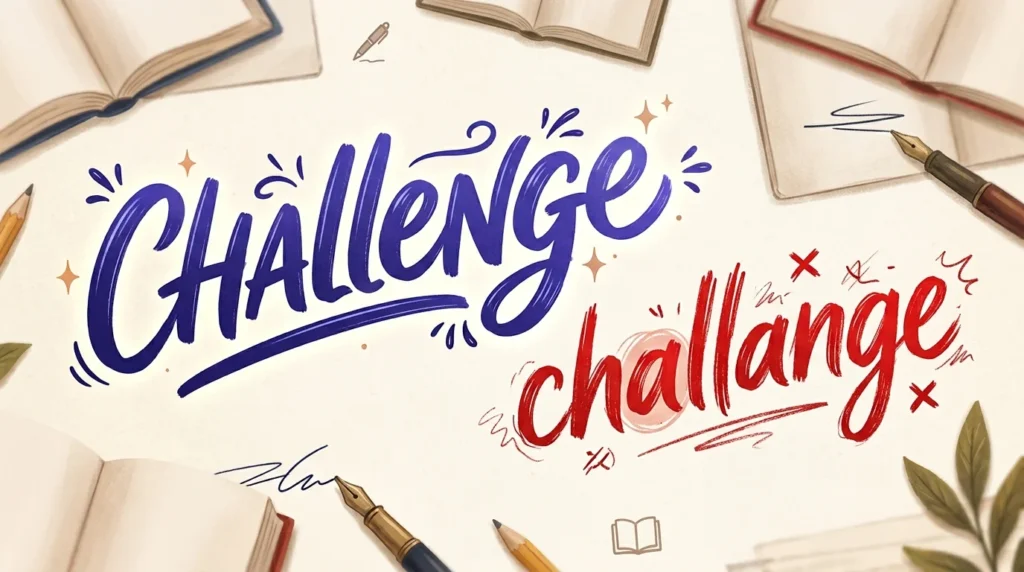

Challenge is the correct spelling, while challange is a misspelling. The word challenge can be a noun meaning a difficult task, situation, or test, and it can also be a verb meaning to question, test, or invite someone to compete. The key spelling difference is the vowel after the double l: challENGE is correct; challANGE is not.
What Is the Difference Between Challenge and Challange?
There is no difference in meaning because challange is not a standard English spelling. The correct word is challenge.
The two forms are easy to confuse because they differ by only one letter:
| Word | Correct? | Meaning |
|---|---|---|
| challenge | ✅ Yes | A difficult task, test, competition, or an act of questioning/testing |
| challange | ❌ No | Misspelling of challenge |
The important part to remember is:
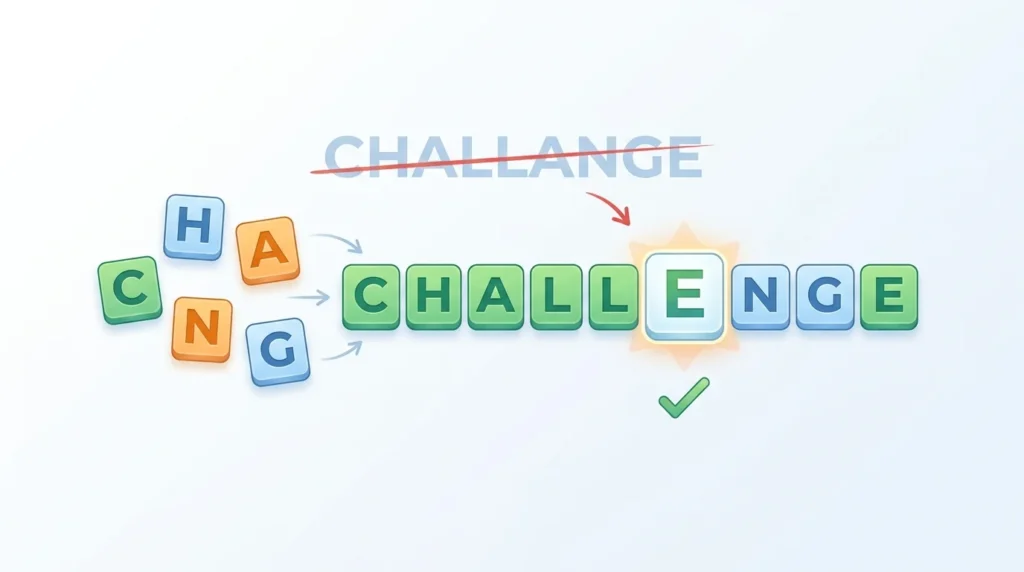
challenge → chall + enge
challange → chall + ange ❌
So if you are writing an email, essay, application, report, article, or social media post, use challenge.
Why Does the Correct Spelling Matter?
A spelling error does not always prevent someone from understanding your sentence. If you write “This project is a big challange,” most readers will understand what you mean.
However, repeated or noticeable spelling mistakes can make otherwise strong writing look unfinished. This matters especially in job applications, academic assignments, business emails, professional documents, and published content.
Because challenge is a common word used in everyday, academic, workplace, and business English, learning its spelling correctly is more useful than memorizing an isolated correction. Cambridge lists challenge as both a noun and a verb with several established meanings.
The Core Rule
Always spell the word as CHALLENGE. The correct ending is “-enge,” not “-ange.”
Think of the word in two parts:
chall + enge = challenge ✅
Not:
chall + ange = challange ❌
The easiest spelling checkpoint is the letter immediately after the double l:
- challEnge ✅
- challAnge ❌
There is no separate British, American, formal, or informal spelling called challange.
How to Use Challenge Correctly
Challenge as a Noun
As a noun, challenge commonly describes something difficult that requires effort, ability, determination, or skill.
Examples include:
- Learning another language can be a challenge.
- The final exam was a serious challenge.
- Starting a new business presents many challenges.
- She accepted the challenge without hesitation.
It can also refer to an invitation to compete or take part in something.
Example:
The champion accepted his rival’s challenge.
Challenge as a Verb
As a verb, challenge has several meanings.
It can mean to test someone’s ability:
The difficult assignment challenged the students.
It can mean to question or dispute something:
The lawyer challenged the accuracy of the report.
It can also mean to invite someone to compete:
She challenged her brother to a game of chess.
These are all standard uses of challenge.
Challenge in Common Expressions
You will often see challenge in phrases such as:
- face a challenge
- accept a challenge
- meet a challenge
- overcome a challenge
- rise to the challenge
- pose a challenge
- present a challenge
- take on a challenge
- challenge a decision
- challenge someone to a competition
For example:
The company faces several challenges this year.
She decided to challenge the decision.
Correct Examples
Here are original examples showing how challenge works in different situations.
- Conversation:
“Learning to drive was a real challenge for me.” - Email:
“Thank you for giving me the opportunity to take on this challenge.” - School:
“The final mathematics problem was the biggest challenge on the test.” - Workplace:
“Our team needs to overcome this challenge before Friday.” - Academic writing:
“Climate change presents a significant challenge for coastal communities.” - Social media:
“I accepted the fitness challenge and completed it today.” - Interview:
“One challenge I faced was managing several projects at once.” - Business:
“The company is facing new challenges in the international market.” - Sports:
“The young player challenged the defending champion.” - Everyday writing:
“Fixing the old computer turned into an unexpected challenge.”
Incorrect vs. Correct
| ❌ Incorrect | ✅ Correct | Why |
|---|---|---|
| This is a difficult challange. | This is a difficult challenge. | The standard spelling uses -enge, not -ange. |
| She accepted the challange. | She accepted the challenge. | Challange is a misspelling. |
| The project presents a major challange. | The project presents a major challenge. | The correct word contains e after the double l. |
| We face a new challange every day. | We face a new challenge every day. | Challenge is the standard English form. |
| He gave me a challange. | He gave me a challenge. | The noun is spelled challenge. |
| This task is quite a challange. | This task is quite a challenge. | The vowel sequence is enge. |
| The team overcame the challange. | The team overcame the challenge. | Challange is not an alternative spelling. |
| She challanged the decision. | She challenged the decision. | The past tense is challenged. |
| We are challanging the old system. | We are challenging the old system. | The correct -ing form is challenging. |
| They have several challanges ahead. | They have several challenges ahead. | The plural is challenges. |
Why People Make This Mistake
Phonetic Confusion
One major reason for the mistake is that English spelling is not always predictable from pronunciation. Challenge is pronounced approximately /ˈtʃæl.ɪndʒ/ in both British and American English, so the middle vowel may not feel obvious when someone is writing the word from sound alone.
A learner may hear the word and mentally produce an a instead of remembering the written e.
Similar Spelling Patterns
English contains many familiar words with -ange, including:
- change
- strange
- range
- arrange
- exchange
That can encourage writers to assume that challenge follows the same pattern.
It does not.
The correct pattern is -enge:
challenge
Fast Typing
When people type quickly, especially on phones, they may write a familiar-looking sequence without consciously checking every letter.
This is particularly easy with a word such as challenge, where the incorrect form looks extremely close to the correct one.
See Also: Shiny vs Shiney: Which One Is Correct?
Overgeneralization
English learners sometimes notice a spelling pattern and apply it too broadly.
For example, if someone remembers several common words ending in -ange, they may unconsciously treat that pattern as a general rule.
But spelling patterns often have exceptions, so remembering the actual spelling of frequently used words is important.
Autocomplete and Spellcheck
Spellcheck can help identify challange, but it should not be treated as a complete spelling strategy. Different apps may handle unfamiliar text differently, and a writer may overlook a suggestion while typing quickly.
The better habit is to recognize the correct spelling yourself:
challenge = chall + enge
Translation Interference
Learners who think in another language before writing English may sometimes transfer pronunciation or spelling patterns from their first language.
This can make a word such as challenge harder to spell correctly, especially when its pronunciation does not clearly reveal the written vowel.
Common Mistakes Checklist
Writing “challange” instead of “challenge”
This is the main error. Remember that the correct sequence is -enge.
Writing “challanged”
The correct past tense is challenged, not challanged.
She challenged the decision. ✅
Writing “challanging”
The correct form is challenging.
The course is challenging but rewarding. ✅
Assuming “challange” is informal English
It is not a standard informal variant. Casual writing may contain typos, but challange is still a misspelling.
Assuming British English uses “challange”
It does not. Challenge is used in both American and British English.
Avoiding the word because you cannot remember it
If you frequently hesitate, memorize the short visual pattern:
chall + enge
That is more useful than trying to reconstruct the spelling from pronunciation every time.
See Also: GMFU Meaning in Text Slang – Viral Internet Expression Explained
Challenge in Real English

Grammatically correct and natural
Challenge is completely natural in everyday English when referring to something difficult, a test of ability, a competition, or an invitation to compete. Expressions such as “face a challenge,” “accept a challenge,” and “rise to the challenge” are established and natural. Cambridge also records uses involving questioning, competition, and testing someone’s ability. (Cambridge Dictionary)
Grammatically possible but less natural
Some sentences can be grammatically possible while sounding less natural because English speakers commonly prefer a different expression. For example, “The work has challenge” is understandable in context but is not a natural everyday construction. “The work is challenging” or “The work presents a challenge” would normally communicate the idea more naturally.
Natural everyday English
In everyday English, speakers commonly use challenge with verbs such as face, accept, overcome, meet, present, pose, take on, and rise to.
For example:
“This job will be a challenge.”
“I’m ready to take on the challenge.”
“We need to overcome this challenge.”
These patterns sound natural because they match common English usage rather than simply following a dictionary definition.
American vs. British English
There is no spelling difference between American and British English for this word.
Both use:
challenge ✅
Neither standard variety uses:
challange ❌
The pronunciation is also essentially the same in the standard forms, although individual accents can naturally affect how the word sounds. Cambridge gives the same basic pronunciation for British and American English. (Cambridge Dictionary)
Formal vs. Informal Usage
Challenge works in both formal and informal English.
Formal
The project presents a significant challenge for the research team.
The committee challenged the validity of the proposal.
Informal
That exam was a real challenge.
Want to take on the challenge?
The spelling never changes between these contexts.
Challange should not be used as the normal informal version.
See Also: Mean Anagram: Definition, Examples, Solver & Guide
Challenge vs. Challange Comparison Table
| Feature | Challenge | Challange |
|---|---|---|
| Standard spelling | ✅ Yes | ❌ No |
| Standard English word | ✅ Yes | ❌ No |
| Noun | ✅ Yes | ❌ No |
| Verb | ✅ Yes | ❌ No |
| Meaning | Difficulty, test, competition, questioning, etc. | None as a standard English word |
| Formal writing | ✅ Appropriate | ❌ Avoid |
| Informal writing | ✅ Appropriate | ❌ Still incorrect |
| American English | ✅ Yes | ❌ No |
| British English | ✅ Yes | ❌ No |
| Correct middle spelling | -enge | -ange ❌ |
Real-Life Situations
Job Interview
Interviewer: “Tell me about a challenge you faced at work.”
Good answer:
“One challenge was managing several deadlines at the same time. I created a priority system and completed each project on schedule.”
Workplace Meeting
“The biggest challenge is completing the project before the deadline.”
Here, challenge is a noun referring to a difficult situation.
Professional Email
“We understand the challenge and are working on a solution.”
This is appropriate in professional communication.
Text Message
“That sounds like a challenge 😂 I’m in.”
The same spelling is used even though the message is informal.
School Assignment
“The novel explores the challenges faced by young people.”
Challenge is suitable for academic writing as well as everyday English.
Sports
“The player challenged his opponent to a rematch.”
Here, challenged is the past-tense verb.
How to Remember the Spelling
Use this simple memory trick:
The challenge has an E.
Or break it visually into:
CHALL + ENGE
When you hesitate between challange and challenge, focus only on the middle:
challE…
not
challA…
You can also connect the spelling to related forms:
- challenge
- challenges
- challenged
- challenging
- challenger
Seeing the word family repeatedly helps reinforce the correct spelling.
Quick Practice
- Choose the correct spelling: challenge / challange
- Complete the sentence: “This assignment is a difficult ______.”
- Correct the sentence: “She challanged the decision.”
- Complete the sentence: “The team faces several ______.”
- Choose the correct form: challanging / challenging
- Complete the sentence: “He ______ me to a race.”
- Is challange a British spelling?
- Is challange an informal spelling of challenge?
Answers
- challenge
- challenge
- She challenged the decision.
- challenges
- challenging
- challenged
- No.
- No.
Frequently Asked Questions
Is “challange” ever correct?
No. Challange is a misspelling of challenge in standard English. It is not an alternative spelling with a different meaning.
How do you spell challenge correctly?
The correct spelling is:
C-H-A-L-L-E-N-G-E
The important sequence is -enge.
Is challenge a noun or a verb?
It can be both. As a noun, it can mean a difficult task or situation. As a verb, it can mean to test, question, oppose, or invite someone to compete. (Cambridge Dictionary)
What is the plural of challenge?
The plural is challenges.
The company faces several challenges.
What is the past tense of challenge?
The past tense is challenged.
She challenged the decision.
How do you spell challenging?
The correct spelling is challenging.
The course is challenging but rewarding.
Is “challange” an American spelling?
No. American English uses challenge.
Is “challange” a British spelling?
No. British English also uses challenge.
Can I use “challange” in informal texting?
You might see it as a typo in casual online writing, but it is not a standard informal spelling. Use challenge instead.
Why does “challange” look correct?
It resembles words such as change, strange, range, and arrange, which can make the -ange sequence feel familiar. But challenge has -enge.
What is the easiest way to remember challenge?
Remember:
CHALL + ENGE = CHALLENGE
The correct word has E, not A, after the double L.
Quick Summary
Challenge is the correct spelling, while challange is a misspelling. Challenge can be used as both a noun and a verb. As a noun, it can describe something difficult, a test of ability, a competition, or an invitation to compete. As a verb, it can mean to test, question, oppose, or invite someone to compete. The main spelling point is the sequence after the double l: challENGE, not challANGE. The spelling is the same in American and British English, and there is no standard informal version called challange. When you are unsure, remember the simple pattern chall + enge = challenge.
See Also: SMN Meaning in Text Slang: Why Everyone Uses This Short Form Daily