
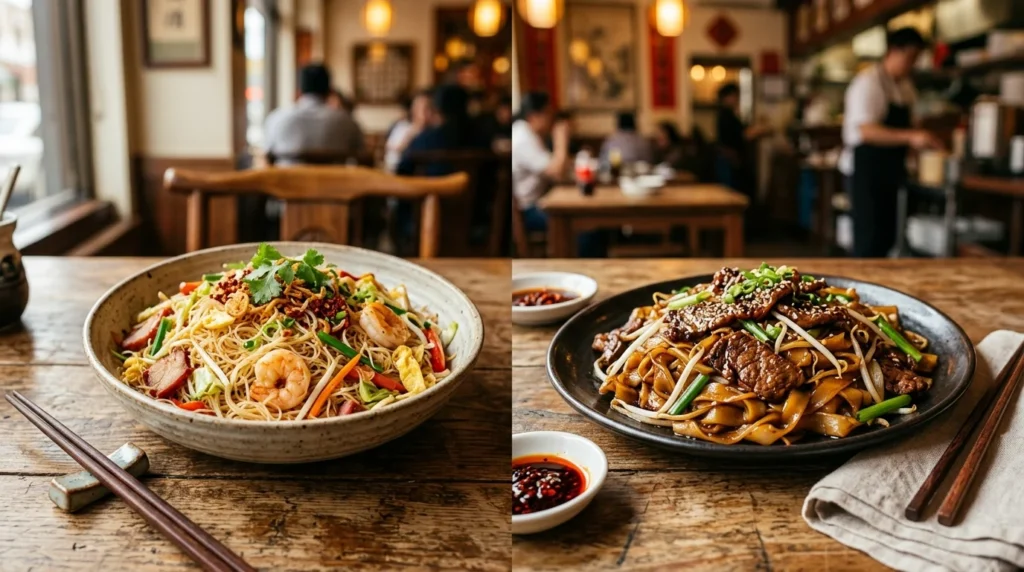

Quick Answer: Mei fun and chow fun are both Chinese rice noodle dishes, but they use very different types of noodles. Mei fun is made with thin, delicate rice vermicelli noodles, while chow fun uses wide, flat rice noodles. Mei fun tends to have a lighter, finer texture, whereas chow fun is soft, chewy, and substantial. Both can be stir-fried with meat, seafood, vegetables, eggs, and savory sauces, but their textures and traditional preparations make them distinct dishes.
What Is the Difference Between Mei Fun and Chow Fun?
The biggest difference between mei fun and chow fun is the shape and texture of the rice noodles. Mei fun is made with thin rice vermicelli, which cooks into fine, delicate strands. Chow fun is made with broad, flat rice noodles that are much wider and have a soft, slippery, chewy texture.
The two dishes can contain similar ingredients, including beef, chicken, shrimp, pork, vegetables, eggs, soy sauce, and other seasonings. However, the noodle shape changes the overall eating experience. Mei fun is usually lighter and more noodle-like, while chow fun feels more substantial because of its wide noodles.
| Feature | Mei Fun | Chow Fun |
|---|---|---|
| Noodle type | Thin rice vermicelli | Wide, flat rice noodles |
| Texture | Fine, light, and delicate | Soft, chewy, and silky |
| Appearance | Thin strands | Broad, flat ribbons |
| Common preparation | Often stir-fried | Often stir-fried |
| Popular variation | Singapore-style mei fun | Beef chow fun |
| Rice-based? | Yes | Yes |
What Is Mei Fun?
Mei fun, also spelled mai fun or commonly described as rice vermicelli, refers to very thin rice noodles. The noodles are made primarily from rice and are much finer than the broad noodles used in chow fun.
Mei fun is commonly prepared by stir-frying the noodles with ingredients such as vegetables, eggs, pork, chicken, shrimp, or other proteins. Different regional and restaurant versions can use different seasonings and ingredients, so there is no single universal mei fun recipe.
What Does Mei Fun Taste Like?
Mei fun itself has a relatively mild flavor, allowing sauces, seasonings, vegetables, and proteins to provide much of the dish’s character. Because the noodles are thin, they can absorb seasoning throughout the strands.
The finished dish can be savory, slightly sweet, spicy, smoky, or aromatic depending on the preparation. Stir-fried versions often have a pleasant combination of tender noodles and crisp vegetables.
What Is Chow Fun?
Chow fun is a dish made with wide, flat rice noodles. The noodles are substantially broader than mei fun noodles and have a soft, smooth texture. Chow fun is strongly associated with Cantonese cuisine.
One of the best-known versions is beef chow fun, traditionally prepared with wide rice noodles, beef, bean sprouts, scallions, and savory seasonings. The noodles are typically stir-fried at high heat, creating a characteristic wok-fried flavor.
See Also:
What Does IDTS Mean in Text? Full Meaning, Slang Use & Chat Examples Explained
What Does Chow Fun Taste Like?
Chow fun noodles have a mild rice flavor and a soft, chewy texture. Because they are broad and relatively substantial, they provide a different mouthfeel from the fine strands of mei fun.
The sauce and other ingredients contribute much of the flavor. Beef chow fun, for example, can have savory, aromatic, and slightly smoky flavors from the beef, soy-based seasonings, vegetables, and high-heat wok cooking.
Mei Fun vs Chow Fun Noodles
The noodles are the clearest way to distinguish these dishes. Mei fun uses thin rice vermicelli, while chow fun uses wide, flat rice noodles.
Mei fun noodles resemble very fine strands and are relatively delicate. Chow fun noodles look more like wide ribbons. Their larger surface area gives chow fun a distinctive silky and chewy texture.
See Also:
YM Meaning in Text Explained – Full Guide, Definition, Uses & Examples
| Noodle Characteristic | Mei Fun | Chow Fun |
|---|---|---|
| Width | Very thin | Wide |
| Shape | Fine strands | Flat ribbons |
| Texture | Delicate and springy | Soft and chewy |
| Cooking behavior | Can separate into many fine strands | Can remain in broad, silky pieces |
Mei Fun vs Chow Fun: Ingredients
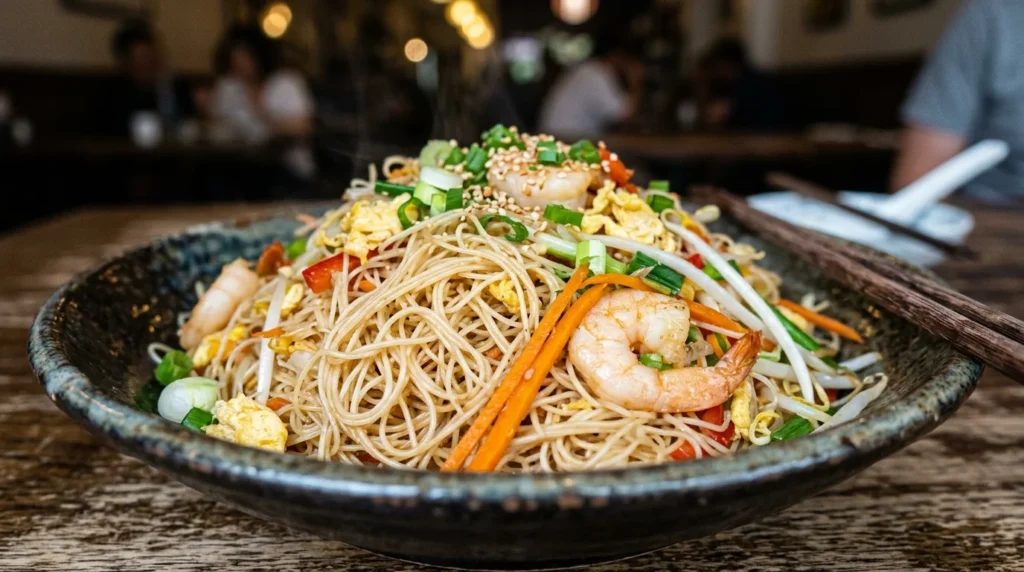
Both dishes can use many of the same ingredients, so the ingredient list alone does not always identify the dish. Restaurants may offer versions containing chicken, beef, pork, shrimp, vegetables, eggs, or combinations of these ingredients.
The major distinguishing feature remains the noodle. A stir-fried dish containing very thin rice vermicelli is generally identified as mei fun, while a dish containing broad, flat rice noodles is generally identified as chow fun.
See Also:
SOLFEGE Meaning in Text Explained – Definition, Origin & Full Guide
Common Mei Fun Ingredients
- Rice vermicelli noodles
- Eggs
- Bean sprouts
- Carrots
- Onions
- Bell peppers
- Chicken, pork, shrimp, or other protein
- Soy sauce and other seasonings
Common Chow Fun Ingredients
- Wide flat rice noodles
- Beef
- Bean sprouts
- Scallions
- Onions
- Soy sauce
- Other savory seasonings
Singapore Mei Fun vs Chow Fun
Singapore mei fun is a popular stir-fried rice vermicelli dish found on many Chinese restaurant menus. It commonly combines thin rice noodles with vegetables, eggs, and proteins such as shrimp, pork, or chicken. Curry powder is also commonly associated with Singapore-style mei fun in Chinese-American restaurant menus, giving it a distinctive yellow color and aromatic flavor.
Chow fun is different because it uses wide, flat noodles. A classic beef chow fun preparation focuses on the contrast between tender beef, broad rice noodles, bean sprouts, and savory wok flavors.
Beef Chow Fun vs Mei Fun
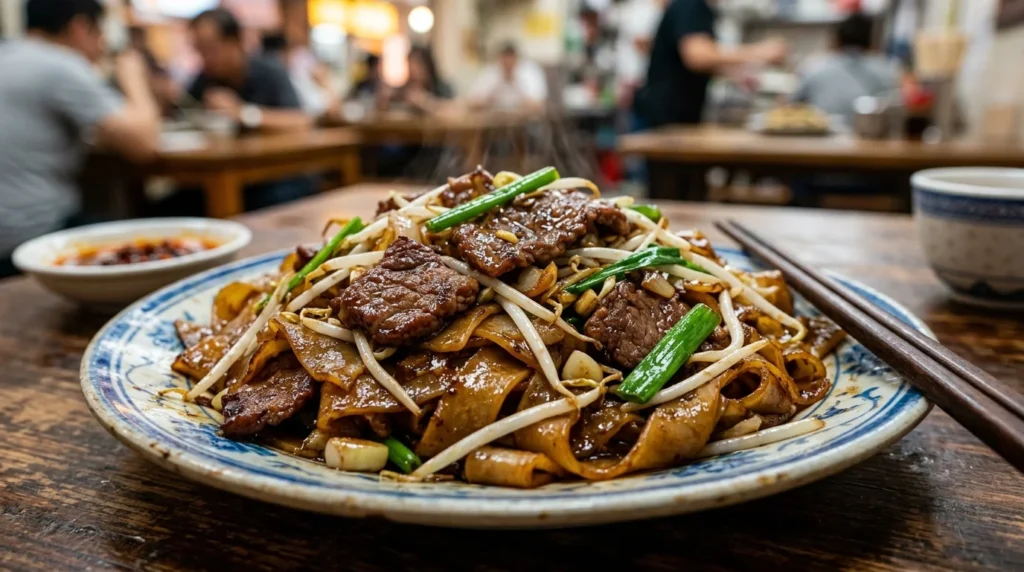
Beef chow fun and beef mei fun can both contain beef, but the noodles make them noticeably different. Beef chow fun uses wide, flat rice noodles, while beef mei fun uses thin rice vermicelli.
Beef chow fun typically has a soft, silky, chewy texture and is often associated with high-heat wok cooking. Beef mei fun is lighter and more delicate because the thin noodles create a different texture.
| Dish | Noodles | Texture |
|---|---|---|
| Beef Mei Fun | Thin rice vermicelli | Fine and delicate |
| Beef Chow Fun | Wide flat rice noodles | Soft and chewy |
How Are Mei Fun and Chow Fun Cooked?
Both dishes can be stir-fried, but their noodles require different handling. Thin mei fun noodles can cook relatively quickly and can become soft or break if overhandled. Chow fun noodles are wider and can also be delicate, especially when fresh, so cooks generally need to handle them carefully during stir-frying.
See Also:
EVB Meaning in Text Explained – Full Guide, Definition, Usage & Examples
High-heat wok cooking is important in many traditional preparations because it allows the ingredients to cook quickly while developing a characteristic roasted or smoky aroma. This effect is particularly associated with Cantonese stir-fried noodle dishes.
Texture: Mei Fun vs Chow Fun
If texture is important to you, the difference between these dishes is easy to notice. Mei fun consists of fine strands that create a lighter, more delicate bite. The noodles can mingle easily with small pieces of vegetables and protein.
Chow fun has wide noodles that feel softer, silkier, and chewier. Each noodle ribbon is much more substantial than an individual strand of rice vermicelli. This makes chow fun particularly recognizable by texture alone.
Are Mei Fun and Chow Fun Made From Rice?
Yes. Both mei fun and chow fun traditionally use rice-based noodles. However, the noodles are manufactured and shaped differently, resulting in different widths, textures, and cooking characteristics.
Rice noodles are naturally gluten-free when made solely from rice and water, but restaurant dishes can contain sauces, seasonings, or other ingredients that may contain gluten. Anyone avoiding gluten should check the ingredients and preparation methods rather than assuming a dish is automatically gluten-free.
Is Mei Fun Healthier Than Chow Fun?
Neither dish is automatically healthier simply because of its noodle shape. The nutritional profile depends heavily on the portion size, cooking oil, sauce, protein, vegetables, and preparation method.
A vegetable-heavy version with moderate oil and sauce can have a different nutritional profile from a heavily sauced or oily version containing a large amount of meat. Therefore, comparing the noodle names alone does not provide enough information to determine which particular restaurant dish is nutritionally preferable.
Mei Fun vs Chow Fun: Calories
The calorie content of mei fun and chow fun varies considerably by recipe and serving size. Restaurants may use different quantities of noodles, oil, meat, sauces, and vegetables.
Because of this variation, there is no single calorie number that applies to every serving of mei fun or chow fun. If you are tracking calories, checking the restaurant’s nutrition information or asking about portion size and ingredients will provide more useful information.
See Also:
EVB Meaning in Text Explained – Full Guide, Definition, Usage & Examples
Mei Fun vs Chow Fun: Which Noodles Are Thinner?
Mei fun noodles are thinner. They are a type of rice vermicelli and have a fine, narrow shape. Chow fun noodles are much wider and flatter.
This difference is one of the easiest ways to identify the dishes visually. Fine strands indicate mei fun, while broad, flat ribbons indicate chow fun.
Mei Fun vs Chow Fun: Similarities
Although the noodles are different, mei fun and chow fun have several similarities. Both are commonly served as savory Chinese noodle dishes and can be stir-fried with a wide range of ingredients.
- Both traditionally use rice noodles.
- Both can be stir-fried.
- Both can contain meat or seafood.
- Both can include vegetables.
- Both can use soy-based seasonings.
- Both are available in many regional and restaurant variations.
Mei Fun vs Chow Fun: Key Differences
- Noodle width: Mei fun uses thin noodles; chow fun uses wide noodles.
- Shape: Mei fun has fine strands; chow fun has flat ribbons.
- Texture: Mei fun is delicate, while chow fun is soft and chewy.
- Popular variation: Singapore mei fun is widely known, while beef chow fun is a classic preparation.
- Eating experience: Mei fun feels lighter and finer, while chow fun provides a broader, more substantial bite.
How to Choose Between Mei Fun and Chow Fun
If you enjoy thin, delicate noodles and want a dish with lots of fine strands mixed with vegetables and protein, mei fun may match that preference. Its narrow noodles also allow sauces and seasonings to distribute throughout the dish.
If you prefer soft, broad, chewy noodles with a silky texture, chow fun offers a distinctly different experience. Wide noodles are particularly noticeable in dishes such as beef chow fun, where they work well with tender meat and crunchy bean sprouts.
Frequently Asked Questions
What is the main difference between mei fun and chow fun?
The main difference is the noodle. Mei fun uses thin rice vermicelli, while chow fun uses wide, flat rice noodles. Their textures are therefore noticeably different.
Is mei fun the same as chow fun?
No. They are different rice noodle dishes. Mei fun uses thin vermicelli noodles, while chow fun uses wide, flat rice noodles.
Is mei fun made from rice?
Yes. Traditional mei fun is made from rice-based vermicelli noodles. However, the complete dish can contain other ingredients and sauces.
Is chow fun made from rice?
Yes. Traditional chow fun uses wide, flat rice noodles.
Which is thinner, mei fun or chow fun?
Mei fun is thinner. Its rice vermicelli noodles are narrow strands, while chow fun noodles are wide and flat.
What is Singapore mei fun?
Singapore mei fun is a popular stir-fried rice vermicelli dish. It commonly contains vegetables, eggs, and proteins such as shrimp, pork, or chicken, and many Chinese-American restaurant versions are seasoned with curry powder.
What is beef chow fun?
Beef chow fun is a Cantonese-style stir-fried dish made with wide, flat rice noodles and beef. Bean sprouts and scallions are also commonly used, along with savory seasonings.
Are mei fun noodles the same as rice noodles?
Mei fun noodles are a type of thin rice noodle, commonly called rice vermicelli. The term “rice noodles” can refer to a broader range of noodle shapes and sizes.
Can chow fun be made with chicken or shrimp?
Yes. Although beef chow fun is especially well known, chow fun can be prepared with chicken, shrimp, pork, vegetables, or combinations of ingredients depending on the recipe.
Can mei fun be made with beef?
Yes. Beef mei fun is a possible variation. The defining feature is the thin rice vermicelli rather than the type of protein used.
Are mei fun and chow fun gluten-free?
The traditional rice noodles themselves can be gluten-free when made only from rice and water, but the complete dish may contain soy sauce or other ingredients containing gluten. Check the specific recipe or restaurant preparation if gluten avoidance is important.
Quick Summary
Mei fun and chow fun are both Chinese rice noodle dishes, but their noodles are very different. Mei fun uses thin rice vermicelli noodles that are fine, delicate, and relatively light. Chow fun uses wide, flat rice noodles with a soft, silky, chewy texture. Both can be stir-fried with vegetables, meat, seafood, eggs, and savory seasonings. Singapore-style mei fun is a well-known variation, while beef chow fun is a classic Cantonese preparation. The easiest way to remember the difference is simple: mei fun means thin rice noodles, while chow fun means wide, flat rice noodles.
See Also:
XD Meaning in Text – Full Guide, Usage, Origin & Examples
FB Meaning in Text: What It Means (Facebook or Follow Back?)
YHU Meaning in Text Messages – Simple Explanation, Examples & Usage