


Onsite, on-site, and on site can all be correct. The choice depends on how the expression functions in the sentence. Onsite is commonly used as a modern adjective or adverb, while on-site is the traditional hyphenated form, especially when it modifies a noun. On site is a two-word phrase commonly used to describe location. For example: “We offer onsite support,” “We offer on-site support,” and “The technician is on site.”
What Is the Difference Between Onsite and On Site?
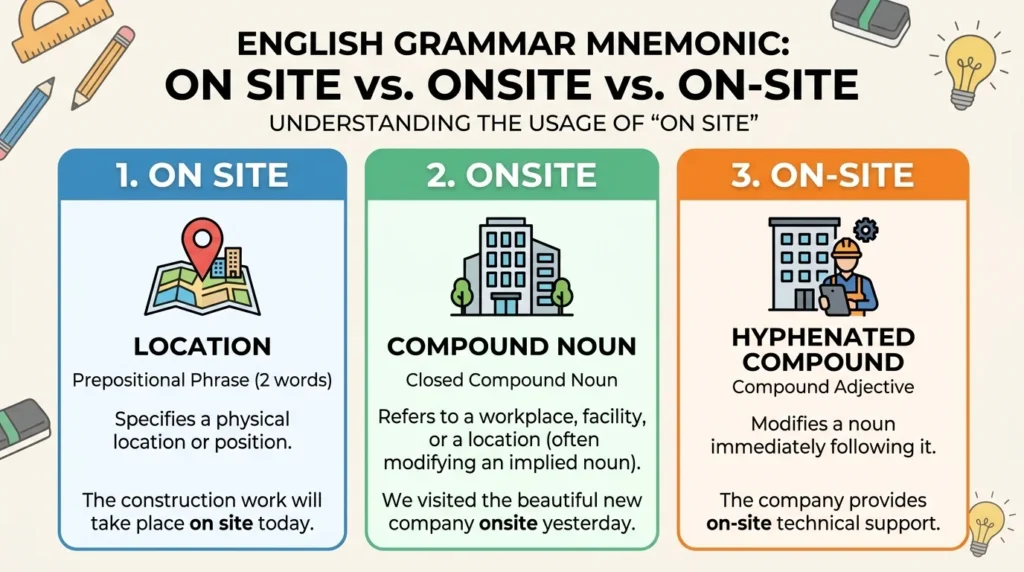
The difference between onsite and on site is mainly a matter of spelling and grammatical function.
On site is a two-word phrase meaning “at the relevant location” or “at the place where an activity is taking place.”
The engineer is on site.
Here, the phrase tells us where the engineer is.
Onsite is a closed compound, meaning the two words have been combined into one. It is commonly used to describe something that is located, provided, or happening at a particular location.
The company provides onsite training.
Here, “onsite” describes the type of training.
There is also a third form:
On-site
This hyphenated form is widely established, particularly when the expression works as a compound modifier before a noun.
The company provides on-site training.
The important point is that these forms are not simply a case of one being “right” and the others being “wrong.” Modern English uses all three, although their grammatical roles and stylistic preferences can differ.
Cambridge recognizes both onsite and on-site, including adjective and adverb uses. The American Heritage Dictionary also lists onsite as an adjective and adverb.
Why Does the Difference Matter?
A missing space or hyphen rarely changes the basic meaning of onsite or on site, but it can affect how polished and clear your writing looks.
This matters particularly in:
- Business emails
- Resumes and job descriptions
- Academic writing
- Technical documentation
- Construction reports
- IT support descriptions
- Company websites
- Workplace policies
- Professional proposals
- Instructions and notices
Compare these examples:
The technician is on site.
We provide onsite technical support.
The first sentence focuses on where the technician is. The second describes the type of support being provided.
Understanding that distinction is more useful than memorizing a rule based only on whether the word comes before or after a verb.
Also Read: PND Meaning in Text: What It Means & Why Everyone Is Searching It
The Core Rule
Use “on site” when you are treating the expression as a phrase meaning “at the location.” Use “onsite” or “on-site” when it functions as a modifier describing something associated with that location.
For example:
- The technician is on site.
- The technician provides onsite support.
- The technician provides on-site support.
- The equipment was installed on site.
- The company offers onsite installation.
- The company offers on-site installation.
The closed and hyphenated forms often overlap in meaning. The main difference between onsite and on-site is frequently editorial style rather than meaning.
How to Use “On Site”
Use on site when you want to express physical presence or location.
It commonly answers the question “Where?”
Where is the manager?
The manager is on site.
Where did the inspection take place?
It took place on site.
Where will the repairs happen?
They will happen on site.
This use is especially natural when the expression follows a verb and functions as a location phrase.
Examples of “On Site”
- The contractor is on site now.
- Our technician arrived on site at eight o’clock.
- The manager will remain on site during the inspection.
- All workers must stay on site until the project is complete.
- The equipment was repaired on site.
- The doctor is on site today.
- We met the construction team on site.
- The supervisor arrived on site before the delivery.
- The damaged machine was inspected on site.
- Staff members are required to remain on site during the event.
In each example, the expression tells the reader where someone or something is or where an action happens.
How to Use “Onsite”
Onsite is a single word. It is commonly used as an adjective to describe something available, located, or occurring at the relevant physical location.
Examples include:
- onsite training
- onsite support
- onsite parking
- onsite staff
- onsite services
- onsite facilities
- onsite interviews
- onsite repairs
- onsite security
- onsite childcare
For example:
The company provides onsite training for new employees.
Here, “onsite” describes “training.”
The hotel has onsite parking.
Here, “onsite” describes “parking.”
Modern dictionaries recognize onsite as an established form, rather than treating it simply as a mistake caused by dropping the hyphen.
Also Read: MYS Meaning in Text: What It Really Means Will Surprise You
How to Use “On-Site”
On-site is the hyphenated form.
It is particularly common when the two elements work together as a compound modifier before a noun.
Examples:
- on-site training
- on-site inspection
- on-site technician
- on-site support
- on-site services
- on-site facilities
- on-site repairs
- on-site consultation
For example:
We scheduled an on-site inspection for Monday.
The hyphen shows that “on-site” works together to modify “inspection.”
The hyphenated form is still widely accepted and appears in dictionary usage. Cambridge lists on-site as both an adjective and an adverb.
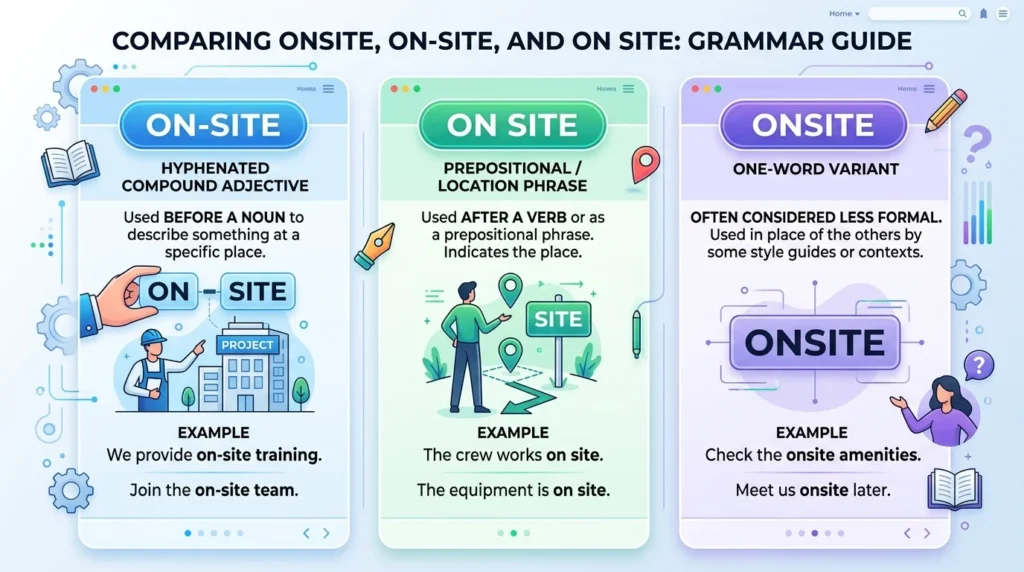
Onsite vs On Site vs On-Site
| Form | Typical function | Example | Meaning |
|---|---|---|---|
| onsite | Adjective or adverb | onsite training | At the relevant location |
| on-site | Hyphenated adjective/adverb | on-site training | At the relevant location |
| on site | Two-word location phrase | The technician is on site | At the location |
The most important distinction is between on site as a location phrase and onsite/on-site as a compound form.
However, the boundaries are not absolute. Modern usage increasingly permits onsite in positions where older style might have preferred on-site.
Is “Onsite” One Word?
Yes.
Onsite is written as one word:
onsite
It is not a misspelling of “on site.” It is an established English form.
For example:
The company offers onsite support.
We have an onsite cafeteria.
The position requires onsite work three days a week.
Cambridge specifically has an entry for onsite, identifying it as an adjective and adverb.
Is “On Site” Two Words?
Yes.
On site is written as two separate words when it functions as a phrase indicating location.
The engineer is on site.
The workers remained on site overnight.
The inspection was completed on site.
This form should not be automatically treated as incorrect simply because onsite also exists.
Is “On-Site” Correct?
Yes.
On-site is a standard hyphenated form.
For example:
The company offers on-site training.
We need an on-site technician.
The building has on-site security.
Dictionary sources recognize the hyphenated form, while other dictionaries also recognize the closed spelling onsite.
Therefore, saying that only one of onsite and on-site is grammatically correct would be misleading.
Also Read: OFN Meaning In Text – What It Really Means & How to Use It
Onsite or On-Site Before a Noun?
When the expression comes directly before a noun, both onsite and on-site can be used.
For example:
onsite training
on-site training
Both mean training provided at the relevant location.
The choice may depend on the dictionary, publication, company style guide, or editorial preference.
In modern business and technology writing, onsite is very common:
onsite support
onsite services
onsite employees
The hyphenated version remains perfectly established:
on-site support
on-site services
on-site employees
The key is to follow one consistent style within the same document.
When “On Site” Is Better
Use on site when the expression is functioning as a location phrase.
For example:
The technician is on site.
The technician arrived on site.
The workers stayed on site overnight.
The manager will be on site tomorrow.
In these sentences, “on site” does not directly modify a noun. It tells us where someone is or where something happens.
This is why the sentence:
The technician is on site.
is structurally different from:
We hired an onsite technician.
In the first sentence, the phrase identifies a location. In the second, “onsite” modifies the noun “technician.”
Correct Examples
Here are examples covering everyday, workplace, academic, professional, and online communication.
Everyday English
The doctor is on site today.
There is an onsite café for visitors.
Workplace
All employees must be on site by 9 a.m.
The company provides onsite training for new staff.
Business Email
Our technician will be on site tomorrow morning.
We can arrange onsite support if necessary.
Construction
The project manager remained on site throughout the inspection.
The contractor offers onsite consultations.
Technology
Our engineer is already on site.
We provide onsite IT support for business customers.
Education
Students can attend onsite classes twice a week.
The instructor will be on site during the practical examination.
Academic Writing
The researchers conducted the measurements on site.
The study included an on-site assessment of the equipment.
Job Descriptions
This is an onsite position.
Employees are expected to be on site five days a week.
Social Media
The team is finally on site and ready to start.
We have onsite activities for everyone attending the event.
Formal Notice
Visitors must remain on site until the evacuation procedure has been completed.
Incorrect vs. Correct
| ❌ Incorrect or less suitable | ✅ Better choice | Why |
|---|---|---|
| The technician is on-site now. | The technician is on site now. | When used simply as a location phrase, the open form is a clear traditional choice. |
| We offer on site support. | We offer onsite support. | Before a noun, use a compound form; the closed form is widely accepted. |
| We offer on site support. | We offer on-site support. | The hyphenated compound is also established. |
| The manager arrived onsite. | The manager arrived on site. | The open phrase clearly expresses where the manager arrived. |
| We hired an on site technician. | We hired an onsite technician. | The expression directly modifies “technician.” |
| We hired an on site technician. | We hired an on-site technician. | The hyphenated compound is another established choice. |
| Employees must work on-site every day. | Employees must work on site every day. | Here the phrase describes location rather than directly modifying a noun. |
| The company has on site parking. | The company has onsite parking. | “Onsite” directly modifies “parking.” |
| The company has on site parking. | The company has on-site parking. | The hyphenated compound is also correct. |
| The inspection was an onsite. | The inspection was on site. | “Onsite” cannot simply replace every occurrence of the phrase. The sentence needs a location expression. |
The important caveat is that some forms often labeled “incorrect” are actually accepted in modern English. For example, “The manager arrived onsite” is recognized in current usage because onsite can function adverbially. Cambridge explicitly lists an adverb use of onsite.
Also Read: WYW Meaning in Text Explained Simply: Usage & Real Examples
Why People Make This Mistake
Phonetic Similarity
Onsite, on-site, and on site are pronounced essentially the same way.
When people hear the expression rather than see it written, there is no sound that tells them whether they should use one word, two words, or a hyphen.
This makes the spelling difficult to determine from pronunciation alone.
Spelling Overlap
The three forms contain exactly the same basic words:
- on
- site
English has many expressions that have developed from separate words into compounds. As a result, writers may naturally wonder whether on site should remain open or become onsite.
Overgeneralization
A learner might memorize:
“Before a noun = onsite.”
Then they may apply the rule everywhere.
Another learner may memorize:
“Formal writing = on-site.”
Neither shortcut works perfectly for every sentence.
The actual grammatical function matters.
Autocomplete and Spellcheck
Digital writing tools can also contribute to the confusion.
A spellchecker may accept onsite, on-site, or both, depending on its dictionary and language settings.
That means spellcheck alone cannot always tell you which style best fits your sentence.
Translation Interference
Learners translating directly from another language may expect compound expressions to follow the spelling patterns of their first language.
English compound formation is not always predictable, so a word-by-word translation may not reveal whether an expression should be open, hyphenated, or closed.
Common Mistakes Checklist
1. Treating “onsite” as always wrong
Mistake: Assuming the word must always be written as “on-site.”
Why it happens: Some traditional grammar resources emphasize the hyphenated form.
How to avoid it: Recognize that onsite is an established dictionary form. Cambridge and American Heritage both recognize it.
2. Treating “on site” as always wrong
Mistake: Assuming “onsite” must replace the two-word form.
Why it happens: Modern business writing increasingly uses the closed form.
How to avoid it: Use on site when you are clearly expressing location.
3. Assuming “on-site” is outdated or incorrect
Mistake: Thinking the hyphenated form is no longer valid.
Why it happens: Many modern websites and businesses prefer the shorter closed form.
How to avoid it: Remember that on-site remains an established form.
4. Mixing styles randomly
Mistake:
onsite support
on-site training
onsite services
on-site employees
Why it can be a problem: Although the individual forms can be correct, unexplained switching can make edited content look inconsistent.
How to avoid it: Choose a preferred editorial style for compound modifiers and apply it consistently.
5. Following a single “before noun/after verb” rule
Mistake: Assuming grammar always changes automatically based on position.
Why it happens: This is an easy rule to memorize.
How to avoid it: Use the grammatical function as your main test, while remembering that onsite can also be used adverbially in modern English.
Also Read: BK Meaning in Text Explained – Full Definition, Uses, Examples & Slang Guide
Onsite in Real English
Onsite is natural and widely used in modern workplace, business, technology, employment, and service contexts. Phrases such as “onsite support,” “onsite training,” and “onsite position” are common. The word can also be used adverbially in modern usage, so sentences such as “The team is onsite” are possible. The closed form is therefore not merely a careless spelling of “on site.”
On Site in Real English
On site remains a clear and natural way to express physical location. It works especially well when the writer wants to say that someone or something is physically present at the relevant place: “The engineer is on site” or “The inspection took place on site.” It is also a useful choice when you want to avoid making a claim about which closed or hyphenated style a publication prefers.
On-Site in Real English
On-site is also established and natural, particularly as a compound modifier before a noun. You will encounter expressions such as “on-site inspection,” “on-site support,” and “on-site facilities.” It should not be treated as an error simply because many modern organizations prefer onsite. The difference between the two forms is often one of editorial style rather than meaning.
American vs. British English
There is not a simple US-versus-UK rule that makes one spelling universally correct in one country and another spelling universally correct in the other.
Current dictionary evidence shows that both onsite and on-site are used in English. Cambridge lists both forms, while its entries show usage in both UK and US contexts.
Therefore, avoid rules such as:
“Americans always use onsite.”
or:
“British English always uses on-site.”
Those statements are too broad.
For professional writing, the better approach is to follow the preferred dictionary or house style for your audience and remain consistent.
Formal vs. Informal Usage
All three forms can appear in professional English, so the distinction is not simply “formal versus informal.”
However, if you are writing for an organization with a specific style guide, follow that guide.
For especially formal or carefully edited writing, on-site may be preferred as a compound modifier by a particular publication, while onsite may be preferred by a modern business or technology organization.
For location phrases, on site is always a clear option:
The inspector is on site.
The goal is not to make every sentence sound formal. The goal is to use a form that fits the grammatical function and your chosen editorial style.
Onsite vs. On-Site vs. On Site: Comparison Table
| Feature | Onsite | On-site | On site |
|---|---|---|---|
| Number of words | One | Two elements joined by hyphen | Two |
| Common role | Adjective and adverb | Adjective and adverb | Location phrase |
| Meaning | At the relevant location | At the relevant location | At the relevant location |
| Before a noun | Common | Common | Less suitable as a compound modifier |
| Describing location | Possible in modern usage | Possible | Very common |
| Example | onsite support | on-site support | The worker is on site |
| Status | Established | Established | Established phrase |
| Style issue | May be preferred in modern business writing | Often preferred by some edited styles | Clear traditional location expression |
Real-Life Situations
Job Interview
“Is this an onsite position, or can employees work remotely?”
Here, onsite describes the position.
Workplace Conversation
“Is Sarah on site today?”
Here, on site tells us Sarah’s location.
Business Email
“Our technician will be on site tomorrow morning.”
The phrase tells the recipient where the technician will be.
Service Advertisement
“We provide onsite computer repair.”
Here, onsite describes the type of repair service.
Academic Research
“The researchers collected the samples on site.”
Here, on site describes where the collection occurred.
Construction Report
“An on-site inspection was completed before construction resumed.”
The hyphenated compound modifies “inspection.”
Company Policy
“Employees assigned to the project must remain on site during working hours.”
The phrase describes required physical location.
Job Listing
“This is an onsite role requiring regular attendance at our office.”
Here, onsite modifies “role.”
Onsite Work vs. On-Site Work
Both onsite work and on-site work can be found in professional English.
For example:
The position involves onsite work.
The position involves on-site work.
The meaning is essentially the same.
If your company or publication prefers the closed form, use onsite consistently. If it prefers the hyphenated form, use on-site consistently.
The important point is not to claim that one form is universally grammatical and the other universally ungrammatical.
Also Read: TFW Meaning in Text: What It Means & How to Use It
Onsite Job vs. On-Site Job
Both forms can be used:
This is an onsite job.
This is an on-site job.
They normally mean that the job requires the employee to work physically at the relevant workplace or location rather than entirely remotely.
In modern job listings, onsite is particularly common because it is compact and easy to scan.
However, on-site remains perfectly understandable and established.
Onsite Support vs. On-Site Support
Both are acceptable:
We provide onsite support.
We provide on-site support.
The choice is primarily stylistic when both are functioning as compound modifiers.
But compare them with:
Our technician is on site.
Here, on site is a location phrase.
This three-way comparison is one of the easiest ways to understand the issue:
onsite support
on-site support
The technician is on site.
Onsite Training vs. On-Site Training
Both forms are used:
The company offers onsite training.
The company offers on-site training.
Both mean training that takes place at the relevant physical location.
If the content is being published under a house style, use the organization’s preferred form.
If no style guide exists, either established form can be used, provided the document is consistent.
Is “The Team Is Onsite” Correct?
Yes, “The team is onsite” is possible in modern English.
It is important not to repeat the oversimplified claim that onsite can only appear before a noun. Cambridge explicitly lists onsite as an adverb as well as an adjective.
For example:
The team is onsite.
This means the team is physically present at the relevant location.
You can also write:
The team is on site.
Both forms can communicate the same basic idea.
If you want the clearest traditional two-word location phrase, on site is an excellent choice.
Is “The Team Is On-Site” Correct?
Yes.
The team is on-site.
This form is also used to describe physical presence at a location.
Dictionary.com, for example, lists on-site as both an adjective and an adverb and also recognizes on site as an alternative.
Therefore, the question is not simply “Which one is grammatically correct?” The more useful question is:
Which form fits the sentence and the style you are following?
The Easiest Way to Remember
Use this three-part memory trick:
- On site = think location
- Onsite = think modern compound
- On-site = think hyphenated compound
Examples:
The engineer is on site.
We offer onsite repairs.
We offer on-site repairs.
If you remember only one thing, remember this:
“On site” clearly expresses where something is; “onsite” and “on-site” commonly describe something connected with that location.
Practice Quiz
Choose onsite, on-site, or on site.
- The technician is ___ now.
- We offer ___ technical support.
- The company provides ___ training.
- The workers remained ___ overnight.
- This is an ___ position.
- We scheduled an ___ inspection.
- The manager will be ___ tomorrow.
- The hotel offers ___ parking.
- The researchers collected the samples ___.
- We need an ___ technician for the project.
Answers
- on site — It describes the technician’s location.
- onsite / on-site — Both work as compound modifiers of “support.”
- onsite / on-site — Both are established forms before “training.”
- on site — It describes where the workers remained.
- onsite / on-site — Both can modify “position.”
- onsite / on-site — Both can modify “inspection.”
- on site — It clearly expresses location.
- onsite / on-site — Both can modify “parking.”
- on site — It describes where the samples were collected.
- onsite / on-site — Both can modify “technician.”
Quick Summary
Onsite, on-site, and on site are all established forms, but they are not identical in grammatical structure. On site is a two-word phrase commonly used to express location, as in “The technician is on site.” Onsite is a modern closed form used as an adjective and, in current usage, an adverb. On-site is the established hyphenated form, especially common as a compound modifier before a noun. Before a noun, you can often choose between onsite and on-site according to your preferred style. When simply expressing location, on site is a clear choice. The safest approach is to consider the sentence’s grammatical function and follow one consistent editorial style.
Frequently Asked Questions
Is “onsite” one word?
Yes. Onsite is an established one-word form. Modern dictionaries recognize it as an adjective and adverb.
Is “on site” grammatically correct?
Yes. On site is a standard two-word phrase meaning at the relevant location.
Is “on-site” grammatically correct?
Yes. On-site is an established hyphenated form used in English, especially as a compound modifier.
Which is correct: onsite or on site?
Both can be correct. On site is commonly used as a location phrase, while onsite is commonly used as a compound form. Modern usage also allows onsite in some adverbial positions.
Which is correct: onsite or on-site?
Both are established forms. The choice often depends on editorial style and the grammatical position of the expression.
Should I write “onsite support” or “on-site support”?
Both are acceptable. Onsite support is a common modern spelling, while on-site support is the established hyphenated form.
Should I write “the technician is onsite” or “the technician is on site”?
Both occur in modern English. The technician is on site is the clear traditional location phrase, while onsite is also recognized as an adverb in current dictionary usage.
Is “onsite” more professional than “on site”?
Not necessarily. Professionalism depends more on correctness, consistency, clarity, and the style expected by your audience than on choosing one spelling universally.
Is “on-site” more formal than “onsite”?
It can be preferred by some formal or traditionally edited styles, but it is not accurate to say that onsite is inherently unprofessional. Both forms are established.
Is onsite the opposite of remote?
Often, yes. In workplace language, an onsite position generally means a position requiring physical attendance at a designated workplace, while a remote position is performed away from that workplace. Exact workplace policies can vary.
Can “onsite” be used after a verb?
Yes. Modern dictionaries recognize onsite as an adverb as well as an adjective. For example: “The team is onsite.”
How do I choose between onsite, on-site, and on site?
First ask what the expression is doing in the sentence. If it clearly expresses location, on site is a straightforward choice. If it modifies a noun, onsite or on-site can work. Then follow your publication or organization’s preferred style consistently.