
Ever read the word ovulating in a message, health article, social-media post, or conversation and wondered exactly what it means? The word sounds medical, but the basic idea is actually simple.
Ovulating means releasing an egg from an ovary. It is a normal part of the menstrual cycle and is closely connected with fertility and the possibility of pregnancy. In everyday conversation, however, people may also use the word jokingly or casually, which can make its meaning less obvious.
This guide explains the ovulating meaning in simple English, shows what happens during ovulation, explains the difference between ovulating and being fertile, and explores what the word can mean when it appears in a text from a girl or guy.
Meaning & Definition
The simplest ovulating definition is: currently releasing an egg from an ovary as part of the menstrual cycle.
“Ovulating” is the present-participle form of the verb ovulate. Cambridge defines ovulate as producing an egg from which a baby could potentially develop. In medical language, ovulation refers to the release of an egg from an ovary.
For example, when someone says, “I am ovulating,” they usually mean that their body is at or around the stage of the menstrual cycle when an ovary releases an egg. The word itself does not automatically mean pregnancy, sex, or a particular emotion. Its basic meaning is biological.
Background
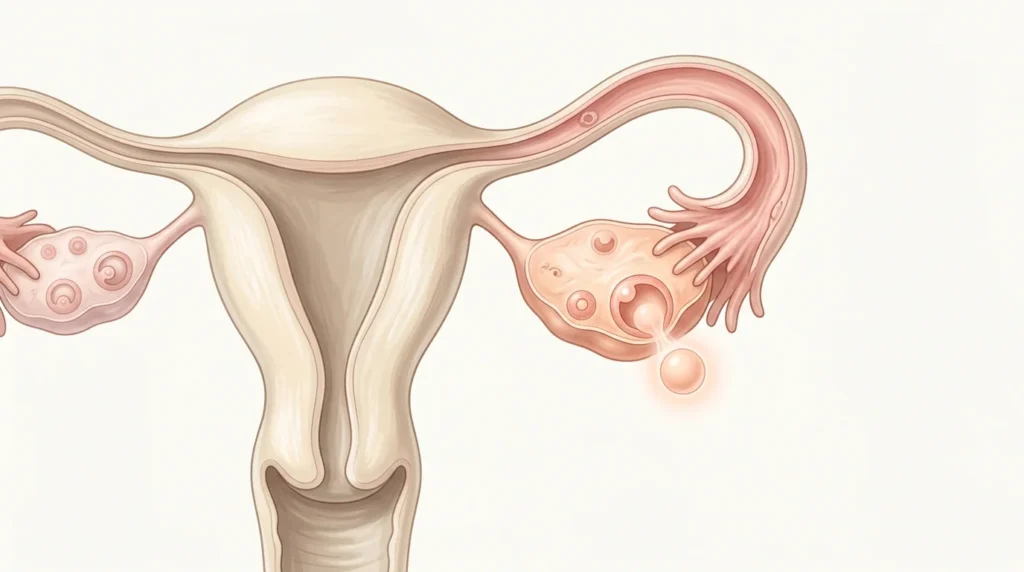
Ovulation is one part of the menstrual cycle. During the cycle, hormones help an egg-containing follicle develop inside an ovary. Around ovulation, hormonal changes lead to the release of an egg. The egg then enters the fallopian tube, where it can potentially meet sperm.
The timing is not identical for everyone. Although people often hear that ovulation happens on day 14, a better general rule is that it often occurs about 14 days before the next menstrual period. Cycle length can vary, so someone with a shorter or longer cycle may ovulate on a different day.
Usage in Different Contexts
The word ovulating can appear in several different contexts.
In a medical or fertility context, it normally has its literal biological meaning: an ovary is releasing an egg or the person is in the ovulatory stage of the cycle. In a conversation about pregnancy, the word may be used to discuss the best time for conception.
Online, people sometimes use the word humorously. Someone might say they are “ovulating” when they are joking about being extremely attracted to someone, excited about something, or making a fertility-related joke. That informal usage is different from the actual biological definition.
What Does Ovulating Mean in Simple Terms?
In simple terms, ovulating means your ovary is releasing an egg.
The released egg can travel into a fallopian tube and may be fertilized by sperm. Because sperm can survive for several days in the reproductive tract and the egg remains viable for roughly a day after release, the days surrounding ovulation are important for pregnancy.
So, if you need a one-line explanation, you can think of it this way: ovulating = releasing an egg as part of the menstrual cycle.
What Happens When You Are Ovulating?
During ovulation, hormonal changes lead to the release of an egg from an ovary. The egg is then picked up by the fallopian tube. If sperm is present at the right time, fertilization may occur. If fertilization does not occur, the egg eventually breaks down and the menstrual cycle continues.
Some people notice physical changes around this time, while others notice very little. Possible signs include thinner, clearer and more slippery cervical mucus, a small rise in basal body temperature after ovulation, and sometimes mild one-sided pelvic discomfort. Not everyone experiences these signs.
Also Read: Kissed Horizontally Meaning: Full Explanation & Context 2026
Is Ovulating the Same as Being Fertile?
Not exactly. Ovulation is the event in which an egg is released. Fertility refers more broadly to the period when pregnancy is most likely to happen.
The fertile window includes several days around ovulation because sperm can survive inside the reproductive tract for multiple days, while the released egg is available for a much shorter time. ACOG describes the fertile window as the days leading up to and around ovulation, and notes that pregnancy can occur from sex several days before ovulation through shortly after it.
This distinction is important when someone searches is ovulating the same as fertile. Ovulation is one specific biological event; the fertile window is the broader period in which conception is more likely.
What Are the Signs of Ovulation?
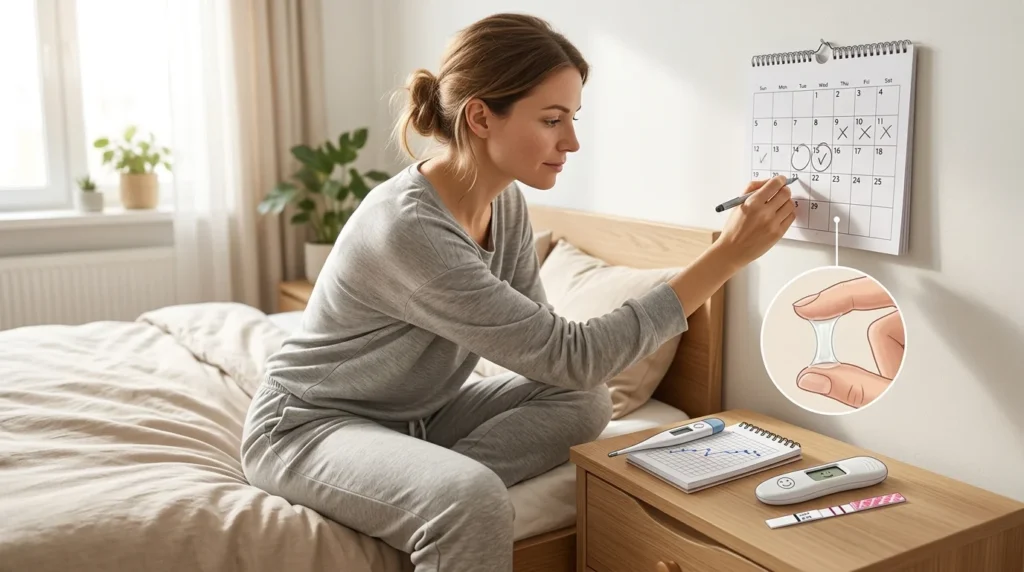
There is no single symptom that proves ovulation is happening. One of the more noticeable changes can be cervical mucus becoming clearer, wetter, more slippery, and stretchy, sometimes compared with raw egg white. This happens because hormone changes alter cervical fluid around the fertile period.
Another tracking method is basal body temperature. After ovulation, resting temperature usually rises slightly and remains higher for the remainder of the cycle. Some people also experience mild pelvic pain or cramping, although symptoms vary considerably from one person to another.
How Do You Know When You Are Ovulating?
People can look at several clues rather than depending on one sign. Tracking cervical mucus can help identify the days when fertility is increasing. Tracking basal body temperature can help confirm that ovulation likely occurred because the temperature typically rises afterward.
Ovulation predictor kits are another option. These tests detect luteinizing hormone, or LH, in urine. A positive result generally indicates that ovulation is approaching, although the exact timing can vary. ACOG notes that a positive urine LH test suggests ovulation may occur within roughly the next 24 to 48 hours.
What Is an LH Surge?
An LH surge is a rapid rise in luteinizing hormone that helps trigger ovulation.
As the ovarian follicle develops, hormonal activity changes. The increase in LH is an important signal that the follicle is preparing to release the egg. ReproductiveFacts explains that ovulation is triggered about 36 to 40 hours after the blood LH rise begins, while home urine tests are used to detect this hormone increase before ovulation.
This is why an ovulation test is best understood as a prediction tool, not an absolute guarantee that an egg has already been released.
What Does Ovulating Mean for Pregnancy?
Ovulation matters because pregnancy generally requires an egg and sperm to meet.
The egg can survive for about 12 to 24 hours after release, while sperm may survive in the reproductive tract for several days. Because of this overlap, pregnancy can occur from sex before ovulation as well as around the day of ovulation.
That is why someone who is trying to get pregnant may pay attention to ovulation signs and fertile-window timing. At the same time, someone trying to avoid pregnancy should not assume that a calendar estimate alone can reliably identify completely safe days. ACOG notes that fertility-awareness methods have higher pregnancy rates with typical use than with perfect use.
How Long Does Ovulation Last?
People often ask how long ovulation lasts, but the answer depends on whether they mean the egg-release event or the fertile period.
The egg itself is usually capable of being fertilized for approximately 12 to 24 hours after release. The broader fertile window is longer because sperm may remain viable for several days. ACOG describes the fertile window as a six-day interval ending on the day of ovulation, while other clinical resources include the day after ovulation when explaining practical fertility timing.
So it is more accurate to think of ovulation as a short biological event surrounded by a longer period of increased fertility.
What Does Ovulating Mean After Your Period?
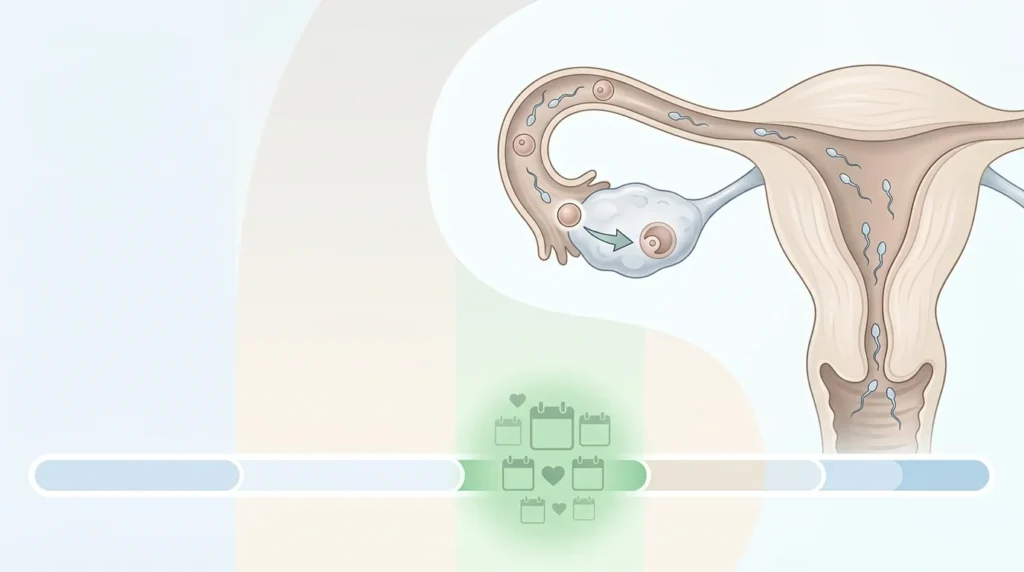
Ovulation does not happen immediately after every period. Its timing depends on the length and pattern of the menstrual cycle.
For many people, ovulation occurs around the middle of the cycle, but the exact day can shift. ACOG notes that in an average 28-day cycle, ovulation occurs about 14 days before the next period. Therefore, someone with a different cycle length may ovulate on a different calendar day.
This is why simply counting a fixed number of days after menstruation may not accurately predict ovulation for everyone, particularly when cycles are irregular.
Can You Ovulate Without Symptoms?
Yes. Some people experience noticeable changes around ovulation, but others do not recognize any clear signs.
Cervical mucus changes, temperature changes and mild pelvic pain can provide useful clues, but they are not guaranteed to happen or be easy to interpret. This means someone may be ovulating even if they do not feel different. Clinical testing can provide additional information when more certainty is needed.
This is one reason fertility tracking can take time to learn. A pattern across multiple cycles is generally more useful than relying on one symptom on one day.
Can You Get Pregnant While Ovulating?
Yes. Ovulation is one of the most fertile times of the menstrual cycle.
Pregnancy can happen when sperm is present around the time an egg is released. The highest chances occur when live sperm are present in the reproductive tract when ovulation takes place.
However, saying that someone is ovulating does not mean pregnancy will definitely occur. Many biological and timing factors influence conception, and having sex during the fertile window increases opportunity but does not guarantee pregnancy.
What Happens After Ovulation?
After the egg is released, the body enters the phase of the menstrual cycle often called the luteal phase. Hormonal changes, including increased progesterone, help prepare and maintain the uterine lining in case pregnancy occurs.
If the egg is not fertilized, the pregnancy does not develop and hormone levels eventually fall. The uterine lining is then shed during menstruation. ACOG explains that progesterone is produced by the ovaries and helps prepare the uterine lining for pregnancy.
What Does Ovulating Mean in a Text?
When you see ovulating in a text message, the meaning depends on the surrounding conversation.
Sometimes the sender simply means the literal biological process. For example, someone discussing cycle tracking might say, “I think I am ovulating this week.” In this setting, there is no hidden slang meaning; they are talking about their menstrual cycle or fertility.
In another conversation, however, the word may be used as a joke or exaggeration. People online sometimes use reproductive terms figuratively to express excitement or attraction. The surrounding words, tone, relationship and context matter more than the word by itself.
What Does Ovulating Mean From a Girl?
If a girl says I am ovulating, the safest interpretation is usually the literal one: she is saying that she believes she is currently ovulating or approaching ovulation.
It does not automatically mean that she wants sex, wants a relationship, is attracted to someone, or is asking another person to take a particular action. People may bring up ovulation because they are tracking their cycle, discussing pregnancy, talking about symptoms, or simply making a joke.
Context changes the meaning. If the message appears in a conversation about fertility, periods or pregnancy, it is probably literal. If it appears alongside jokes about attraction, the sender may be using the word informally.
What Does Ovulating Mean From a Guy?
A guy using the word ovulating is generally not using it in the literal personal biological sense.
Men can discuss ovulation accurately when talking about another person’s menstrual cycle, fertility, pregnancy, or reproductive health. But on the internet, a man may also use “I am ovulating” as a humorous or exaggerated expression of excitement or attraction. Informal slang sources document this kind of figurative usage.
The important point is that this slang interpretation is not the standard dictionary definition. When interpreting a message, look at the full conversation rather than assuming that every use of the word has the same meaning.
Is There a Slang Meaning of Ovulating?
There can be an informal or humorous meaning.
On social media and in casual conversation, people sometimes use ovulating as an exaggerated joke about attraction, excitement, desire, or emotional intensity. Some slang resources explicitly record “ovulating” as a humorous expression rather than a biological statement.
Still, this is context-dependent. It is better to describe it as informal or joking usage, not as the primary definition of the word. In medical writing, reproductive-health discussions and dictionaries, ovulating refers to the biological process of releasing an egg.
Ovulating vs Ovulation
The words are closely related but serve different grammatical roles.
Ovulation is a noun. It names the biological process or event. For example: “Ovulation can occur about 14 days before the next period.”
Ovulating is a verb form or participle. It describes the person who is going through that process. For example: “She is ovulating.”
The difference is similar to other word pairs such as “menstruation” and “menstruating.” One names the process, while the other describes the action or state.
Ovulating vs Fertile Window
These terms should not be treated as exact synonyms.
Ovulating refers to the release of an egg. The fertile window refers to the broader group of days during which intercourse can result in pregnancy because sperm can live for several days and the egg remains available for a shorter period. ACOG describes the fertile window as the six-day period ending on the day of ovulation.
Understanding this distinction helps avoid a common mistake: assuming that only the exact day of egg release matters. In reality, the days leading up to ovulation can also be important for conception.
Does Ovulating Always Happen on Day 14?
No.
Day 14 is often used as a simple example for a 28-day cycle, but it is not a universal rule. Medical organizations generally explain ovulation in relation to the next period rather than saying that everyone ovulates on the same calendar day.
Someone with a shorter or longer cycle may ovulate earlier or later. Stress, health changes, hormonal conditions and natural cycle variation can also affect timing. Therefore, a calendar estimate should be treated as an estimate rather than proof.
What If You Are Not Ovulating?
Not ovulating is called anovulation. It can happen for different reasons, and persistent problems with ovulation may affect fertility.
For example, PCOS can interfere with regular ovulation and menstrual cycles. ACOG identifies ovulation problems as a common cause of female infertility, while MedlinePlus notes that PCOS can result in irregular or absent periods and problems with normal egg release.
Irregular or absent periods do not automatically prove that someone is not ovulating, but major changes in a menstrual pattern are worth discussing with a healthcare professional, especially when pregnancy is desired.
How Is Ovulation Tested?
There are several ways to monitor or evaluate ovulation.
An ovulation predictor kit checks urine for an LH rise and can help predict when ovulation is approaching. Basal body temperature tracking can help show that ovulation likely happened because temperature usually rises afterward. Cervical mucus observation provides another fertility clue.
In clinical settings, healthcare professionals may also use blood hormone testing or ultrasound. ReproductiveFacts notes that progesterone testing after the expected ovulation period can help confirm that ovulation occurred, while ultrasound can monitor follicle development.
Can You Ovulate Without Getting Pregnant?
Absolutely.
Ovulation means an egg was released; it does not mean fertilization occurred. Pregnancy requires sperm to fertilize the egg and additional biological steps for implantation and continued development.
A person may ovulate normally for many cycles without becoming pregnant. Age, sperm factors, timing, reproductive anatomy and many other factors can affect conception. ACOG identifies ovulation as only one part of the fertility picture.
So ovulating does not equal being pregnant, and it does not guarantee that pregnancy will happen.
When Should You Talk to a Doctor?
Occasional changes in cycle timing can happen, but significant or persistent changes deserve medical attention.
Consider speaking with a healthcare professional if periods become very irregular or stop, if bleeding becomes unusually heavy, if severe pelvic pain occurs, or if there are ongoing concerns about ovulation or fertility. NHS guidance advises medical evaluation for severe or recurring abdominal pain, while ACOG notes that highly irregular periods can be a reason to seek evaluation rather than relying only on home ovulation prediction.
For people trying to conceive, ACOG recommends infertility evaluation after 12 months of regular unprotected intercourse, or after 6 months for women older than 35, with earlier discussion appropriate in some circumstances.
Why Understanding the Word Matters
Knowing the ovulating meaning is useful because the term sits at the intersection of language and health.
Someone might encounter it while reading a fertility article, looking at a period-tracking app, discussing pregnancy, or receiving a casual text. Understanding the literal meaning prevents confusion, while recognizing the informal use helps explain why the same word may appear differently online.
For clear explanations of other words, definitions, and everyday terms, Meaning Nova can also be useful. If you want to understand any meaning, definition, or explanation, you can explore Meaning Nova for clear and simple explanations.
Frequently Asked Questions
What does ovulating mean?
Ovulating means that an ovary is releasing an egg as part of the menstrual cycle. The egg then enters a fallopian tube and may be fertilized if sperm is present.
What does ovulating mean in simple terms?
In simple words, ovulating means releasing an egg from an ovary. It is a normal part of the reproductive cycle.
What does ovulating mean in a text?
In a normal conversation, it usually means the person is talking about the biological process of egg release. In casual online conversations, it may sometimes be used jokingly to express attraction or excitement.
What does ovulating mean from a girl?
Usually, it means she believes she is currently ovulating or approaching ovulation. It does not automatically communicate sexual interest or any particular intention.
What does ovulating mean from a guy?
A guy may use the word while discussing fertility or someone else’s menstrual cycle, but “I am ovulating” can also be used jokingly online as an exaggerated expression of excitement or attraction.
Is ovulating the same as being fertile?
No. Ovulation is the release of an egg, while the fertile window is the broader period in which pregnancy is more likely because sperm can survive for several days.
How do you know when you are ovulating?
Possible clues include clear, slippery cervical mucus, changes in basal body temperature, and sometimes mild pelvic discomfort. Ovulation predictor kits detect the LH rise that typically comes before ovulation.
How long does ovulation last?
The egg is usually capable of fertilization for about 12 to 24 hours after it is released. The fertile window lasts longer because sperm can survive for several days.
Can you get pregnant while ovulating?
Yes. Ovulation is one of the times when pregnancy is most likely, especially when sperm are already present in the reproductive tract.
Can you ovulate without symptoms?
Yes. Some people notice clear physical signs, while others experience little or no noticeable change. Tracking methods or medical testing may provide more information when needed.
Does ovulating mean you are pregnant?
No. Ovulation means an egg has been released. Pregnancy requires fertilization and subsequent biological processes, so ovulation alone does not indicate pregnancy.
Does ovulation always happen on day 14?
No. Day 14 is a common example for a 28-day cycle, but ovulation usually occurs about 14 days before the next period and can happen on different days for people with different cycle lengths.
What is an LH surge?
An LH surge is a rise in luteinizing hormone that helps trigger ovulation. Urine ovulation tests are commonly used to detect this rise and predict when ovulation is approaching.
What does clear stretchy discharge mean?
Clear, slippery, stretchy cervical mucus can be a sign that the body is approaching ovulation and that fertility is increasing. However, cervical mucus by itself does not prove that an egg has already been released.
Can you be fertile before ovulating?
Yes. The days before ovulation can be fertile because sperm can survive for several days. This is why intercourse before egg release can still result in pregnancy.
What happens after ovulation?
After ovulation, progesterone typically increases and the body enters the post-ovulation phase of the cycle. If pregnancy does not occur, hormone levels eventually fall and menstruation begins.